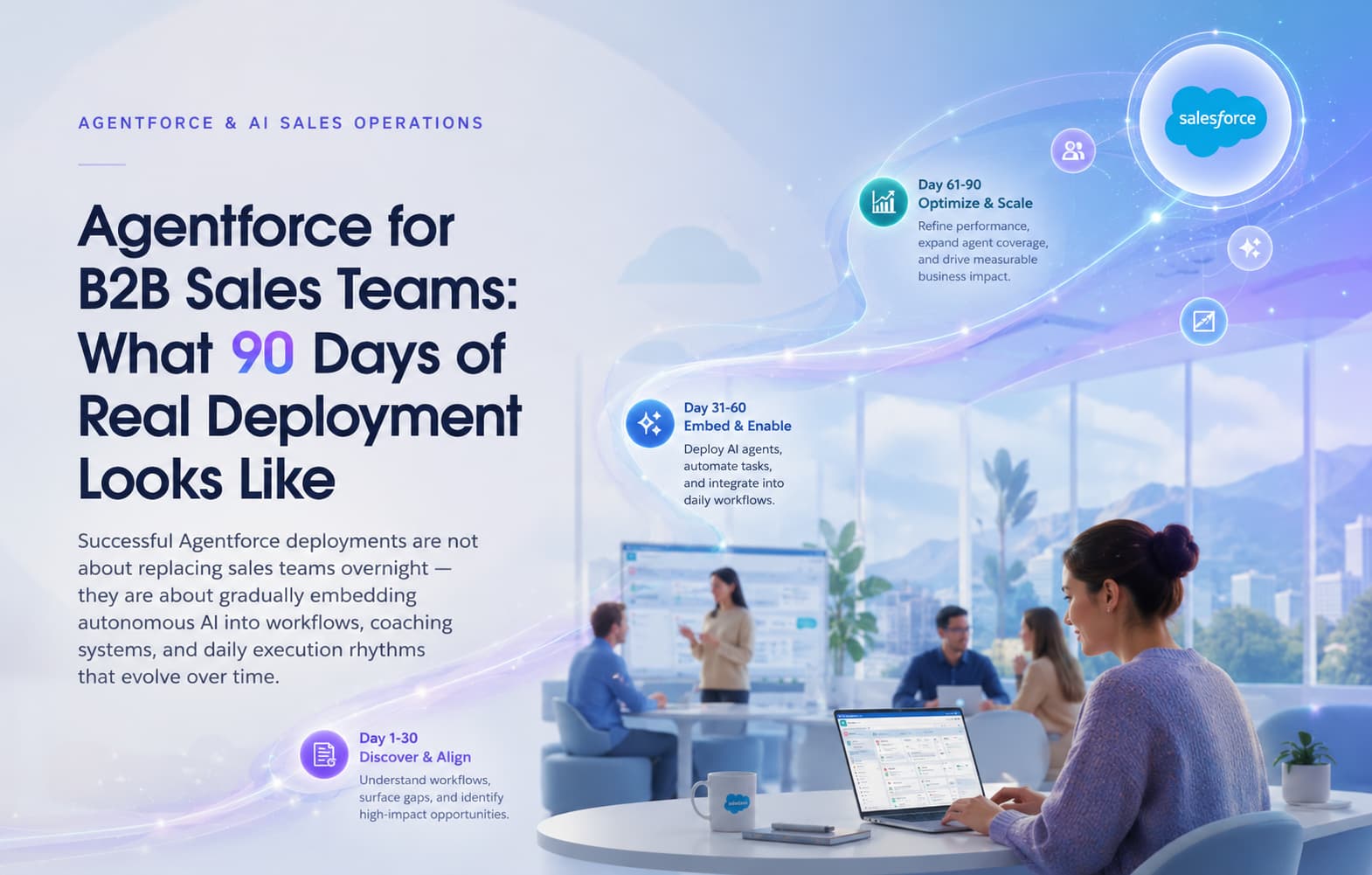
Agentforce for B2B Sales Teams: What 90 Days of Real Deployment Looks Like

Table of content
Every Salesforce partner is publishing content about Agentforce. Most of it reads the same way: autonomous AI agents, transformative productivity gains, the future of selling. And essentially none of it tells you what actually happens when a real B2B SaaS sales team deploys Agentforce and attempts to use it in production.
We deployed Agentforce for a 120-person B2B SaaS company in Q3 2025 — a VP Sales-led organization running inbound and outbound pipelines across North America and the UK. What follows is a week-by-week account of the first 90 days: what the team expected, what we configured, what broke, and what the data showed at the end.
If you are a VP Sales or Head of RevOps evaluating Agentforce, this is the content your Salesforce partner's marketing team will not publish — because the real story is more useful than the hype, and more complicated than a feature overview.
Why Most Agentforce Deployments Fail Before They Start
Agentforce is not a feature you switch on. It is a capability layer that runs on the quality of data, the accuracy of configuration, and the consistency of processes already inside your Salesforce org.
An Agentforce lead qualification agent does not qualify leads autonomously from day one. It qualifies leads based on the ICP scoring model you define, against the data fields you have populated, following the business logic you configure, connected to the channels you have enabled. Change any one of those inputs and the agent's output changes accordingly.
If your lead records are missing company size, industry, or inbound source data — Agentforce does not compensate for that. It processes what exists. If your opportunity stages are seller-defined rather than buyer-defined, and your close date history reflects optimism rather than buyer-side signals — Agentforce's next-best-action recommendations reflect those inaccuracies.
The organizations that deploy Agentforce successfully spend six to eight weeks on data foundation and configuration readiness before the agent goes live. The organizations that deploy without that preparation spend the weeks after go-live explaining to leadership why the AI is making confident recommendations that are commercially wrong.
Weeks 1–3: Readiness Assessment and Data Foundation
The first three weeks of the engagement were not about Agentforce at all. They were about fixing the conditions Agentforce needed to operate.
Our pre-deployment audit surfaced three blocking issues:
Missing ICP fields on 62% of lead records
The Agentforce lead qualification logic was configured to use company size and industry as primary scoring signals. Both fields were missing on the majority of inbound lead records. Without them, the scoring model would default to generic behavioral patterns — functionally indistinguishable from no scoring at all.
Resolution: lead enrichment was configured through Data Cloud against a third-party enrichment provider. Enrichment ran automatically on new inbound submissions and backfilled against existing leads. Field completion on the two critical fields reached 89% within 12 days.
Seller-defined opportunity stages
Stage definitions mapped to what the rep had done — 'sent proposal,' 'had demo' — rather than what the buyer had committed to. Einstein's historical win-rate model was trained on these definitions, producing probability scores that overstated deal progress. Agentforce's next-best-action recommendations were anchored to those inflated signals.
Resolution: opportunity stages were redesigned around buyer-gate criteria over a two-week period. Historical stage data was preserved. The new definitions were rolled out with a 30-minute team session explaining the logic.
Einstein Activity Capture not configured
Email engagement data was not being captured systematically. Einstein Activity Capture had not been enabled. Agentforce's engagement scoring — a core signal in lead prioritization — was operating on approximately 28% of actual email activity, based on what reps had manually logged.
Resolution: Einstein Activity Capture was enabled and configured for the full sales team against the company's Google Workspace environment. Calendar sync was included. Configuration took four hours. Data completeness moved to 81% within the first 30 days.
None of this was visible to the sales team during weeks one through three. From their perspective, nothing had changed. From Agentforce's perspective, the environment had moved from unworkable to functional.
Weeks 4–6: Agent Configuration and Controlled Launch
Agentforce deployment for this sales team covered two use cases: autonomous lead qualification for inbound pipeline, and next-best-action recommendations for open opportunities in stages two through four.
Lead qualification was scoped to inbound web-to-lead submissions only — not to existing pipeline. This scoping decision was deliberate. Agentforce needed a clean, high-volume, consistent input to generate reliable early results. Web-to-lead submissions, enriched through Data Cloud in real time, provided that.
The qualification logic followed the company's ICP: B2B SaaS companies between 50 and 500 employees, inbound channel indicating product-level intent, industry matching three core verticals. Leads meeting all three criteria were scored high, auto-assigned to an AE with an SLA notification, and tagged with an 'Agentforce Qualified' record type that triggered a differentiated outreach sequence.
Leads below threshold were routed to a Marketing Cloud Account Engagement nurture sequence — automatically, without rep involvement, and with no notification creating noise in the sales team's queue.
Week four through six ran as a controlled launch with five AEs. By the end of week six, the controlled group had processed 140 inbound leads. Manual review of a 30-lead sample by a senior AE confirmed 87% accuracy in ICP identification — 26 of 30 leads scored high were assessed as genuinely high-fit on manual review.
Weeks 7–10: Full Team Rollout and the Friction Points
Full rollout to 18 AEs happened at the start of week seven. This is where the real-world friction that no Agentforce marketing material covers began to appear.
Friction Point 1: Reps bypassing the routing
Five of 18 AEs were selecting leads directly from the inbound queue rather than working their Agentforce-assigned pipeline. The queue remained accessible. The agent's routing was being ignored in favor of each rep's own lead-selection instincts.
Resolution: direct queue access was restricted for the sales team. Agentforce-qualified leads moved to a dedicated assigned-lead view with ownership enforced by the system. Routing compliance reached 100% within seven days of the change.
Friction Point 2: Next-best-action recommendations being dismissed
The next-best-action panel inside Salesforce was being closed by reps as a reflex — the same behavioral response most users apply to notification windows. Recommendations that required urgent attention were going unseen.
Resolution: a daily digest email was configured — surfacing each rep's top three next-best actions, delivered at 8:00 AM before the team started their day. Email open rates for the digest reached 78% by week nine. Actions taken on recommended opportunities increased from 23% to 61% over the same period.
Friction Point 3: Existing customer domain mismatch
An agent logic error was identified on day three of full rollout: inbound leads from email domains belonging to existing customers were being scored as new high-priority opportunities. The agent had no logic to cross-reference lead email domains against existing Account records.
A senior AE flagged the error. The fix — adding an Account domain lookup to the qualification logic — was deployed within 24 hours.
The 90-Day Commercial Results
At the close of the 90-day deployment, we measured against the five metrics the VP Sales had defined at the start of the engagement:
- Inbound lead response time: reduced from an average of 4.2 hours to 22 minutes. Agentforce's routing eliminated the manual queue-monitoring step that was adding hours to every inbound lead response.
- Lead-to-meeting conversion rate: increased from 14% to 21% for Agentforce-qualified leads against the trailing 90-day baseline. ICP accuracy improvement drove this — reps were investing time in better-fit conversations.
- Rep time on lead qualification: reduced by approximately 3.5 hours per rep per week. Across 18 reps, that is 63 hours per week recovered for pipeline progression and customer-facing activity.
- Forecast accuracy: pipeline weighted value at quarter start tracked within 12% of actual close, compared to a 31% variance in the prior quarter. The combination of stage redesign and Einstein's improved training data drove this.
- Agentforce-qualified lead close rate: 18% over the 90-day window — 28% higher than the 14% baseline close rate for all inbound leads in the prior period.
None of these results required new headcount. They required a correctly configured Salesforce environment — built on clean data, buyer-aligned stages, and automated activity capture — with an Agentforce deployment scoped to one use case, one ICP, and a defined measurement framework.
Three Things We Would Do Differently
With the benefit of 90 days of live data, three changes we would make to the deployment sequence:
- Start rep adoption design in parallel with technical deployment, not after. The friction points in weeks seven through ten — bypass behavior, dismissed recommendations — were foreseeable from the first week of rollout planning. The behavioral governance solutions should have been designed before go-live, not discovered post-launch.
- Scope one use case for the first 90 days, not two. Running lead qualification and next-best action simultaneously created diagnostic complexity. When a rep rejected a recommendation, we could not immediately determine whether the issue was agent logic, data quality, or behavioral resistance. Starting with lead qualification alone — then adding next-best action in month four — would have produced cleaner learning and faster iteration.
- Build the measurement dashboard before go-live, not after. We defined success metrics in week one but did not build the Salesforce reports to track them until week five. The first four weeks of live data were measured against manually pulled figures. The measurement framework should be a go-live prerequisite, not a post-launch task.
Working With Makedian
Makedian's Agentforce implementation practice works exclusively with B2B SaaS companies running Salesforce Sales Cloud. We scope Agentforce deployments around one use case, one ICP definition, and a defined commercial measurement framework — not feature lists or platform demos.
If you want to understand what Agentforce would look like for your specific sales team before committing to an implementation, our Salesforce RevOps Diagnostic covers Agentforce readiness as one of its six diagnostic areas — alongside pipeline health, activity capture, and data quality.
Book your RevOps Diagnostic at makedian.com/revops-audit — and we will tell you within 45 minutes whether your Salesforce is ready for Agentforce, or whether foundational work needs to happen first.
.webp)














Agentforce for Financial Services: AI-Driven Banking & Insurance Solutions









.webp)








n8n Workflow Automation: From Lead Capture to CRM in Minutes, Not Hours


%20(1).webp)