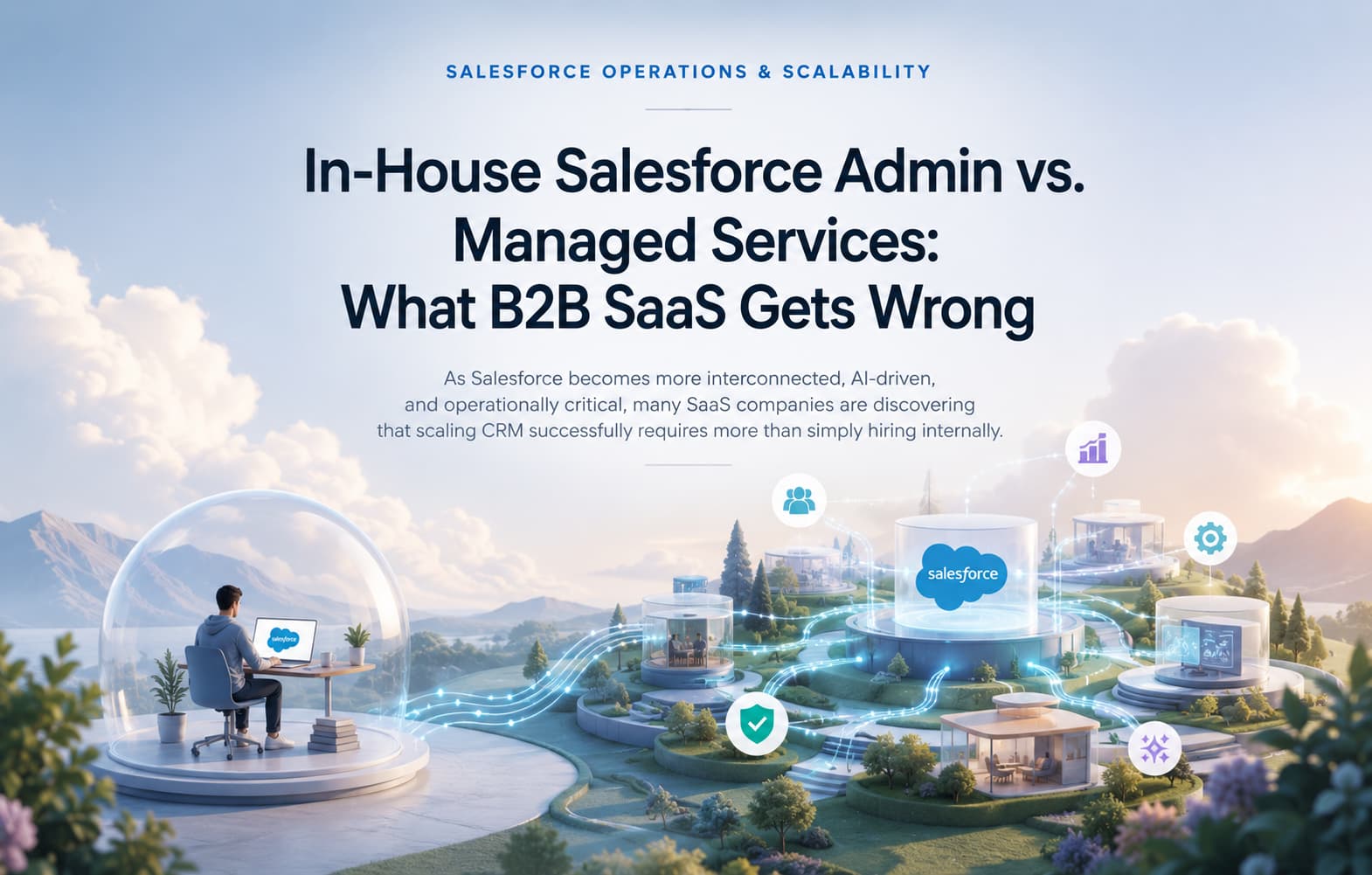
In-House Salesforce Admin vs. Managed Services: What B2B SaaS Gets Wrong

Table of content
The decision most B2B SaaS VP Sales and RevOps leaders get wrong is not which Salesforce features to activate next. It is whether to hire a Salesforce Admin or engage a managed services partner.
Get this wrong in one direction and you pay a full-time salary for a skill set your business needs part-time. Get it wrong in the other direction and you deploy a generalist contractor who burns most of their hours on user requests with no strategic context.
This article explains how to make the right call for a B2B SaaS company between 50 and 300 employees — the stage where the consequences of getting this decision wrong are most commercially significant.
Why the Instinct to Hire Usually Fails at This Stage
The instinct to hire a full-time Salesforce Admin is understandable. You want someone on Slack. Someone who attends standups. Someone accountable by name. It feels like a clean solution to a complex problem.
The reality at a 50–200 person B2B SaaS company is almost always this: the role is 60% reactive — user requests, report changes, permission sets, list uploads, field additions — and 40% strategic — process design, automation architecture, data governance, Einstein configuration.
Most Salesforce Admins you can hire at this stage are strong at one or the other. Rarely both.
When you hire someone reactive, your strategic Salesforce roadmap stalls. Configuration decisions get made without architectural context. Technical debt accumulates silently. By the time leadership identifies the problem, there are 18 months of decisions to unpick.
When you hire someone strategic, they are bored within six months. The day-to-day reactive volume is not what they accepted the offer for. Attrition in this profile is high — and every time an Admin leaves, institutional knowledge leaves with them.
What a Managed Services Model Actually Provides
A well-structured Salesforce managed services engagement provides access to a team, not a single person. In practice, for a 50–200 person B2B SaaS company, that means:
- A Salesforce Architect who sets strategic direction, governs configuration decisions, and prevents technical debt accumulation — available for two to four hours per week of focused input.
- A Senior Admin who handles complex automation, Flow design, process implementation, and release management.
- A Support Admin who handles day-to-day user requests, report changes, permission sets, and routine maintenance tasks.
For most companies at this stage, you need 2–4 hours per week of architect-level thinking and 8–15 hours per week of admin execution. Under a managed services model, you pay for that blended mix. Under a full-time hire, you pay a full-time salary for a single profile that almost never covers all three levels.
The Cost Comparison
The economics are direct.
A US-based Salesforce Admin at a 50–200 person B2B SaaS company earns $75,000–$110,000 per year fully loaded with benefits, payroll taxes, and recruiting costs. A Salesforce managed services engagement covering equivalent or greater capability — with architect-level oversight included — typically costs $24,000–$60,000 per year.
Beyond the salary differential, the managed services model eliminates three costs that rarely appear in the hire vs. outsource comparison:
- Single-person risk: illness, resignation, and skill-gap limitations that fall entirely on the business when your only Salesforce resource is unavailable.
- Recruitment and ramp cost: replacing a Salesforce Admin typically costs $15,000–$25,000 in recruiter fees and three to four months of reduced productivity during onboarding.
- Opportunity cost of a reactive-only admin: an Admin spending 80% of their time on support tickets is an Admin who is not building the pipeline governance, Einstein activation, or Agentforce readiness your business needs to scale.
When Hiring In-House Is the Right Call
There are scenarios where a full-time Salesforce Admin hire makes clear commercial sense:
- Your Salesforce org is genuinely complex — 500+ users, multi-cloud deployments, 20+ integrations, and custom Apex development in production — and you need daily on-site presence.
- You are scaling faster than a managed services partner can respond — opening new markets, launching new products, and spinning up new Salesforce processes every three to four weeks.
- Security or compliance requirements restrict external access to your production Salesforce environment.
Below $30M ARR with fewer than 200 employees, these conditions rarely apply. At that stage, managed services almost always wins on both cost and capability.
The Hybrid Model Most High-Growth SaaS Companies Use
The most effective model for B2B SaaS companies between $10M and $50M ARR is a hybrid: a managed services partner handling Salesforce operations, paired with an internal RevOps lead who owns business process and commercial outcomes.
The internal RevOps lead does not need Salesforce Admin skills. They need business acumen, cross-functional authority, and clear ownership of the revenue process. The managed services partner executes the Salesforce configuration that serves that process.
This structure separates the business problem from the technical problem — and gets both solved by the right people, at the right level of seniority, without a full-time headcount commitment for either role.
"Your Salesforce Admin should be thinking about your revenue process — not answering permission-set tickets. The managed services model makes that possible."
Working With Makedian
Makedian's Salesforce Managed Services model is built for B2B SaaS companies between 50 and 300 employees who need the equivalent of a senior Salesforce team without the full-time overhead. Every engagement includes architect oversight, senior admin execution, and day-to-day support — scoped to what your business actually requires.
Every engagement begins with a Salesforce RevOps Diagnostic — a 45-minute working session that maps your current environment against your commercial needs and identifies the specific capability gap. From there, we propose a managed services structure sized to your business.
Book your RevOps Diagnostic at
.webp)













Agentforce for Financial Services: AI-Driven Banking & Insurance Solutions







.webp)







n8n Workflow Automation: From Lead Capture to CRM in Minutes, Not Hours

%20(1).webp)