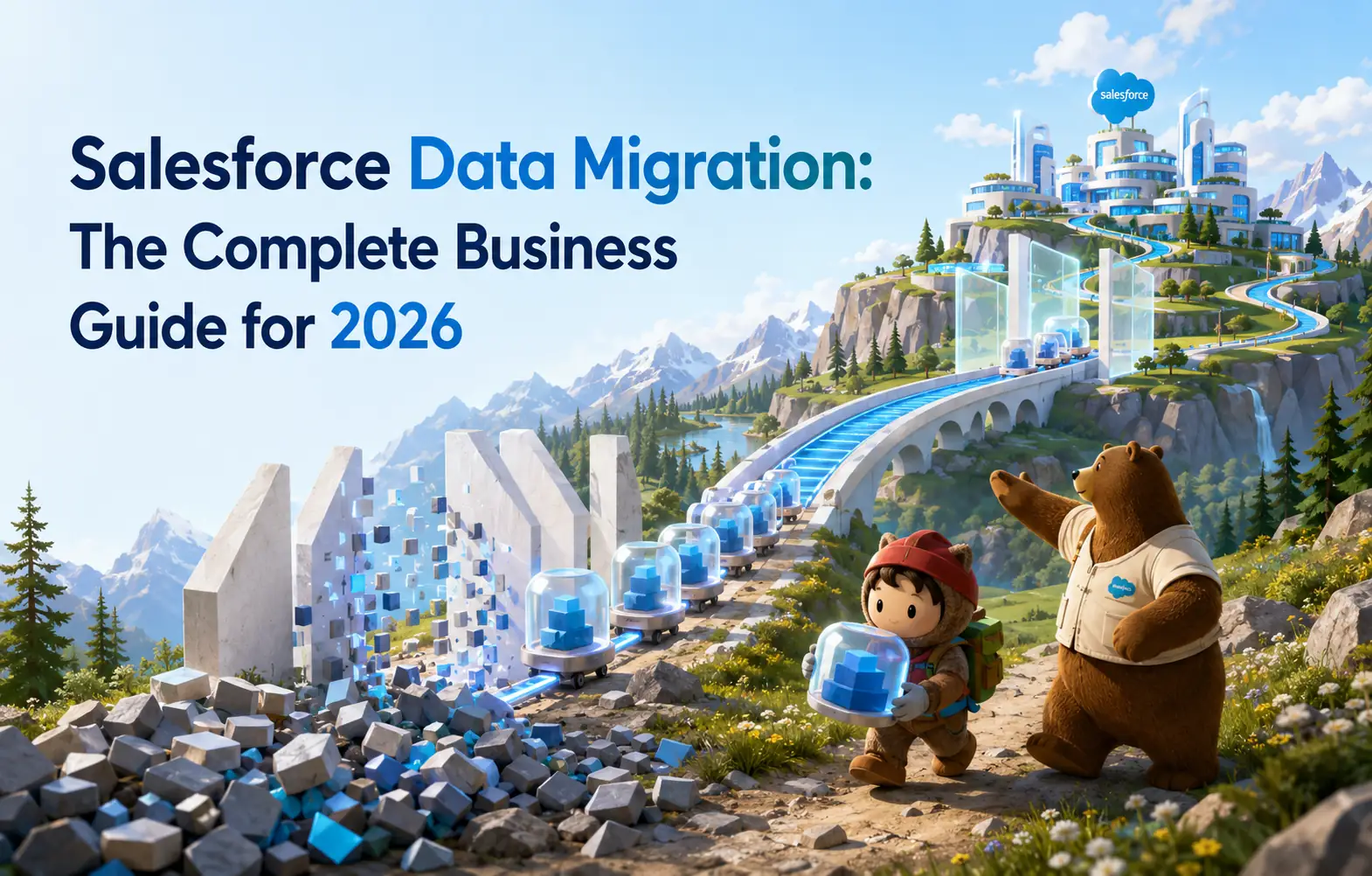
The Salesforce Data Migration Mistakes That Cost Companies 6 Months of Rework

Table of content
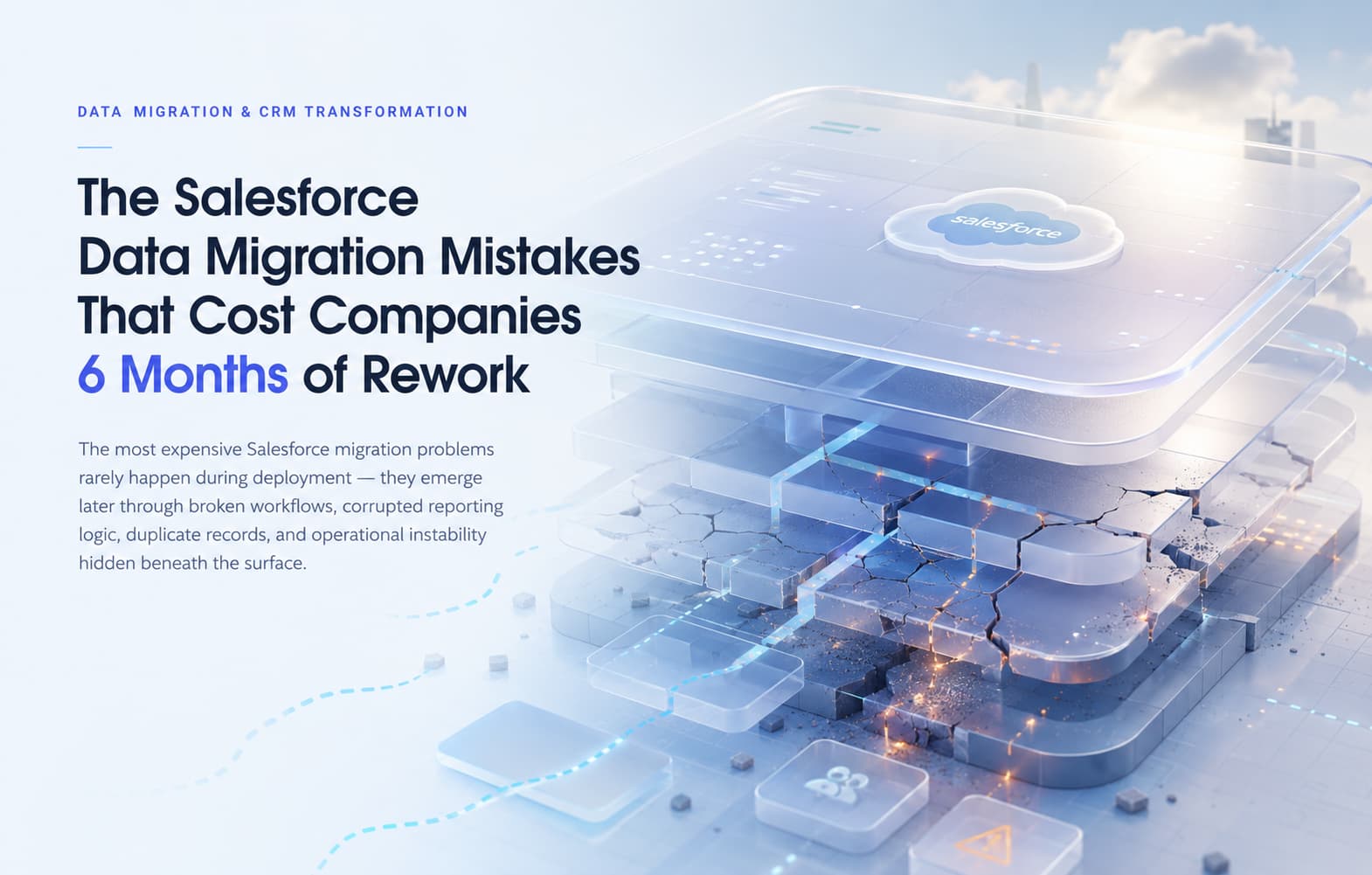
Salesforce data migration is the project that every implementation team underestimates, every project timeline underallocates, and every post-go-live retrospective cites as the primary cause of delay.
It is also the project where the mistakes are almost entirely predictable. The same six errors appear in failed or overrun Salesforce migration projects across industries, company sizes, and geographies. They are not caused by unusual technical complexity. They are caused by decisions made in the planning phase — or, more precisely, by decisions that were skipped in the planning phase.
This article documents those six mistakes and what the correct approach looks like for each. If you are planning a Salesforce data migration or have inherited an org whose data quality tells the story of a migration that went wrong, this is the diagnostic you need before the next project begins.
Why Salesforce Data Migrations Fail
The standard narrative is that data migration is a technical problem: the wrong tools, insufficient API limits, format incompatibilities. In practice, the technical problems are rarely what cause migrations to fail or require months of rework.
The root cause is almost always a governance problem: unclear ownership of data quality decisions, insufficient pre-migration analysis, and a migration plan that treats data as a lift-and-shift exercise rather than an opportunity to establish the quality standards the new Salesforce environment will enforce going forward.
When data migration is treated as a technical task instead of a business project, the decisions that matter most — which records to migrate, how to resolve conflicts, what quality threshold to enforce — get made by developers under deadline pressure. The results land in production and persist for years.
The Six Mistakes That Add Months of Rework
1. Migrating Everything Instead of What You Need
The default assumption in most migration projects is that all data from the source system should move to Salesforce. This assumption is almost always wrong.
Legacy CRM systems typically contain records spanning five to ten years: contacts who have left companies, accounts that have closed, leads that were entered once and never qualified, opportunities for products the company no longer sells. Migrating this data in full brings every quality problem that existed in the source system directly into Salesforce — at scale, on day one.
The correct approach is a migration scope decision made by a business owner, not a technical team: which records are commercially relevant, what is the cutoff date for historical data, and which records should be archived or discarded rather than migrated. This decision belongs to the VP Sales or RevOps leader, signed off before a single data extraction runs.
Companies that skip this step typically spend the first three to six months after go-live deduplicating and archiving records that should never have been migrated in the first place.
2. Not Running a Pre-Migration Data Audit
A pre-migration data audit examines the source data before a single record is extracted. It identifies: duplicate records, missing required fields, formatting inconsistencies, invalid values in picklist fields, and referential integrity breaks (contacts with no parent account, opportunities with no owner).
In most legacy systems, a pre-migration audit will surface issues in 20–40% of records. This is not a problem if you find it before migration. It is a severe problem if you find it in production, after go-live, when your sales team is trying to use the system.
A pre-migration audit should produce a data quality report that becomes a project governance document — reviewed by the business owner, with resolution decisions made before migration begins. The audit is not optional. It is the work that makes everything else reliable.
3. Migrating Without Field Mapping Sign-Off
Field mapping — documenting which field in the source system maps to which field in Salesforce, and how values are transformed in transit — is the most commonly under-documented step in Salesforce migrations.
When field mapping is not formally documented and signed off by a business stakeholder, transformation decisions get made by the migration developer based on their best interpretation. These decisions are often technically correct but commercially wrong: a 'lead source' field that had seven values in the legacy system gets mapped to Salesforce's default picklist, erasing the granularity your marketing team needs for attribution.
Field mapping documentation should be reviewed by the person who owns each object commercially — the VP Sales reviews Opportunity mapping, the marketing ops lead reviews Lead mapping — before migration runs. Changes after go-live are expensive and disruptive.
4. Skipping Duplicate Resolution Before Migration
Legacy systems accumulate duplicate records at a rate most businesses do not track. Contacts entered by multiple reps. Accounts created when a company changed its trading name. Leads that were imported twice from different list sources.
Migrating duplicates into Salesforce without resolving them first means your Salesforce duplicate management rules — however well-configured — are fighting a backlog from day one. More practically, it means sales reps encounter the same company multiple times in searches, create activities on the wrong record, and produce pipeline reports that double-count accounts.
Duplicate resolution should run in the source system before extraction, using a combination of automated deduplication tools and human review for high-value records. This takes time. It is not skippable.
5. No Migration Testing Environment
Production migration should never be the first migration run. A complete test migration into a Salesforce sandbox, using a representative data sample, is the mechanism that surfaces transformation errors, missing field mappings, and referential integrity failures before they affect the live environment.
In practice, test migrations are frequently skipped or compressed when timelines are tight. The consequence is that errors discovered during or after go-live must be corrected in production — with users already working in the system, and with the reputational cost of a CRM that does not work correctly in its first weeks.
A full test migration with a 10–20% representative data sample typically adds two to three weeks to a migration project. That investment is smaller than the rework cost of correcting a production migration error by a factor of three to five.
6. No Post-Migration Data Validation Protocol
The migration is not complete when the data lands in Salesforce. It is complete when the data has been validated against a defined acceptance criteria.
Post-migration validation should cover: record counts by object (do the numbers match the migration scope?), key field completion rates, referential integrity across related records, and a business-user spot-check of a random sample of migrated records.
The spot-check by a business user — not a developer — is the step most technical teams deprioritize. It is also the step that catches the errors no automated check finds: the opportunity that migrated with the right record count but the wrong owner, the contact that landed in Salesforce with a correct email but an incorrect account association.
"Data migration is not a technical project with a business sponsor. It is a business project with technical execution. The governance decisions belong to the business owner — not the migration developer."
How Long a Correctly Run Salesforce Data Migration Takes
For a 50–200 person B2B SaaS company migrating from a legacy CRM or spreadsheet-based system into Salesforce, a correctly planned and executed data migration should take:
- Pre-migration audit and data quality resolution: 2–3 weeks
- Field mapping documentation and sign-off: 1 week
- Duplicate resolution in source system: 1–2 weeks
- Test migration and validation: 1–2 weeks
- Production migration and post-migration validation: 3–5 days
Total: 5–9 weeks, depending on source data volume and quality. Companies that try to compress this timeline below four weeks consistently spend three to six months on post-go-live remediation. The time savings from rushing do not survive first contact with production.
Working With Makedian
Makedian's Salesforce Data Migration practice covers the full process: pre-migration audit, field mapping documentation, duplicate resolution, test migration, production cutover, and post-migration validation — delivered as a fixed-scope engagement with a defined timeline and acceptance criteria agreed before work begins.
If you have inherited a Salesforce org whose data quality reflects a migration that was not run correctly, our RevOps Diagnostic will identify exactly where the damage is and what the remediation path looks like.
Book your Salesforce RevOps Diagnostic at
.webp)




















Agentforce for Financial Services: AI-Driven Banking & Insurance Solutions














.webp)



















n8n Workflow Automation: From Lead Capture to CRM in Minutes, Not Hours






%20(1).webp)