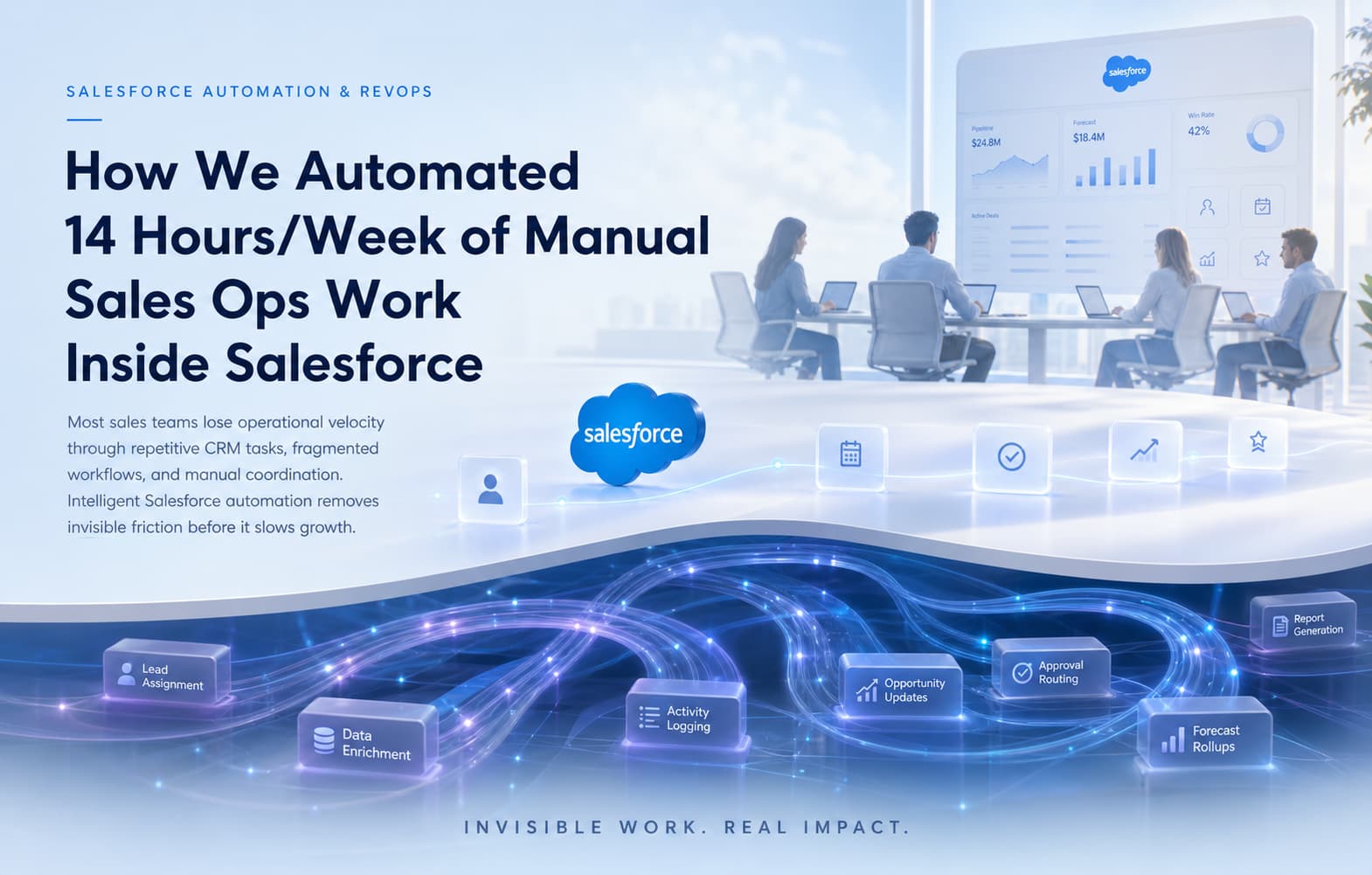
How We Automated 14 Hours/Week of Manual Sales Ops Work Inside Salesforce

Table of content
At the start of every RevOps engagement, we ask the sales team the same question: what do you spend time on in Salesforce that you wish you did not have to do?
The answers are always specific. Updating close dates that slipped. Logging call notes from a Zoom session that ended an hour ago. Moving an opportunity stage after a meeting the manager does not know happened yet. Chasing a teammate for an account update that should have been in Salesforce but was not. Pulling a list of overdue follow-ups that should be a report but is not.
For one of our clients — a 90-person B2B SaaS company with a 14-rep sales team — we did the exercise properly. We mapped every manual task the team performed in Salesforce in a given week, estimated the time per task per rep, and totalled it. The number was 14 hours per week across the team. Not per rep. Not in total across the company. Per week, for 14 reps combined — roughly an hour per rep, per week, every week, spent on work that should not require human input.
This article documents what that work was, what we built to automate it, and what changed in the first 60 days after go-live.
The Audit: What the Team Was Doing Manually
The 14 hours broke down into five categories:
1. Close date updates after deals slipped (3.2 hours/week)
Close dates were being pushed manually by reps after the original close date passed — usually in a batch session at the start of the week when the pipeline report was reviewed. Each update took 60 to 90 seconds. With 30-plus open opportunities and an average of eight to ten pushed per week, this was a material time drain — and it was entirely detached from any actual buyer signal.
2. Stage updates after meetings (2.8 hours/week)
Reps were updating opportunity stages manually after meetings — sometimes immediately, more often at the end of the day or the following morning. Stages were consistently accurate but consistently delayed. Managers reviewing the pipeline at 9 AM were looking at stage data that reflected yesterday's meetings, not this morning's.
3. Activity logging from external tools (3.5 hours/week)
The team used Zoom for demos, Gmail for follow-up emails, and Google Calendar for meeting scheduling. None of these were syncing automatically to Salesforce. Reps were logging activities manually — writing call notes, creating tasks, updating engagement fields — on top of their actual selling activity.
4. Follow-up task creation (2.1 hours/week)
After every discovery call, demo, or proposal send, reps were manually creating a follow-up task in Salesforce: setting a subject, assigning it to themselves, and setting a due date. This process was non-standard — some reps created tasks immediately, some created them in batches, and some used calendar reminders instead of Salesforce tasks, creating visibility gaps for managers.
5. Pipeline review prep (2.4 hours/week)
Each Friday, the VP Sales ran a 45-minute pipeline review. Reps spent an average of 10 minutes per person updating their opportunities before the review — ensuring close dates, stages, and notes were current enough to discuss. This pre-review prep was unpaid governance tax: work done not because the business required it, but because the review would be embarrassing without it.
What We Built: Five Automations Over Six Weeks
Automation 1: Automated close date recalculation on stage change
A Salesforce Flow was configured to trigger when an opportunity stage is updated. The Flow calculates a recommended close date based on the average sales cycle for that stage — pulled from the trailing 90-day historical data — and surfaces it as a recommended close date field. Reps can accept the recommendation (one click) or override it. Acceptance is logged.
Effect: manual close date batch updates dropped to near zero. The recommended close date field reduced the cognitive load of each close date decision from 'what date should I put?' to 'does this suggestion look right?'
Automation 2: Stage progression prompts after meeting completion
Einstein Activity Capture was configured to sync Google Calendar and Gmail. When a calendar event associated with a Salesforce opportunity is marked complete, a Salesforce notification prompts the rep: 'Your meeting with [Contact Name] just ended. Did the stage change?' — with a one-click stage update embedded in the notification.
Effect: stage update latency dropped from an average of 18 hours post-meeting to under 2 hours. Pipeline data freshness — the gap between real-world deal status and Salesforce stage — improved measurably in the first 30 days.
Automation 3: Einstein Activity Capture full configuration
Gmail and Google Calendar were connected to Salesforce via Einstein Activity Capture for all 14 reps. Emails sent to and received from Salesforce contacts are logged automatically. Calendar events linked to known contacts are associated with the relevant opportunity record.
Effect: activity logging time dropped from 3.5 hours per week team-total to under 30 minutes — covering exceptions that the automated capture did not associate correctly. Activity completeness in Salesforce moved from 31% to 78% within 45 days.
Automation 4: Auto-created follow-up tasks on stage transition
A Flow creates a standardized follow-up task automatically when an opportunity moves to specific stages — Proposal Sent, Demo Completed, Contract Sent. The task subject, due date (calculated from the stage SLA), and priority are set by the automation. The rep receives a notification and can edit the details if needed.
Effect: follow-up task creation time dropped to zero for standard post-meeting tasks. Task coverage — the percentage of opportunities in active stages with an open follow-up task — increased from 54% to 91%.
Automation 5: Pre-populated pipeline review dashboard
A pipeline review dashboard was configured in Salesforce that the VP Sales opens directly at the start of the Friday review. It surfaces: opportunities with close dates within 14 days, opportunities with no activity in 7 days, opportunities where stage has not changed in 21 days, and opportunities with no next step set. The dashboard refreshes automatically. Reps do not prep for it — the dashboard makes the preparation unnecessary.
Effect: pre-review prep time dropped from 10 minutes per rep (2.4 hours team-total) to zero. The pipeline review itself shortened from 45 minutes to 30 minutes because the data was current when the call started.
The 60-Day Results
At 60 days post-go-live, we measured against the baseline audit:
- Manual sales ops time recovered: 12.8 hours per week — 91% of the 14 hours identified in the original audit. The remaining 1.2 hours were edge-case tasks that required human judgment.
- Activity completeness: increased from 31% to 78% — enabling Einstein Opportunity Scoring to operate at meaningful accuracy for the first time in the org's history.
- Follow-up task coverage: increased from 54% to 91% across active opportunities.
- Pipeline data freshness: stage update latency reduced from 18 hours average to under 2 hours.
- Rep satisfaction: surveyed at 60 days. 11 of 14 reps rated the automation changes as 'significantly improved' or 'improved' for daily workflow. The three who did not cited the stage-update notification as appearing too frequently for their preference — a threshold adjustment made in week nine.
"The goal of sales automation is not to make Salesforce smarter. It is to make your reps faster — by removing the work between customer conversations that should not require a human."
Working With Makedian
Makedian's RevOps practice includes a Sales Ops Automation audit as part of every RevOps Diagnostic — mapping the manual tasks your team performs in Salesforce each week and identifying which are automatable within the existing platform without additional tooling costs.
The automation roadmap we produce prioritizes by time recovered per week, not by technical complexity. The five automations described in this article were built using native Salesforce Flows, Einstein Activity Capture, and standard dashboard configuration — no third-party tools, no custom development.
Book your Salesforce RevOps Diagnostic at
.webp)
















Agentforce for Financial Services: AI-Driven Banking & Insurance Solutions












.webp)














n8n Workflow Automation: From Lead Capture to CRM in Minutes, Not Hours



%20(1).webp)