Why Most B2B SaaS Marketing Automation Setups Are Broken

Table of content
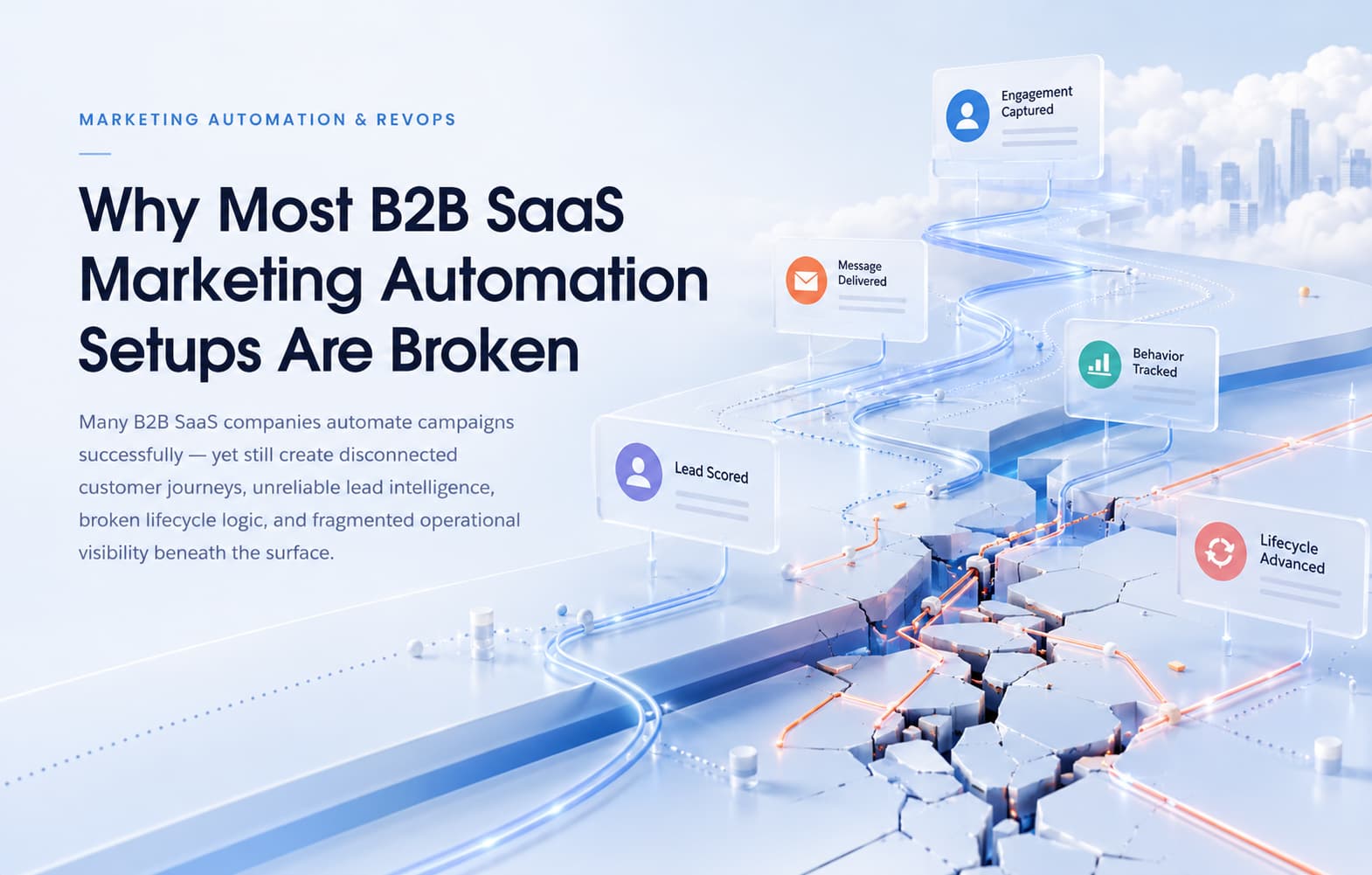
Pardot — now Marketing Cloud Account Engagement — is one of the most powerful B2B marketing automation platforms in the Salesforce ecosystem. It is also one of the most commonly misconfigured.
The typical B2B SaaS company at Series A has had Pardot running for 12 to 18 months. Email campaigns are going out. Forms are capturing leads. The Salesforce integration is technically live. And the marketing team reports a healthy number of 'marketing qualified leads' each month.
The sales team does not trust any of them.
This is the defining symptom of a broken Pardot setup: a marketing automation platform that is producing volume without producing qualified pipeline. The problem is almost never the platform — it is five structural decisions that were made (or skipped) when Pardot was first configured.
This article documents those five problems and what the fix looks like for each. If you are a VP Sales or RevOps leader whose SDR team has stopped actioning marketing-sourced leads because the quality is too inconsistent, this is the diagnosis your marketing team needs.
Problem 1: Lead Scoring That Does Not Reflect Your ICP
Pardot's default lead scoring model assigns points based on activity: opening an email (+5), clicking a link (+5), visiting a webpage (+5), downloading a piece of content (+10). After enough activity, a lead reaches the MQL threshold and routes to sales.
The problem is that this model scores engagement volume, not ICP fit. A developer from a 10-person agency who reads three blog posts and downloads your pricing guide scores higher than a VP Sales from a 150-person SaaS company who visited your homepage once from a LinkedIn ad.
Your ICP is the VP Sales, not the developer. Your default scoring model does not know that.
The fix is a two-dimensional scoring model that separates behavior score from profile grade:
- Behavior score: how engaged is this person with your content — email opens, page visits, form submissions, content downloads.
- Profile grade: how closely does this person match your ICP — company size, industry, job title, geography.
A lead only routes to sales when both dimensions exceed their respective thresholds. High engagement from a low-fit profile goes into a nurture sequence, not an SDR queue. Low engagement from a high-fit profile triggers a targeted outreach campaign, not a generic drip.
This single change — separating profile from behavior in the scoring model — is the most common fix that restores trust between sales and marketing in broken Pardot setups.
Problem 2: The Salesforce Integration Is Technically Live But Commercially Broken
The Pardot-Salesforce connector is often described as a native integration. In practice, 'native' means the two systems are connected — it does not mean they are exchanging the data your sales process needs.
The most common integration failures:
- Pardot lead records syncing to Salesforce as Leads rather than converting to Contacts on existing Account records. Result: a Salesforce Lead object full of duplicates for companies already in your CRM as Accounts, with no engagement history visible to the AE working the account.
- Engagement data (email opens, landing page visits, form submissions) visible in Pardot but not surfaced in Salesforce. Result: an AE making an outreach call with no visibility into the prospect's recent content behavior — the signal that would tell them what the prospect is actually interested in.
- Pardot campaigns not mapped to Salesforce campaigns. Result: marketing cannot report on campaign influence on pipeline, and the 'marketing sourced revenue' number in board reporting is either zero or manually calculated.
Fixing the integration means configuring bi-directional data flow for the fields that matter commercially: engagement activity surfaced on the Salesforce Contact record, campaign membership synced for attribution reporting, and an account-matching rule that prevents duplicate Lead creation for known accounts.
Problem 3: Nurture Sequences Built Around Content, Not Buying Stage
Most B2B SaaS Pardot nurture sequences are organized around content themes: a 'Product Education' sequence, a 'Case Study' sequence, a 'Feature Spotlight' sequence. They are essentially content calendars automated into email form.
Effective B2B nurture sequences are organized around buying stage and ICP problem, not content inventory. The question that should drive every nurture email is: where is this prospect in their buying decision, and what do they need to see to move to the next stage?
A VP Sales who visited your pricing page two weeks ago and then went cold is not in the same nurture stage as a VP Sales who downloaded a TOFU thought leadership piece yesterday. Sending them the same sequence in the same order is the definition of a broken nurture program.
Effective nurture design:
- TOFU leads (low score, early engagement): educational content that builds category awareness. No CTA to book a call — they are not ready.
- MOFU leads (building engagement, some profile fit): comparison content, customer stories, specific pain-point frameworks. CTA to access a more detailed resource, not to schedule a demo.
- BOFU leads (high profile fit, high engagement, pricing/demo page visits): case studies relevant to their industry, direct outreach from a named AE, invitation to a strategy call — not a generic 'book a demo' button.
The trigger from one stage to the next is behavioral: a specific action taken by the prospect, not a number of days elapsed.
Problem 4: No Engagement Studio Governance
Pardot's Engagement Studio is the workflow engine that powers nurture sequences, scoring adjustments, and routing logic. In most B2B SaaS setups that have been running for more than 12 months, Engagement Studio contains:
- Multiple overlapping programs sending to the same prospect simultaneously.
- Abandoned programs that are technically still active and still enrolling new prospects.
- Programs with incorrect list memberships — sending content designed for a specific segment to an unrelated audience.
The result is prospects receiving multiple uncoordinated emails in the same week from the same company, with conflicting messages and CTAs. This does not look like automation. It looks like a team that has lost control of its marketing system — because it has.
Engagement Studio governance requires a quarterly audit: review every active program, confirm its list membership is correct, confirm no overlap with other active programs, and retire any program that has not been reviewed in six months.
Problem 5: Pardot-Reported MQLs Are Not the Same as Sales-Qualified Leads
The metric that surfaces the fundamental misalignment between most marketing and sales teams in B2B SaaS is the MQL-to-SQL conversion rate. In a well-configured Pardot setup serving an accurately defined ICP, this rate should sit between 30% and 50%. Below 20% consistently indicates a scoring model that is qualifying the wrong leads.
Most VP Sales leaders we speak with do not know their MQL-to-SQL rate because it requires a report that spans Pardot and Salesforce — and that report is often not configured. Marketing reports MQLs from Pardot. Sales reports opportunities from Salesforce. The gap between the two numbers is a black box.
Building the MQL-to-SQL conversion report is a one-time configuration task. Running it monthly is a two-minute review. And having that number on the same dashboard as your pipeline coverage ratio — so leadership sees lead quality alongside pipeline quantity — is the single most effective mechanism for aligning marketing and sales around the same commercial outcome.
"Marketing automation that produces volume is easy to build. Marketing automation that produces qualified pipeline requires the same precision that goes into designing a sales process — because it is part of the same process."
Working With Makedian
Makedian's Marketing Cloud Account Engagement practice works with B2B SaaS marketing and RevOps teams who need Pardot rebuilt around their ICP — not around their content calendar.
We cover the full setup: two-dimensional lead scoring, Salesforce integration data mapping, stage-based nurture architecture, Engagement Studio audit, and the MQL-to-SQL reporting bridge between Pardot and Salesforce.
If your SDR team has stopped trusting marketing-sourced leads, that is a solvable configuration problem — not a marketing strategy problem. Start with our Salesforce RevOps Diagnostic, which covers Pardot integration health as part of its standard scope.
Book your RevOps Diagnostic at
.webp)















Agentforce for Financial Services: AI-Driven Banking & Insurance Solutions











.webp)










n8n Workflow Automation: From Lead Capture to CRM in Minutes, Not Hours


%20(1).webp)