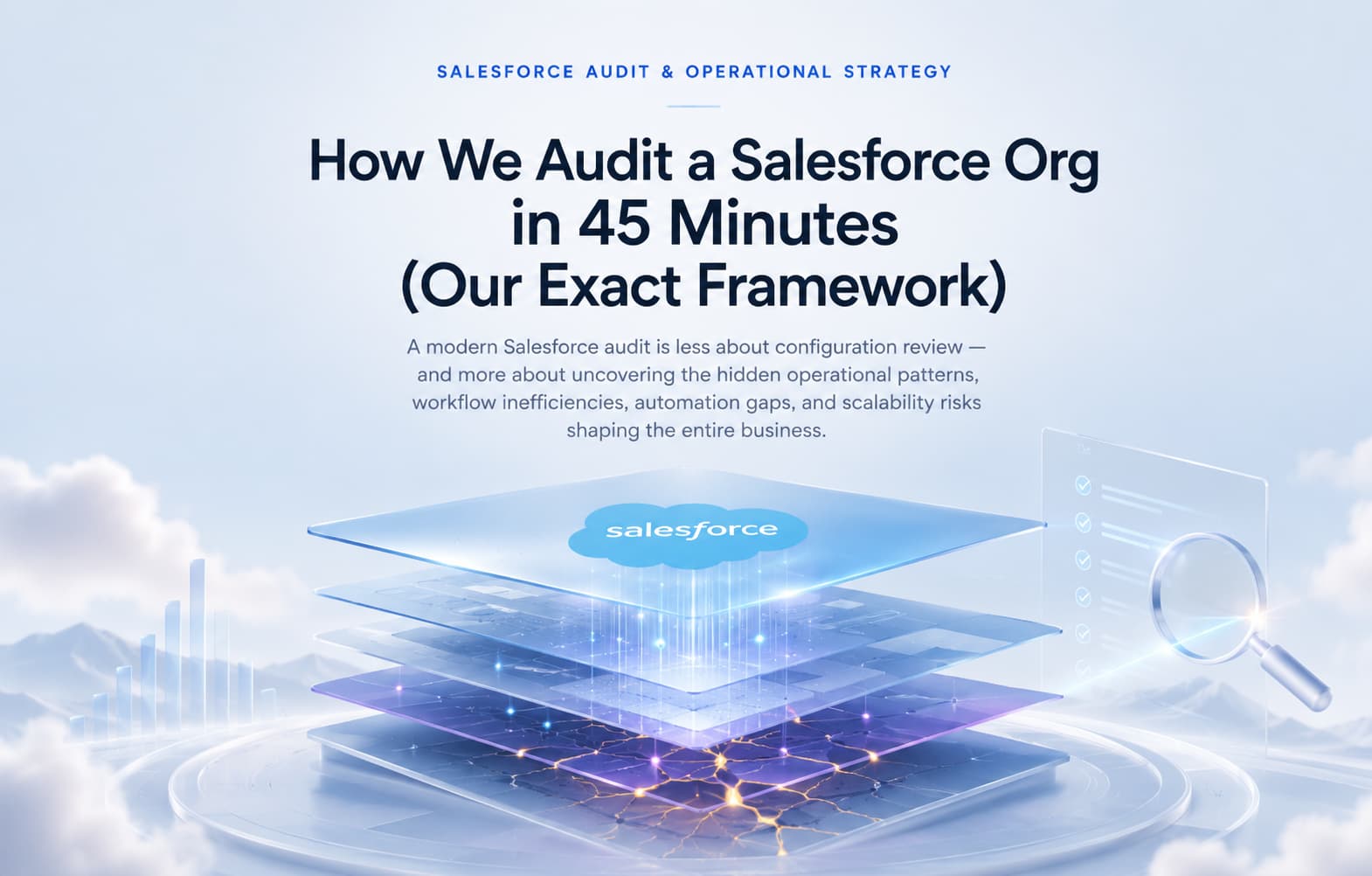
How We Audit a Salesforce Org in 45 Minutes (Our Exact Framework)

Table of content
Most VP Sales and RevOps leaders at B2B SaaS companies know something is wrong with their Salesforce. Reports do not reconcile with reality. Forecasts are consistently optimistic. Reps are logging in less frequently than they should be. The system is technically working — it is just not working for the business.
When we begin a new client engagement, before we touch a single configuration, we run a structured Salesforce org audit. It takes 45 minutes. It covers six diagnostic areas. And in virtually every case, it surfaces the same five to seven issues — in different combinations, with different severity levels, but the underlying problems are almost always the same.
This article documents our exact audit framework. You can run it yourself against your own Salesforce environment. Or use it as a benchmark to evaluate whether the system you are running is genuinely serving your commercial operations — or whether your team is working around it.
Why Most Salesforce Health Checks Miss the Point
There are two types of Salesforce audits in the market, and they answer completely different questions.
The first type is a technical audit. It checks code coverage percentages, governor limit utilization, deprecated API versions, and security posture against Salesforce's published standards. This is genuinely useful if you are preparing for a major platform upgrade or submitting an AppExchange app for security review. It tells you almost nothing about whether Salesforce is serving your revenue process.
The second type — the type we run — is a commercial audit. It asks one question across every diagnostic area: is this configuration making it easier or harder to close revenue? A field that is configured correctly but never filled in is commercially broken. A report that is technically accurate but that no one trusts is not doing its job.
Every finding in our audit maps to a business impact, not a technical score. That distinction determines whether the output produces action or gets archived.
The Six Diagnostic Areas
1. Pipeline Data Integrity
We start with the pipeline because this is where commercial pain is most visible and most measurable.
The questions we ask:
- Do opportunity stages map to buyer-side criteria — what the buyer has done, agreed to, or committed to — or seller-side criteria — what the rep has done?
- What percentage of open opportunities have a next step with a specific date attached?
- What is the average age of open opportunities? How many have had their close date pushed three or more times?
- What percentage of the pipeline sits in the final three stages where close probability exceeds 50%?
A pipeline audit that takes 15 minutes typically surfaces stage definitions that create false confidence, missing next steps on 40–60% of open deals, and a concentration of aged opportunities that have never been officially lost — they have simply been pushed indefinitely.
The commercial impact: forecast variance, quarterly close rates below capacity, and leadership making resourcing decisions based on pipeline numbers that overstate commercial reality.
2. Activity Capture and Logging Completeness
The second diagnostic area examines what Salesforce actually knows about customer interactions.
We pull the activity report for the trailing 30 days and measure: total activities logged, breakdown by type (email, call, meeting, note), and activities logged per open opportunity. We then compare this against what the team describes in their weekly pipeline reviews.
The gap is almost always significant. In a typical 50–150 person B2B SaaS company, Salesforce captures 25–45% of actual customer interactions. The rest happen in Gmail, Zoom, Slack, or channels entirely outside the CRM and are never logged.
This matters for two reasons. First, Einstein's predictions are built on logged data. A predictive model trained on 30% of reality produces predictions at that accuracy level. Second, managers cannot coach what they cannot see. If a rep is running five meetings per week that do not appear in Salesforce, their manager has no visibility into deal momentum — and no foundation for a useful coaching conversation.
The fix is automated capture, not more manual logging. Einstein Activity Capture, properly configured, syncs Gmail and Google Calendar automatically. Pair that with a conversation intelligence integration and you can reach 80%+ activity visibility without changing a single rep behavior.
3. Data Quality and Record Completeness
The third area examines the underlying record quality across core Salesforce objects.
We check: duplicate account and contact records (a common result of poor import governance and missing deduplication rules), field completion rates on Opportunity, Account, and Lead objects, and the age and quality of Lead records that have never been converted or officially disqualified.
In most orgs we audit, 15–30% of Account records are duplicates or near-duplicates. This distorts everything from territory planning to Einstein model training to executive reporting. It is also the single most common reason Einstein features underperform on first activation — the model cannot learn from records that represent the same customer twice with different data in each.
4. Automation Health
The fourth area is a structural review of all automations running in the org: Flows, legacy Workflow Rules, and Process Builder automations.
This diagnostic identifies:
- Legacy automations built on Workflow Rules — a tool Salesforce has deprecated from its product roadmap — that need migration to Flows before the next major release cycle.
- Conflicting automations that trigger on the same object and overwrite each other's changes, creating unpredictable record behavior that support tickets cannot explain.
- Orphaned automations that reference fields, record types, or users that no longer exist in the org — running silently without producing their intended effect.
The business impact of automation debt is unpredictable system behavior: records updated with incorrect values, emails triggered at the wrong time, stage changes that cascade into errors downstream. Most orgs accumulate this debt invisibly over two to three years of changes made by different administrators with different standards and no governance documentation.
5. Reporting and Dashboard Utility
The fifth area examines whether the reports being run are trustworthy and whether the dashboards in use are actually being used.
We check: when each dashboard was last refreshed, which reports are embedded in active dashboards versus abandoned, and whether leadership can access the five metrics that actually govern their commercial decisions — close rate by stage, pipeline coverage ratio, average sales cycle by segment, forecast versus actual variance, and rep activity volume by week.
In most audits, we find dashboards that have not been refreshed in 90 days alongside reports that are technically correct but structured in a way that requires 20 minutes of manual interpretation to extract a single data point. Neither is useful. A report your VP Sales needs to export to Excel to answer a question is not a report — it is a data dump.
6. User Adoption and License ROI
The final area is the most revealing. We look at login frequency by user, record creation and update dates (identifying users who batch-update records once per week rather than maintaining them in real time), and the correlation between Salesforce activity levels and individual rep performance.
This diagnostic answers the question most VP Sales are actually asking when they request an audit: is my team using Salesforce enough to justify what we are paying for it? In most orgs at this stage, 20–30% of licensed users are logging in fewer than twice per week — creating data gaps that compound every issue found in the five diagnostic areas above.
What We Find in Almost Every Audit
Across every Salesforce audit Makedian has run for B2B SaaS companies between 50 and 300 employees, the same five findings appear in the majority of engagements:
- Opportunity stages that map to rep actions rather than buyer decisions — causing systematic overforecasting every quarter.
- Activity capture below 50% — preventing Einstein from operating at meaningful accuracy regardless of how the feature is configured.
- Duplicate records at 15%+ across the Account object — distorting territory data and degrading AI model training.
- Legacy automations running in parallel with newer Flows — creating unpredictable record behavior that generates support tickets no one can fully explain.
- No pipeline health metrics in active executive use — forcing managers to rely on rep self-reporting rather than behavioral data.
None of these are rare edge cases unique to specific industries or implementation partners. All of them are preventable with correct configuration from the start. All of them are fixable with a structured remediation plan. And all of them produce measurable commercial cost every quarter they go unaddressed.
The Audit Output: What You Get
A Salesforce org audit is only useful if it produces a clear action plan that non-technical stakeholders can act on.
Our audit output includes:
- A prioritized list of findings ranked by commercial impact — not technical severity. The most important finding is the one costing you the most revenue, not the one requiring the most configuration work.
- The estimated effort to fix each issue in hours, not sprints — so you know what a realistic remediation timeline looks like before committing.
- The specific Salesforce configuration changes required for each fix, written in plain language your operations team can review and approve.
- A phased remediation roadmap with quick wins — changes executable in under a week — separated from structural changes that require longer delivery.
The goal is not a comprehensive technical report. The goal is a document your VP Sales reads in 10 minutes and understands exactly what needs to happen, in what order, and why it matters commercially.
Working With Makedian
Makedian's Salesforce RevOps Diagnostic is a structured 45-minute working session with your key Salesforce stakeholder. We cover all six diagnostic areas, ask the questions outlined in this article, and return a prioritized audit report within five business days.
The diagnostic is available at no cost for companies that are a fit for our managed services or project engagement model. If you are not a fit, we will tell you — and point you toward the right resources regardless.
Book your Salesforce RevOps Diagnostic at
.webp)















Agentforce for Financial Services: AI-Driven Banking & Insurance Solutions











.webp)








n8n Workflow Automation: From Lead Capture to CRM in Minutes, Not Hours

%20(1).webp)