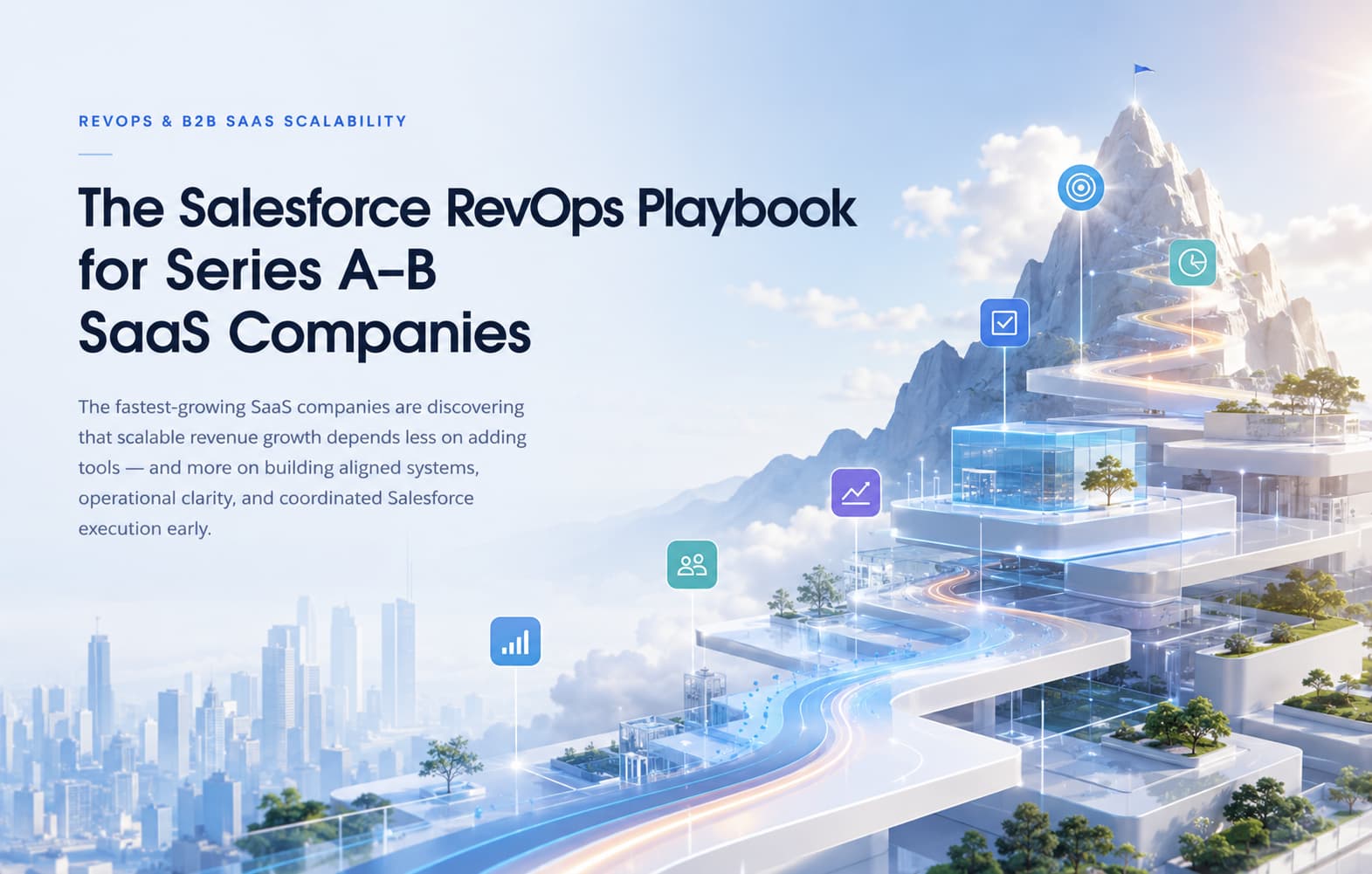
The Salesforce RevOps Playbook for Series A–B SaaS Companies

Table of content
The Salesforce configuration that works for a 20-person startup is not the configuration that works for a 100-person growth-stage company. And the setup that gets a Series A SaaS company to $10M ARR is almost never the one that takes it to $30M.
Revenue Operations on Salesforce is not a one-time implementation project. It is a progressive discipline: the right foundation at seed, the right upgrades at Series A, and the right architecture investments at Series B. Get the sequencing right and each stage builds on the last. Get it wrong and you arrive at each fundraising round inheriting the technical debt of a configuration that was never designed for the scale you are now at.
This is the playbook we use with every new B2B SaaS client who comes to us post-Series A with a Salesforce environment that is not keeping pace with the business. It covers what should be in place at each stage, what breaks when it is not, and what the practical implementation looks like — without the generic frameworks that look good in slide decks but do not survive contact with a real Salesforce org.
The Three RevOps Stages and What Each One Requires
Stage 1: Foundation (Pre-Series A, 10–30 employees)
At this stage, Salesforce is primarily a contact and opportunity database. The team is small enough that pipeline visibility happens in weekly standups rather than reports. The configuration priorities are:
- A clean lead-to-opportunity conversion process — no duplicates, no orphaned leads, no contacts without parent accounts.
- Opportunity stages that reflect how the business actually sells — even if that is only three or four stages at this point.
- Basic activity logging — email and calendar sync configured from day one, not added later when habits are already formed.
- One dashboard the CEO and VP Sales look at every Monday — pipeline by stage, close rate trailing 90 days, open opportunities by owner.
Most companies skip the activity capture setup at this stage because it feels like a nice-to-have. It is not. Every week of manual-only activity logging is a week of incomplete data that Einstein will need to work around at Series A when you try to activate it.
Stage 2: Operational Scale (Series A, 30–100 employees)
Series A is where the configuration debt from Stage 1 becomes visible and painful. The team has grown. Deals are more complex. Leadership needs reporting that the current setup cannot produce reliably. Three things break simultaneously:
- Pipeline accuracy degrades as more reps interpret stages differently, push close dates without consequence, and create opportunities inconsistently.
- Forecasting becomes unreliable because there is no formal forecast category structure — everything lives in stage probability, which was never calibrated against your actual close rates.
- Onboarding new reps takes longer than it should because the Salesforce environment is not intuitive — page layouts were designed for three users, not 30.
The Series A RevOps buildout on Salesforce covers five areas:
Pipeline Governance Framework
Stage definitions are redesigned around buyer-gate criteria — what the buyer has done, not what the rep has done. Forecast categories are configured: Committed, Best Case, Pipeline, Omitted. Each category maps to a defined confidence level agreed with finance.
Next step fields are made required at key stages. Stale-pipeline alerts are automated: any opportunity with no activity in 14 days and a close date within 45 days triggers a manager notification. This single automation surfaces more deal risk proactively than most weekly pipeline reviews.
Lead Lifecycle and Routing
At Series A, inbound volume has grown to the point where manual lead assignment creates response time problems. Lead routing automation — by territory, by company size, by product interest, or by round-robin — ensures every qualified lead reaches a rep within minutes, not hours.
Lead scoring is introduced at this stage: a combination of firmographic fit (company size, industry, geography) and behavioral engagement (page visits, content downloads, email opens if MCAE is connected). High-score leads route to senior AEs; lower-score leads route to SDRs for qualification.
Einstein Activation
Einstein Opportunity Scoring becomes reliable at Series A — not because the feature changes, but because the activity data required to train it meaningfully is now available if Stage 1 was done correctly. Einstein Lead Scoring is activated alongside opportunity scoring, giving the SDR team a ranked queue rather than a flat list.
Einstein Copilot, where available, is introduced for high-volume AEs as a next-best-action layer. Adoption at this stage is measured by usage rate, not deal outcome — the goal is habit formation.
Reporting for Commercial Leadership
Series A reporting requirements are fundamentally different from Stage 1. Finance wants a forecast they can model against. The VP Sales wants close rate by rep and stage conversion rates. The CEO wants pipeline coverage ratio — how much pipeline exists relative to the quarterly target.
The reporting buildout at this stage produces five operational dashboards: CEO pipeline health, VP Sales forecast, rep activity and pipeline, SDR inbound performance, and win/loss analysis. Each is refreshed daily, not manually. Each uses Salesforce-native data, not exports.
Process Documentation and Governance
At 30–100 employees, Salesforce governance moves from informal to structured. Every configuration change requires a documented rationale. Every new field has a defined owner. Every automation has a description and a last-reviewed date.
Without this structure, the configuration debt that accumulated invisibly in Stage 1 reappears at Series B — compounded.
Stage 3: Intelligence (Series B, 100–300 employees)
Series B is where Salesforce transitions from an operational system into an intelligence platform — if the Stage 1 and Stage 2 foundations were built correctly.
The configuration priorities at this stage:
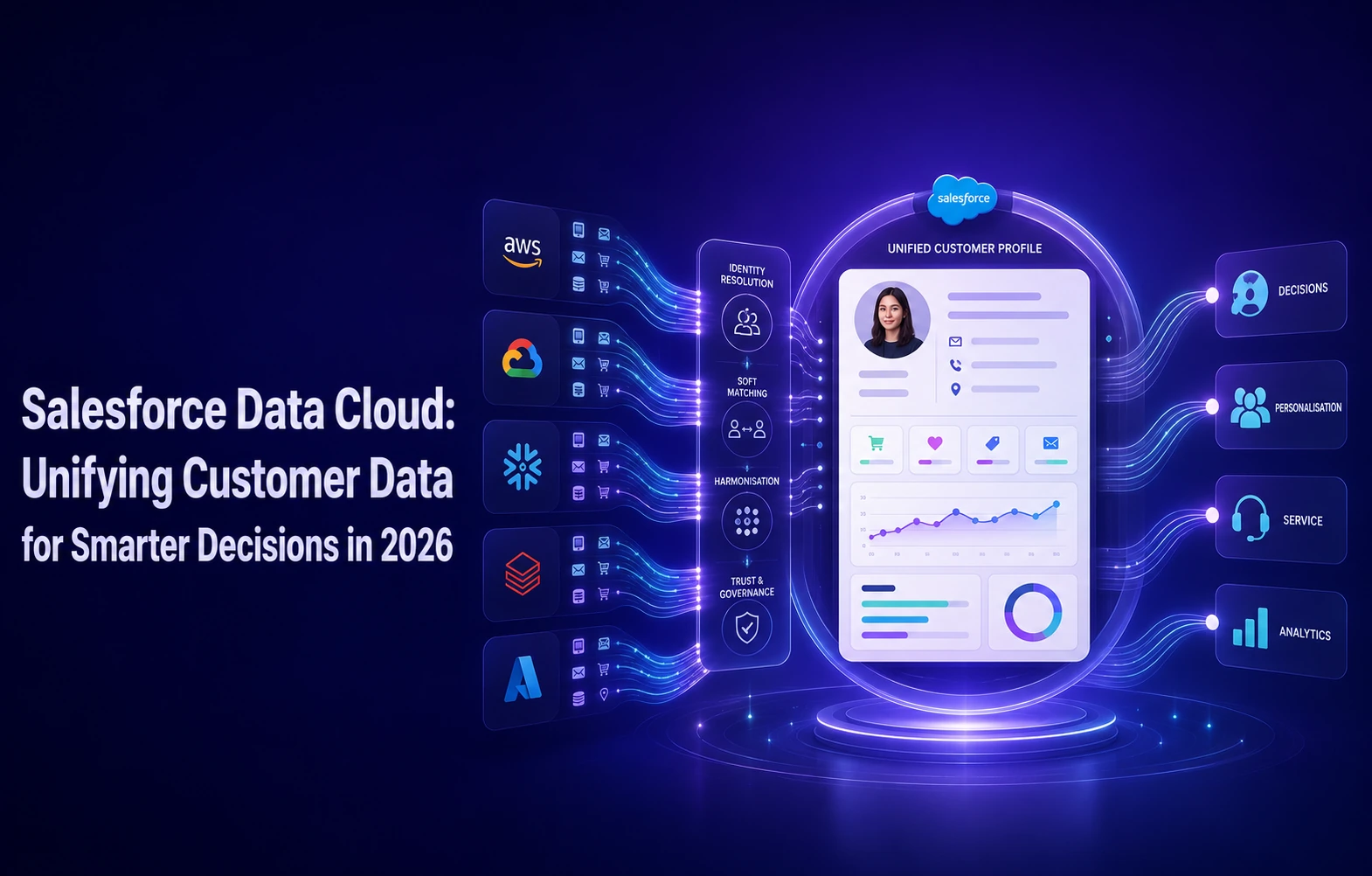
- Data Cloud activation — unifying Salesforce CRM data with product usage data, marketing engagement data, and customer success signals into a single real-time customer profile.
- Agentforce deployment — autonomous lead qualification, next-best-action recommendations, and multi-agent orchestration across sales and service workflows.
- Revenue intelligence — Einstein-powered deal predictions that are accurate enough to present to the board, built on two to three years of clean, consistently logged historical data.
- Territory planning and quota modeling — using Data Cloud-unified signals to set territory boundaries and quota targets from actual account potential, not historical rep performance.
None of the Series B capabilities work without the Series A foundation. And none of the Series A foundation works without the Stage 1 basics. The companies that arrive at Series B without a clean Salesforce environment spend their first 12 months remediating — not scaling.
The Most Common RevOps Mistakes at Each Stage
Across the B2B SaaS companies we work with, the same configuration mistakes appear at each stage:
At Stage 1
- Skipping activity capture setup. Every week without automated capture is a week of incomplete historical data.
- Using Salesforce's default opportunity stages without customizing them to the actual sales process.
- No deduplication rules. The duplicate records that enter Salesforce at 20 users are much harder to resolve at 100.
At Series A
- Trying to activate Einstein before the data foundation is clean. The output is confident-sounding predictions with 40% accuracy — worse than a manager's instinct.
- Building reports for the configuration that exists rather than the process you are trying to drive. Reports should pull people toward the right behavior, not just document what is already happening.
- Skipping forecast categories. Stage probability alone produces forecast variance that finance cannot model against.
At Series B
- Deploying Agentforce before the data quality issues from Stage 1 have been resolved. The agent performs at the quality level of its training data.
- Treating Data Cloud as a data warehouse rather than a real-time activation layer. Data Cloud's value is in what it enables, not what it stores.
- No dedicated RevOps owner at 100+ people. At this scale, Salesforce configuration decisions need a business owner — not just a technical administrator.
What the First 90 Days of a RevOps Engagement Look Like
For a Series A SaaS company engaging Makedian to run a full RevOps buildout, the first 90 days follow a structured sequence:
- Days 1–14: Salesforce RevOps Diagnostic — six-area audit covering pipeline health, activity capture, data quality, automation architecture, reporting utility, and user adoption.
- Days 15–30: Foundation fixes — stage redesign, forecast categories, activity capture configuration, critical deduplication pass, and executive dashboard buildout.
- Days 31–60: Lead lifecycle and routing — ICP scoring model, lead assignment rules, SDR queue configuration, and conversion tracking.
- Days 61–90: Einstein activation and governance — opportunity scoring, lead scoring, Copilot where available, and process documentation for the changes made.
At day 90, the leadership team has a Salesforce environment that reflects how the business actually sells — not how it sold when the org was first configured. From that point, managed services take over: quarterly release management, ongoing optimization, and the Series B capability roadmap built on the Series A foundation.
"The companies that grow fastest on Salesforce are not the ones who spent the most on implementation. They are the ones who sequenced the right capabilities at the right stage — and built each phase on a foundation that was actually ready for it."
Working With Makedian
Makedian works with B2B SaaS companies at Series A through Series B who are scaling on Salesforce and need RevOps built — or rebuilt — around how the business actually operates today.
Every engagement starts with a RevOps Diagnostic: a 45-minute structured audit that surfaces exactly where your current Salesforce environment is blocking commercial growth and what the highest-impact fixes are. From there, we scope and price a fixed-scope delivery program based on what we find.
Book your Salesforce RevOps Diagnostic at
.webp)














Agentforce for Financial Services: AI-Driven Banking & Insurance Solutions







.webp)




n8n Workflow Automation: From Lead Capture to CRM in Minutes, Not Hours

%20(1).webp)