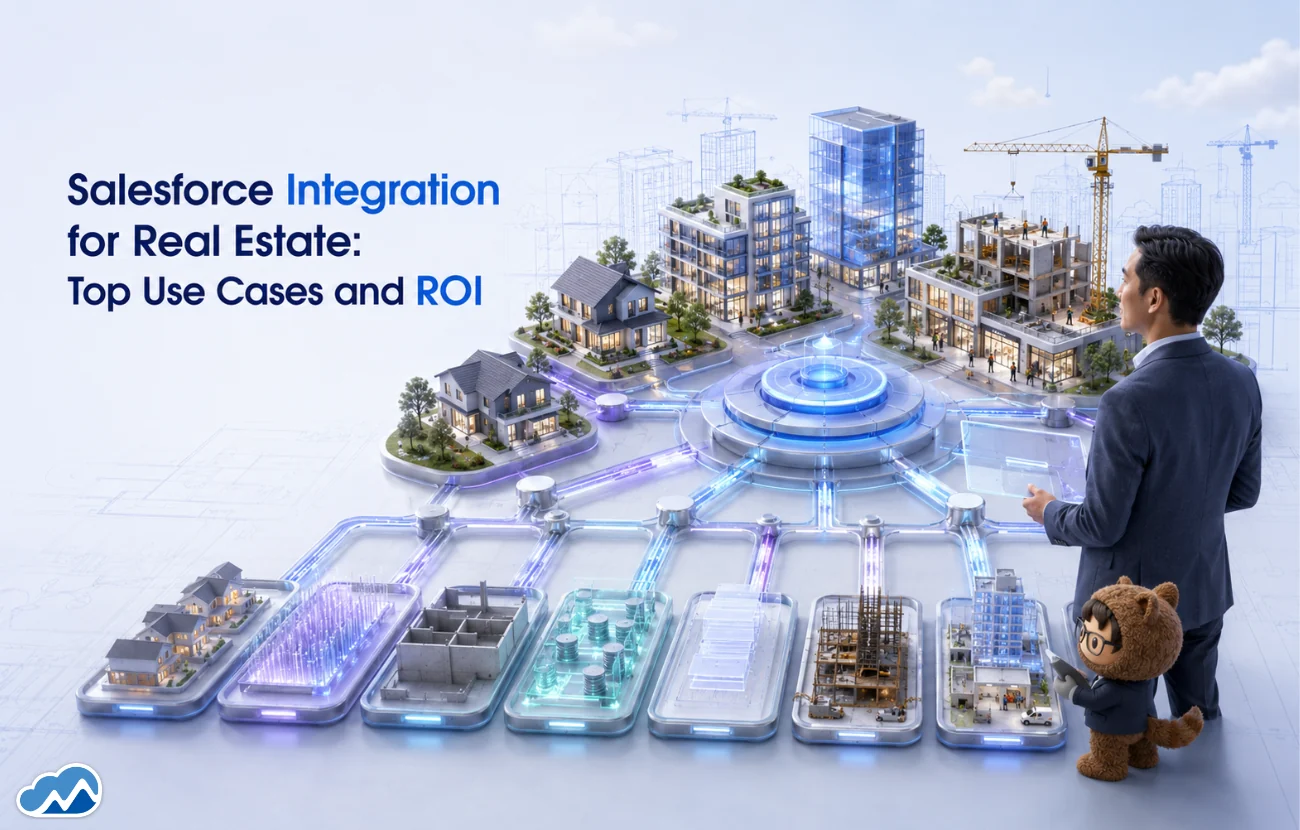
Salesforce Integration for Real Estate: Top Use Cases and ROI

Table of content
Real estate runs on a surprising number of tools. Listing portals, a marketing platform, document signing, accounting, communication apps, and Salesforce sitting somewhere in the middle. When those systems do not talk, agents become the integration: copying details from a portal into the CRM, re-keying a signed deal into accounting, updating the same contact in three places. Salesforce integration for real estate is how you stop paying people to move data by hand, and this guide covers the use cases that deliver the clearest return.
Here is where Salesforce integration for real estate earns its keep, and how to think about the ROI.
What Salesforce Integration for Real Estate Means
Salesforce integration for real estate is the work of connecting Salesforce to the other systems a property business relies on, so data flows between them automatically instead of being re-entered by hand. The point is not integration for its own sake. It is removing the manual copy-paste that slows agents down and quietly introduces errors.
The industry context for this is in our Salesforce for Real Estate guide, and the wider view of Salesforce across industries is in our Salesforce for Every Industry guide. This piece focuses on the specific integrations that matter for property businesses.
Top Use Cases
A few Salesforce integration for real estate patterns come up again and again.
Listing and portal sync. Connecting Salesforce with the portals where properties are listed and leads come from, so enquiries land against the right record instantly and stock stays accurate.
Marketing integration. Linking your marketing platform so campaigns feed leads into Salesforce and engagement flows back, and no lead goes cold in a gap between systems.
Document signing and management. Connecting e-signature and document tools so a deal moving through the pipeline generates and tracks the paperwork without manual chasing.
Accounting and finance. Syncing closed deals into accounting so nobody re-keys numbers, and the sales and finance pictures agree.
Communication channels. Wiring in phone, email and messaging so every interaction is logged against the right contact automatically.
The ROI of Integration
The return on Salesforce integration for real estate is concrete. The obvious gain is time: hours saved every week that agents were spending moving data between systems, redirected into actually selling. The second is speed, because integrated lead capture means faster response, and in real estate speed-to-lead is often the whole difference between winning and losing a deal. The third is accuracy, because data entered once and synced beats data typed three times and drifting apart.
Add those up and the case is straightforward: less manual work, faster follow-up, cleaner data, and fewer deals lost to slow or dropped handoffs. For most agencies, the time saved alone pays for the integration.
How the Integration Is Built
Much of this is real integration engineering, connecting systems through their APIs with proper error handling so a failed sync surfaces as an alert rather than a silent gap.
The underlying discipline is covered in our Salesforce API Integration Services guide, and for the systems that have no ready-made connector, our Custom Salesforce API Integration guide covers building bespoke connections. And because integration often runs alongside cleaning and moving existing data, our Salesforce Data Migration guide is a useful companion.
Frequently Asked Questions
Agentforce for Financial Services: AI-Driven Banking & Insurance Solutions













.webp)


















n8n Workflow Automation: From Lead Capture to CRM in Minutes, Not Hours





%20(1).webp)