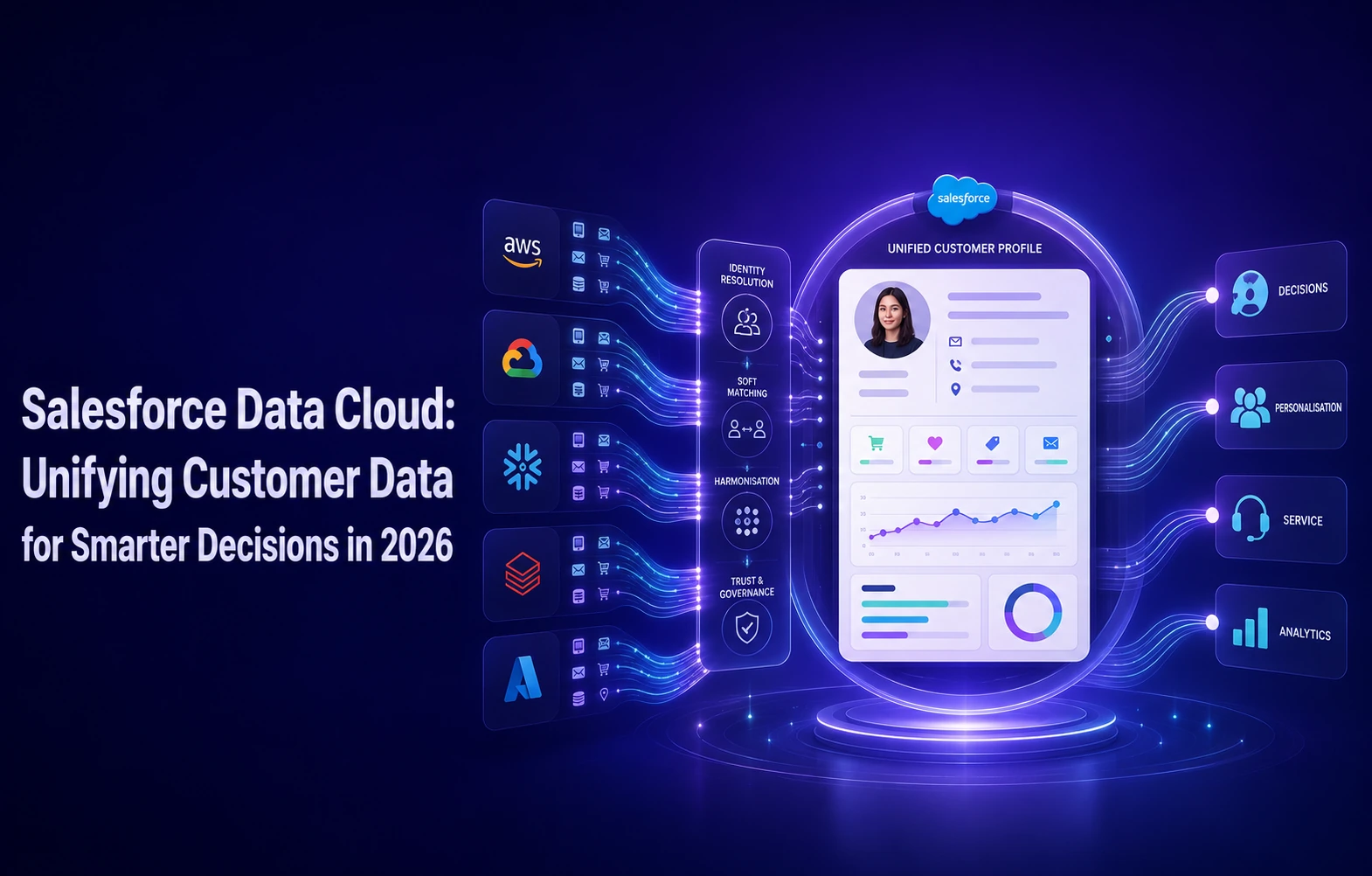
Salesforce Data Cloud: Unifying Customer Data for Smarter Decisions in 2026

Table of content
Here's a question worth sitting with: how many different versions of the same customer does your business currently hold? Sales knows them one way, support another, marketing a third, the billing system a fourth. Same person, four records, four spellings of their name, four slightly different stories. And every team is quietly certain their version is the right one.
That's the mess a 360-degree customer view is supposed to fix, and it's the mess most companies still live in. Stitching those fragments into one real, current picture of each customer is exactly what Salesforce Data Cloud services are built to do. Not another database to add to the pile, a layer that unifies the ones you already have.
And in 2026 this has gone from a nice-to-have to the foundation everything else stands on, because the AI everyone wants is only ever as good as the data underneath it. So let's talk about what Data Cloud actually does, and why unified data suddenly matters more than it ever has.
What Data Cloud Actually Is
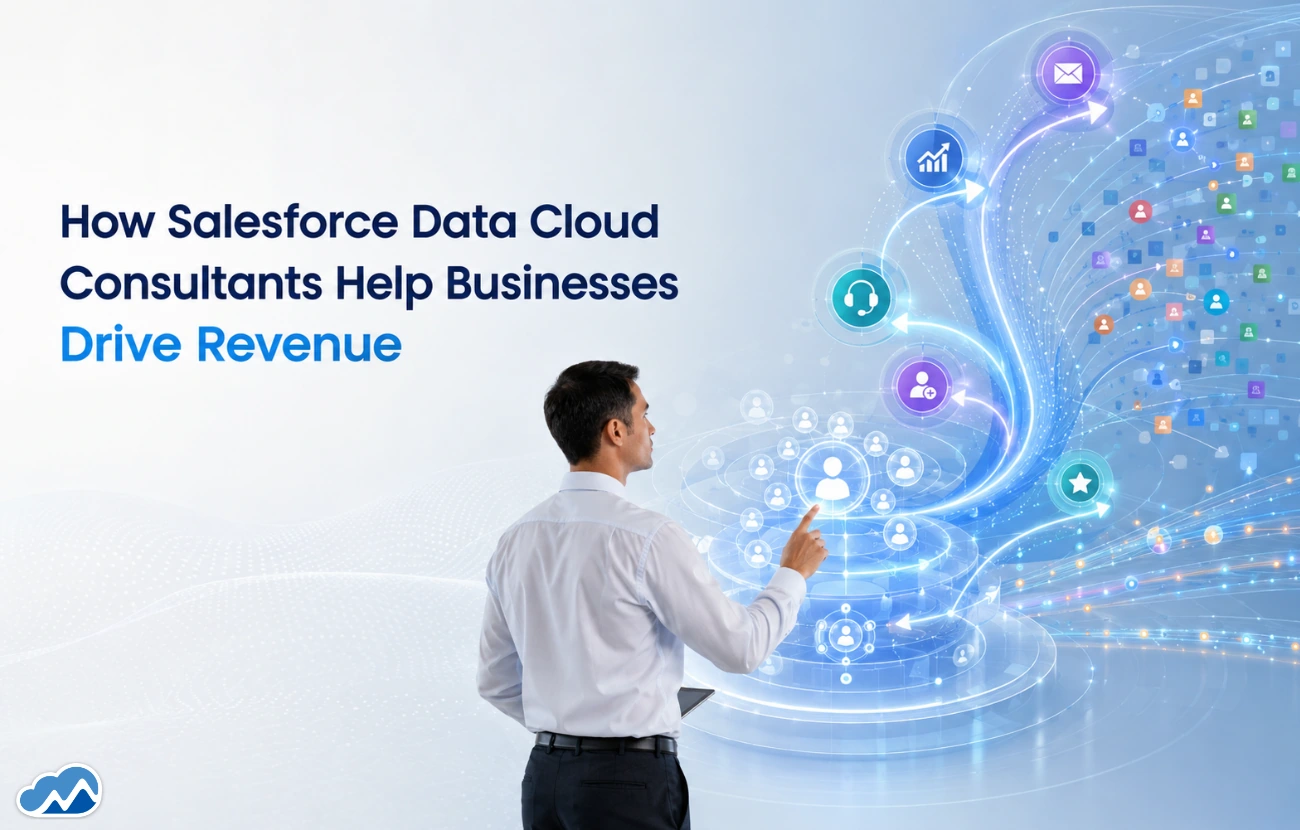
Data Cloud is Salesforce's platform for unifying customer data. It pulls information from across your systems, Salesforce and non-Salesforce, and resolves it into a single, real-time profile of each customer that the rest of your tools can then use. Think of it as the layer that finally makes "one view of the customer" true rather than aspirational.
The important thing to understand is what it isn't. It isn't just another place to dump data, and it isn't a traditional warehouse you query overnight. Salesforce Data Cloud services are about bringing your existing data together, matching records that belong to the same person, and making that unified profile available instantly, everywhere it's needed. The goal isn't to store more. It's to finally make sense of what you already have.
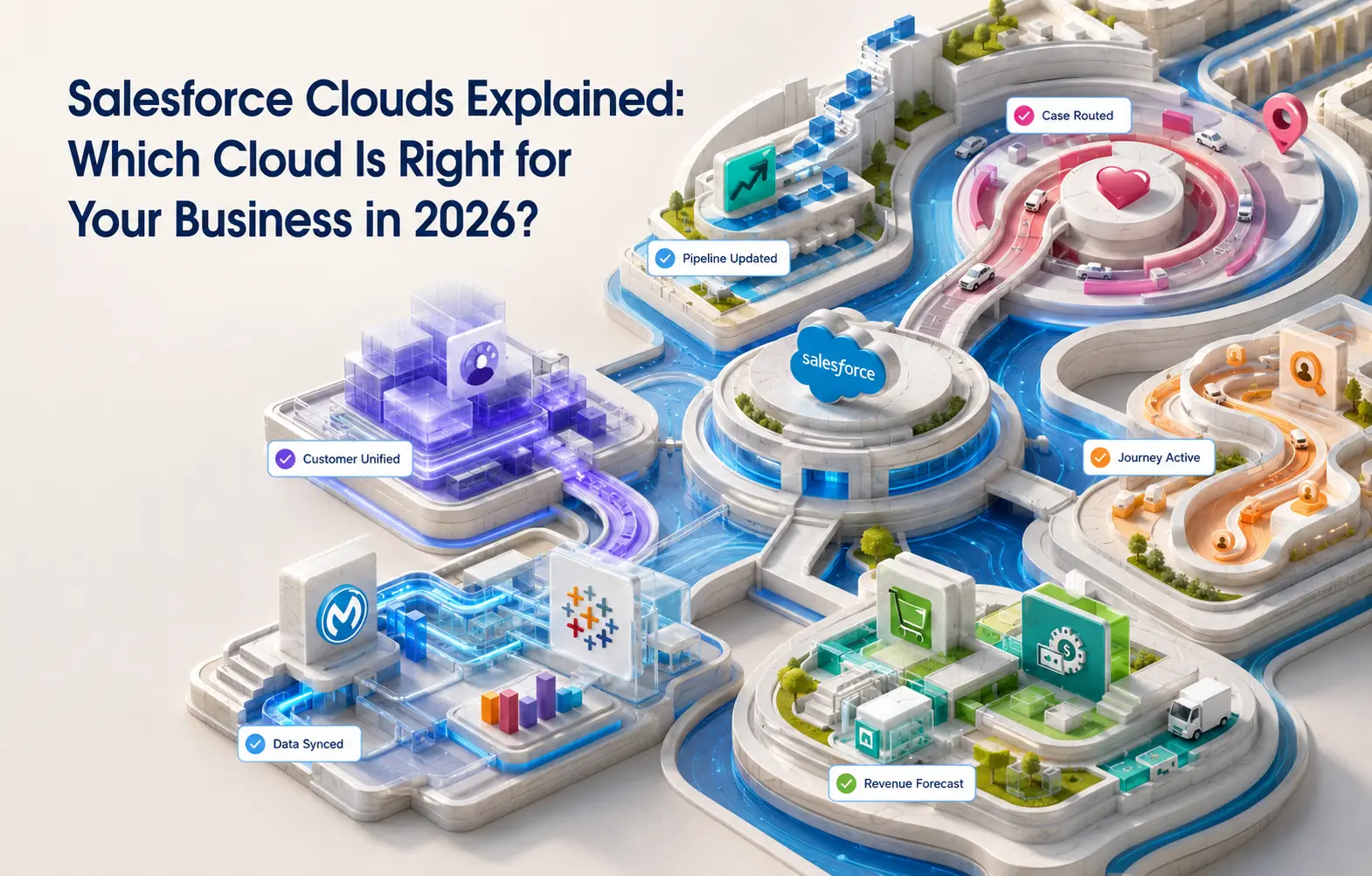
Data Cloud is one piece of the wider Salesforce picture. If you're still mapping which clouds your business needs, our Salesforce Clouds Overview covers how they fit together. This guide is about what Data Cloud does and why unified data has become the thing everything else depends on.
Why Unified Data Is Suddenly the Whole Game
For years, unifying customer data was the project that never made it to the top of the list, important, but rarely urgent. That's changed, and AI is why. Every impressive thing businesses now want from AI, Einstein predictions, Agentforce agents that resolve real cases, personalisation that actually feels personal, depends entirely on the quality and completeness of the data feeding it.
Feed AI fragmented, contradictory data and it produces confident nonsense, at scale. Feed it a unified, current view of each customer and it becomes genuinely useful. That's why Salesforce Data Cloud services have moved from the back of the queue to the front: they're the foundation the whole AI story is built on. Skip this layer and everything above it wobbles.
What Data Cloud Does That a Warehouse Doesn't
It's fair to ask how this differs from the data warehouse you might already have. The difference is in three things a warehouse typically doesn't give you.
It works in real time. A warehouse usually updates on a schedule, overnight or hourly. Data Cloud is built to unify and update profiles as things happen, so the picture is current when a customer is actually in front of you, not as of last night.
It resolves identity. A warehouse stores your records; it doesn't necessarily know that four of them are the same person. Data Cloud's job is precisely that matching and merging, turning fragments into a single profile.
It activates the data. This is the big one. A warehouse is somewhere data goes to be analysed. Data Cloud pushes the unified profile back out into the tools that act on it, marketing, sales, service, AI, so the data does something rather than just sitting there. That activation is the heart of what Salesforce Data Cloud services deliver.
Identity Resolution: Turning Five Records Into One Person
This deserves its own moment, because it's the part that quietly makes everything else possible. Your customer signed up with a work email, bought with a personal one, phoned support from a mobile the system doesn't recognise and appears three more times with typos in the name. To every system, that's several different people.
Identity resolution is the process of recognising that they're all the same person and building one profile from the pieces. Get this right and suddenly every team sees the whole customer, complete history, all interactions, one truth. Get it wrong, or skip it, and you've just centralised the confusion. It's detailed, unglamorous work, and it's exactly where good Salesforce Data Cloud services earn their value.
Real-Time, Not Overnight
The real-time nature matters more than it sounds. Imagine a customer browses your site, then phones support ten minutes later. With overnight data, your agent has no idea about that visit. With Data Cloud, the profile already reflects it, and the conversation can be relevant to what the customer is actually doing right now.
Multiply that across every interaction and you get a business that responds to customers as they are in the moment, not as they were yesterday. That immediacy is a large part of why unified, real-time data has become the thing worth investing in, and why a proper implementation focuses as much on freshness as on completeness.
Where AI Comes In
This is the payoff, and the reason the timing matters. Once your data is unified and current, the AI layer finally has something solid to stand on. Einstein predictions get sharper. Agentforce agents can resolve cases confidently because they can see the whole customer. Personalisation stops guessing because it knows who it's talking to.
None of that works on fragmented data. It's genuinely that simple. This is why the smartest teams treat Salesforce Data Cloud services as step one and the AI ambitions as step two, in that order. Build the foundation, then let the intelligence stand on it. Reverse the order and you're just automating your data problems faster than before.
No Rip-and-Replace: Zero Copy and Integration
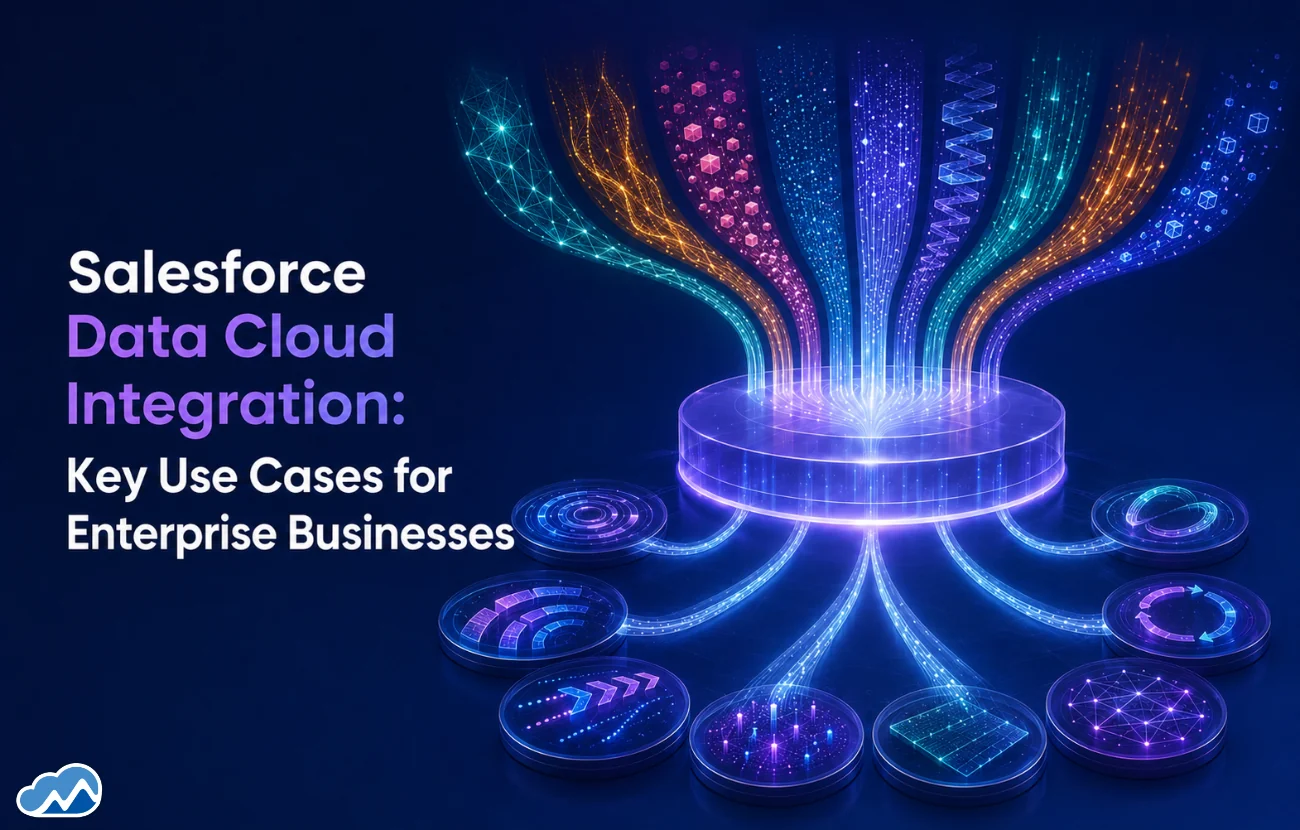
A fair worry at this point is whether unifying your data means ripping out the systems you already run. It doesn't. Data Cloud is designed to connect to what you have, including major data platforms like Snowflake, Databricks and BigQuery, and increasingly to work with data where it already lives rather than forcing yet another copy of everything.
That matters practically and financially. You're not migrating your whole world into a new system; you're placing a unifying layer over what exists. Good Salesforce Data Cloud services lean into that, connecting and harmonising rather than tearing out, so you get the unified profile without the disruption and cost of a full replacement.
What a Data Cloud Implementation Involves
People imagine this as a purely technical exercise. Most of the value is actually in the decisions. A sound implementation starts by working out which sources genuinely matter and what a unified customer profile should even contain. Then it connects and ingests those sources, harmonises them into a common shape, and does the careful identity-resolution work of matching records to real people.
From there it's about calculated insights, the useful metrics you want on every profile, and activation, pushing that unified data back into the tools and AI that will use it. As with any Salesforce work, the hard part isn't the plumbing; it's the thinking about what "one customer" means for your business. A partner who only wants to talk about connectors and never about your data strategy is one to be cautious of.
Mistakes We See in Data Cloud Projects
A few patterns come round again and again.
Unifying everything because you can. More data isn't the goal; the right data is. Pull in sources nobody will use and you add cost and noise, not value.
Skipping the hard identity work. Rushed matching produces a profile that merges the wrong people or misses obvious duplicates, which is worse than no unification at all.
Treating it as a warehouse. If you unify data and never activate it back into your tools, you've built an expensive read-only report.
Leading with AI. Switching on agents and predictions before the data is unified gives you confident, wrong answers at scale.
No ongoing ownership. Sources change, new systems arrive, and a Data Cloud left unmaintained drifts out of accuracy.
Signs You Need Data Cloud
Not sure whether this is urgent? Run through these honestly.
The same customer exists differently in several systems and nobody can say which is right. Your teams argue about basic customer facts. Your "360 view" is really five partial views in a trench coat. You want to use AI seriously but suspect your data isn't ready, and you're right to suspect it. Personalisation feels generic because it's working from fragments. Two or three of those, and Salesforce Data Cloud services aren't a luxury, they're the groundwork you'll need before anything else you want to do will actually work.
Choosing a Data Cloud Partner
If you bring in help, a few things separate a partner worth keeping from one you won't.
They start with your data strategy, not their connectors. If the first conversation is all about ingestion and none about what "one customer" means for you, be wary.
They take identity resolution seriously, because that's the part that decides whether unification helps or just centralises the mess.
They plan for activation, not just storage, since data that never flows back into your tools delivers nothing.
They think about what comes next. Good Salesforce Data Cloud services are built as the foundation for AI and personalisation, not as a one-off tidy-up.
Frequently Asked Questions












Agentforce for Financial Services: AI-Driven Banking & Insurance Solutions








.webp)





n8n Workflow Automation: From Lead Capture to CRM in Minutes, Not Hours

%20(1).webp)