Salesforce Sales Cloud in 2026: Features, Benefits & Implementation Guide

Table of content

Ask your sales team, privately, how much they actually trust the forecast in Salesforce. Watch the faces. If you get a confident "completely," you're in rare company. Most of the time you'll get a shrug, and then the admission that the real pipeline lives in a rep's head, a private spreadsheet, or three sticky notes on a monitor.
That gap, between what Salesforce says and what the sales team believes, is almost never a software problem. It's an implementation problem. And it's exactly what a proper Salesforce Sales Cloud implementation is meant to close.
Here's the uncomfortable bit. Sales Cloud is a genuinely excellent product. But buying it and rolling it out well are two completely different things, and the second one is where most of the value, or the disappointment, actually comes from. Let's talk about how to get it right.
What Sales Cloud Actually Is (Beyond the Sales Pitch)
Strip away the marketing and Sales Cloud is one thing: the system where your entire sales process lives. Leads come in, opportunities move through stages, activities get logged, forecasts get built, and managers get a view of what's actually happening rather than what someone remembered to mention in the Monday meeting.
Done well, it's the single source of truth for revenue. Every rep works the same process, every deal follows the same stages, and the number at the top of the forecast is one people can actually stand behind. Done badly, it's an expensive place to store contact details that everyone quietly works around. The product is the same in both cases. The difference is the implementation.
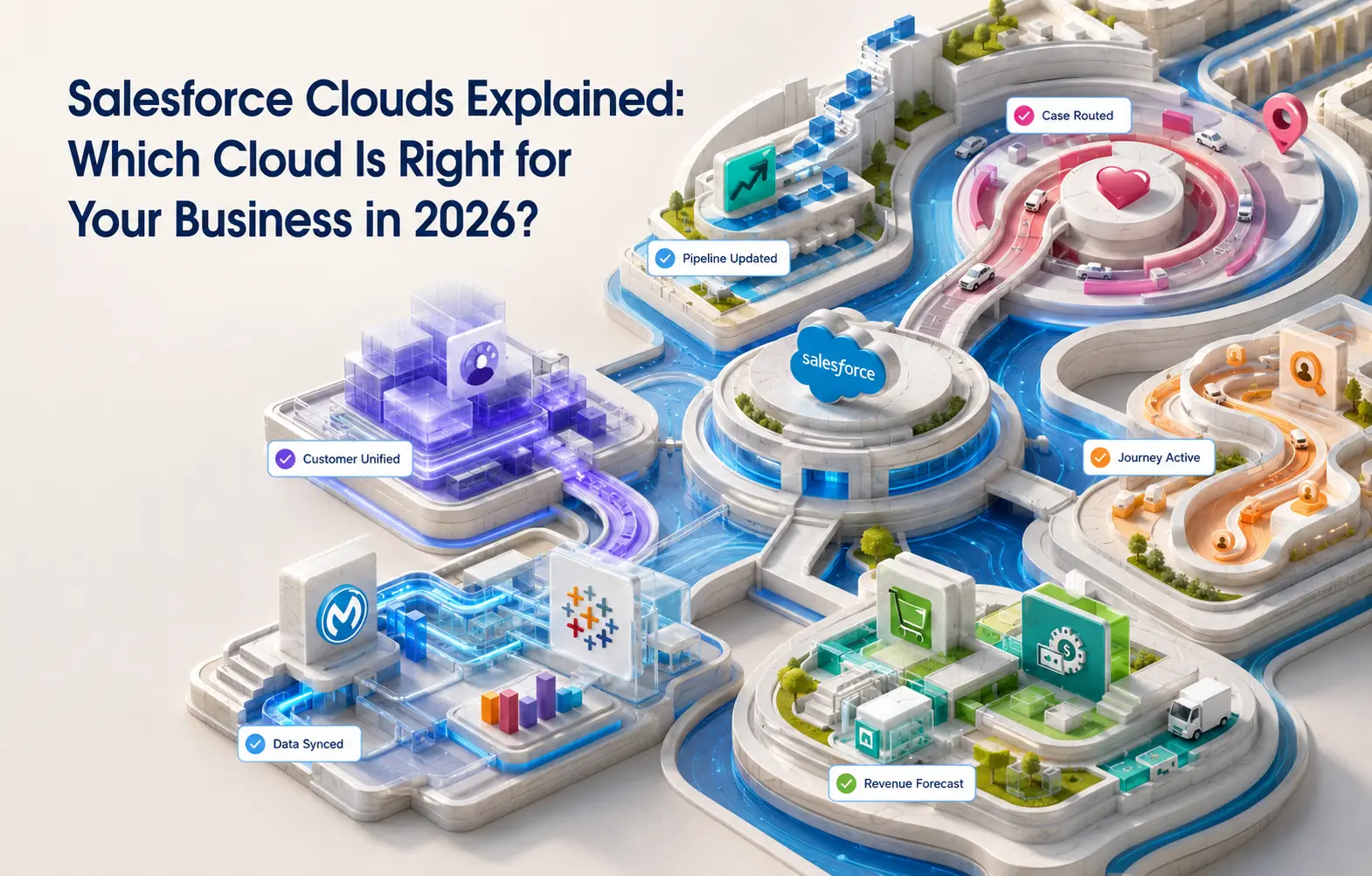
Sales Cloud is one of several Salesforce clouds, and if you're still deciding which ones you need, our Salesforce Clouds Overview walks through how they fit together. This guide stays with Salesforce Sales Cloud implementation itself, getting it live and working properly.
Why "We Bought Sales Cloud" Isn't the Same as "We Implemented It"
This is the misunderstanding that quietly wastes the most money. A licence gives you a powerful, almost empty platform. It doesn't know your sales process, your stages, your products, your rules or your definition of a qualified lead. All of that has to be built in, and that building is the implementation.
Skip it, or rush it, and you get the classic failure: a Sales Cloud that technically works but that nobody trusts or uses properly. Reps see it as admin overhead rather than a tool that helps them sell. Data goes in half-complete. Reports contradict each other. And within a year someone is asking whether Salesforce was worth it, when the honest answer is that it was never really implemented in the first place.
The Features That Actually Move the Needle
Sales Cloud has a long feature list. Most of it matters far less than the vendor demo suggests. Here's what genuinely earns its place in a good Salesforce Sales Cloud implementation.
Lead and opportunity management. The core. A clean path from raw lead to qualified opportunity to closed deal, with stages that mean the same thing to everyone. Get the stages wrong and every downstream report inherits the confusion.
Pipeline and forecasting. The reason leadership cares. When stages are honest and data is current, the forecast becomes a planning tool instead of a hopeful guess. This is where implementation quality shows up most visibly.
Activity capture and automation. Reps hate data entry, and every minute they spend on it is a minute not selling. Automating activity logging, follow-up tasks and stage updates is what turns Salesforce from a burden into something reps actually don't mind using.
Einstein and AI. Predictive lead and opportunity scoring, so reps focus on the deals most likely to close, plus AI-drafted summaries and next-best-action nudges. Useful, but only once the underlying data is clean enough to trust, which is another reason implementation order matters.
Mobile and reporting. A rep updating a deal from their phone after a meeting is worth more than a perfect desktop setup nobody touches until Friday. And dashboards that managers actually open are what keep the whole thing honest.
Where AI Fits Now, in 2026
The AI story in Sales Cloud has moved on. Einstein still handles the predictive layer, scoring leads and opportunities and surfacing insight. On top of that, Agentforce brings sales agents that can do work rather than just advise, researching accounts, drafting outreach and updating records, with a human in the loop where it matters.
It's genuinely useful, with one honest caveat: AI amplifies whatever data you feed it. Deploy it on a messy, half-implemented org and it confidently amplifies the mess. This is precisely why a solid Salesforce Sales Cloud implementation comes first, and the AI layer second. Sequence them the other way round and you've automated your problems.
What a Salesforce Sales Cloud Implementation Actually Involves
People imagine implementation as a technical setup. Most of it isn't. Here's the shape of a project that works.
It starts with discovery, mapping how your team actually sells today, not how a process document claims they do. Then the data model and stage design: opportunity stages, products, fields and the rules that keep data clean. Then automation, to take the admin load off reps. Then migration of your existing data, de-duplicated rather than dumped in. Then integration with the other systems in your stack, marketing, ERP, whatever feeds or consumes sales data. And finally, the part everyone underestimates: adoption. Training, rollout and iteration, because a system reps don't use is a failed project no matter how elegant the build.
Notice how little of that is code. The hard, valuable work is the thinking, the decisions, and the change management. A partner who only wants to talk about technical configuration and never asks how your reps actually work is one to be wary of.
The Benefits, Honestly
When it's done right, the payoff is real and specific. Reps spend less time on admin and more time selling. Managers get a forecast they can plan against. Deals stop falling through cracks because follow-ups are automated rather than remembered. New hires ramp faster because the process is built into the tool. And leadership finally gets one version of the truth instead of reconciling three.
The honest caveat is that none of this is automatic. You don't get it from the licence. You get it from the implementation, and from maintaining the thing afterwards so it doesn't drift back into chaos. The benefits are real. They're just earned, not bought.
Mistakes We See in Sales Cloud Implementations
A few patterns show up so often they're almost predictable.
Too many required fields. Force reps to fill in fifteen boxes to save a record and they'll enter garbage to get past the screen. Now your clean-data plan has produced dirty data faster. Ask only for what you'll genuinely use.
Stages that don't match reality. If "proposal sent" means five different things to five reps, your pipeline is fiction. Stages need clear, shared definitions and exit criteria.
Building for management, ignoring reps. A system designed purely to give leadership dashboards, with no thought for whether it helps reps sell, gets quietly abandoned. Adoption is a design requirement, not an afterthought.
No plan for adoption. Dropping a new system on the team with a one-hour training session and hoping is how good builds die. Rollout and reinforcement matter as much as configuration.
Treating go-live as the finish. Sales processes change, and an org that isn't maintained drifts out of usefulness within a year.
Signs Your Sales Cloud Needs a Rethink
Not sure whether yours is working? Run through these honestly.
Your reps keep a "real" pipeline outside Salesforce. Nobody trusts the forecast enough to plan around it. Reports on the same question give different answers. Onboarding a new rep means teaching them the workarounds, not the system. Data entry is seen as punishment rather than part of selling. Two or three of those, and you don't have a Sales Cloud problem, you have a Salesforce Sales Cloud implementation that never quite landed, and it's fixable.
How to Choose a Sales Cloud Implementation Partner
If you bring in help, a few things separate a partner worth keeping from one you'll regret.
They ask about your sales process before your tech. If the first conversation is all about features and none about how you actually sell, that's a warning sign.
They design for adoption. Ask how they'll get reps to actually use it, not just how they'll configure it. A partner with no answer there is building you shelfware.
They think about what comes next. A good Salesforce Sales Cloud implementation is built to be maintained, integrated and extended, not handed over and forgotten.
And ideally they understand the whole platform, because sales rarely lives alone. The same customer your reps are selling to is the one your support team will look after in Salesforce Service Cloud, and a partner who sees both sides builds a Sales Cloud that plays well with the rest of your org rather than in isolation.
Frequently Asked Questions














Agentforce for Financial Services: AI-Driven Banking & Insurance Solutions













.webp)









n8n Workflow Automation: From Lead Capture to CRM in Minutes, Not Hours



%20(1).webp)