Deal Closes in HubSpot, Onboarding Starts Instantly: A HubSpot + n8n + Claude Playbook

Table of content

A deal closes in HubSpot on a Tuesday afternoon. The rep celebrates, updates the deal stage, and moves on to the next call. Three days later, the new customer still hasn't received a welcome email, nobody's created their account in the delivery system, and the onboarding specialist only finds out the deal closed because they happened to check the dashboard. That gap between “deal won” and “onboarding actually starts” is where a lot of goodwill quietly leaks out of an otherwise good sales experience. A properly built HubSpot n8n Claude workflow closes that gap entirely, moving a closed deal into a running onboarding process within moments, not days.
Does This Sound Like Your Handoff Right Now?
A quick check before we get into how the pieces connect.
- A deal closing in HubSpot doesn't automatically trigger anything in your onboarding or delivery systems.
- The onboarding team finds out about new customers by checking a dashboard or waiting for a Slack message, not through anything automatic.
- Welcome emails and kickoff scheduling happen whenever someone remembers to send them, not consistently within a set window.
- New customers have mentioned feeling like the enthusiasm from the sales process disappeared the moment they signed.
If two or more of those are true, the rest of this is worth the read before your next round of onboarding feedback comes in.
What Each Piece Actually Does in This Playbook
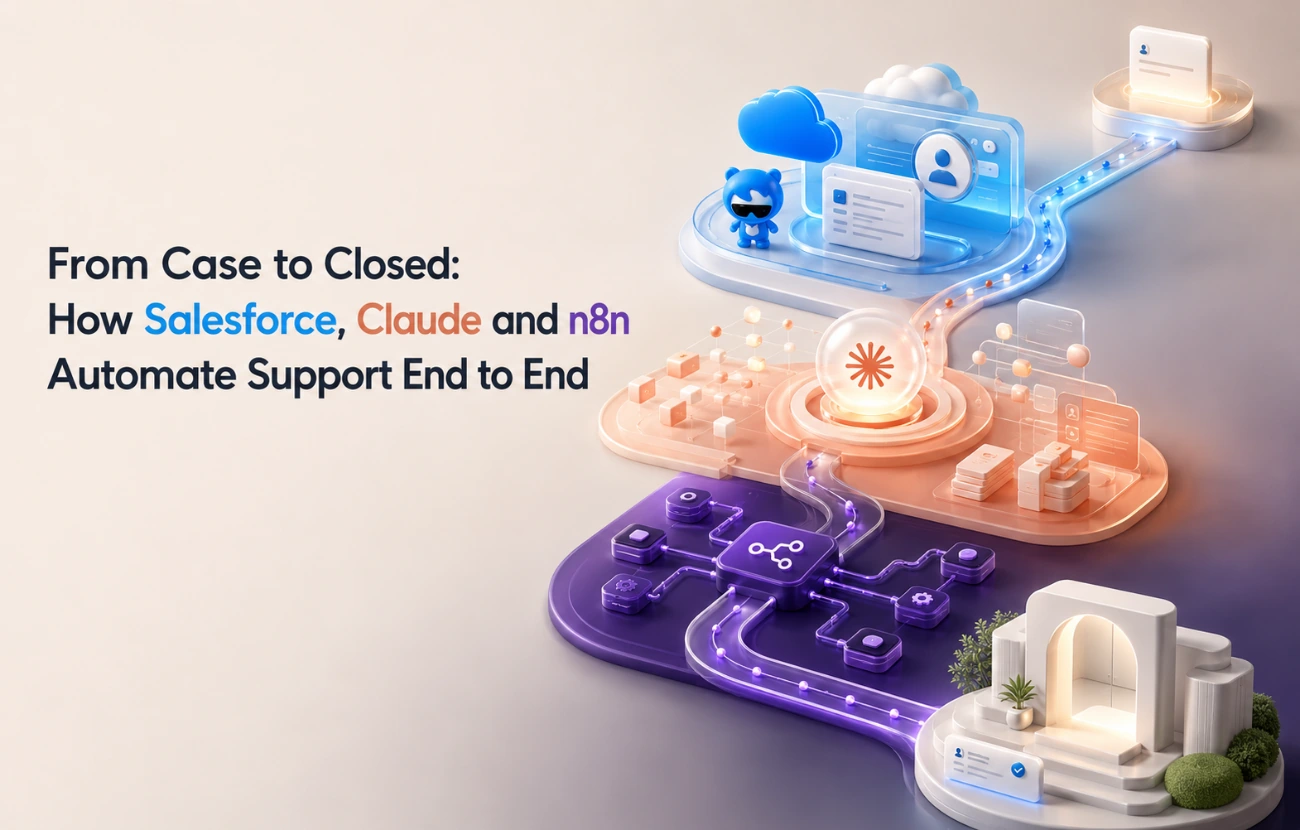
HubSpot is where the deal lives and where the close actually happens, the trigger point for everything that follows. n8n is the connective layer that notices the deal closed and carries that signal into every other system that needs to know, without anyone manually forwarding an email or updating a spreadsheet. Claude is the piece that adds judgment to the handoff, drafting a personalized welcome email based on what was actually discussed and sold, rather than a generic template that ignores the specifics of the deal. Together, closing a deal stops being the finish line for sales and quietly becomes the starting gun for onboarding, without a person having to fire it manually.
How the Workflow Actually Runs, Step by Step
Breaking this into an actual sequence makes the value concrete.
- A deal's stage changes to closed-won in HubSpot, and n8n picks up that change the moment it happens.
- n8n pulls the relevant deal details, what was sold, any specific terms or notes from the sales process, and any custom fields your team tracks.
- Claude drafts a personalized welcome email referencing the actual product or plan the customer bought, not a generic “welcome aboard” template.
- The draft queues for review, or sends automatically for well-defined, low-risk deal types your team has already trusted the process with.
- n8n creates the customer's account in your delivery or provisioning system and creates an onboarding task for the right team member.
- The onboarding specialist gets notified with full context already attached, instead of a bare notification that a deal closed.
The entire sequence, from deal closing to onboarding actively underway, can happen in minutes, not the days it often takes when the handoff depends on someone remembering to do it.
A Worked Example: From Signature to Kickoff Call
Seeing this in a specific scenario makes the mechanics clearer.
- A mid-market customer signs after a multi-week sales process, and their deal moves to closed-won in HubSpot the moment the contract is countersigned.
- n8n immediately pulls the deal record, including the specific package tier and any custom terms the rep negotiated.
- Claude drafts a welcome email referencing their specific plan and next steps, queuing for the rep's quick review since it's a larger deal.
- The rep approves it within minutes, and n8n sends it and simultaneously creates the customer's account in the delivery system.
- An onboarding task appears automatically in the right specialist's queue, with the welcome email and deal context already attached.
- The specialist schedules a kickoff call the same day, referencing details from the sales process the customer doesn't have to repeat.
The customer experiences a seamless handoff, not a multi-day silence, and nobody on your team had to manually orchestrate a single piece of it.
Picture This
A B2B software company had a well-oiled sales process but a noticeably rougher start to the customer relationship, since onboarding routinely began two to four days after a deal closed, depending on whether anyone remembered to flag it. After connecting HubSpot deal closure to an automated onboarding kickoff, with Claude drafting the welcome communication and n8n handling account provisioning and task creation, that gap collapsed to same-day in nearly every case. Customer satisfaction scores around the onboarding experience specifically started climbing within the first quarter, not because onboarding itself changed, but because it finally started when the customer's excitement was still fresh instead of after it had faded.
Where This Usually Goes Wrong
A handful of patterns show up repeatedly in playbooks like this that don't hold up in practice.
- Generic emails that ignore deal specifics — a welcome email that doesn't reference what the customer actually bought reads as an obvious template, undermining the personal touch the automation was supposed to add.
- No review gate for larger or unusual deals — auto-sending everything regardless of deal size or complexity risks a wrong or awkward message going out on exactly the accounts that deserve the most care.
- Account provisioning that doesn't match sales terms — if custom terms negotiated during the sales process don't carry through to what actually gets provisioned, onboarding starts with a mismatch nobody catches until the customer does.
- No visibility for the onboarding team into why something happened — a task appearing with no context forces the specialist to go hunting for the same information the automation already had.
Getting HubSpot n8n Claude workflow builds right means designing for all four from the start, since a customer's first real experience after signing is exactly the wrong place to discover a gap in the process.
Tuning the Line Between Automatic and Reviewed
Not every closed deal needs the same level of human oversight, and treating them all identically wastes either time or trust. A straightforward, well-understood deal type, the kind your team closes dozens of times a month with little variation, is a reasonable candidate for a welcome email that sends automatically once the pattern's been trusted through review for a while. A larger, more customized, or first-of-its-kind deal deserves a human glance before anything goes out, since the cost of a mismatched detail is higher and the deal itself is rarer, so the extra thirty seconds of review is cheap insurance. Getting this balance right usually means starting everything under review, then graduating specific deal types to automatic sending once you've built confidence the drafts are consistently accurate for that segment.
Keeping the Onboarding Trigger Reliable
A workflow that fires perfectly in testing still needs to hold up months later when a rep changes a deal stage by mistake or a field goes unexpectedly blank. It's worth building a few sanity checks into the trigger itself, confirming the deal actually has the fields the downstream steps need before kicking off account provisioning, rather than assuming every closed-won deal is uniformly complete. It's also worth deciding what happens if a deal gets accidentally moved back out of closed-won after the workflow has already fired, since an onboarding process that's already underway needs a defined way to pause or flag itself rather than continuing on autopilot. None of this is complicated to build, but it does need to be thought through before the first edge case shows up in production rather than after a customer gets a confusing duplicate welcome email.
What Changes for the Sales and Onboarding Teams
The handoff itself stops being a task anyone has to remember, which changes the tone of the relationship between sales and onboarding more than people expect. Sales reps stop fielding “did you tell onboarding yet” questions, since the system handles that notification the moment the deal closes. Onboarding specialists stop losing the first few days of a relationship reconstructing context from a rep's memory or a hastily forwarded email thread, since the deal details arrive with the task automatically. The two teams end up trusting the handoff enough to stop double-checking it manually, which is really the point: not that the process got faster in isolation, but that nobody has to actively manage it once it's running.
Build It Yourself, or Bring in Help?
A single, simple trigger, deal closes, one email sends, is reasonable to attempt in-house with a small HubSpot setup. Where it gets harder is exactly what's covered above: pulling the right deal context into a genuinely personalized draft, deciding which deal types warrant review versus automatic sending, and making sure account provisioning actually reflects what was sold rather than a generic default. If you're weighing that decision, look at how a provider actually approaches HubSpot n8n Claude Workflow projects day to day, not just whether each tool is listed separately as a capability. Ask how they personalize communications based on actual deal data. Ask how they decide what needs human review. Ask how provisioning stays in sync with whatever custom terms sales actually negotiated.
How This Fits Into the Bigger Picture
This onboarding handoff is one specific, high-value play inside a broader pattern, connecting HubSpot, n8n, and Claude, often alongside Salesforce, so your tools behave like one connected system instead of four separate ones a person has to bridge by hand. For the fuller picture of what a connected stack looks like and the other plays worth building, our Connected AI Automation Stack Guide walks through the platform combination more broadly.
The point of a HubSpot n8n Claude workflow like this one isn't to make the moment of closing a deal feel more automated. It's to make sure the enthusiasm a customer feels the moment they sign doesn't sit idle for three days waiting for someone to notice, so their first real experience with your company after buying is momentum, not silence. That first impression, more than almost anything else in the relationship, is worth protecting with something more reliable than a person remembering to check a dashboard.
Frequently Asked Questions
.webp)














Agentforce for Financial Services: AI-Driven Banking & Insurance Solutions













.webp)









n8n Workflow Automation: From Lead Capture to CRM in Minutes, Not Hours



%20(1).webp)