HubSpot CRM Setup Done Right: Pipelines, Deal Stages and Custom Objects

Table of content
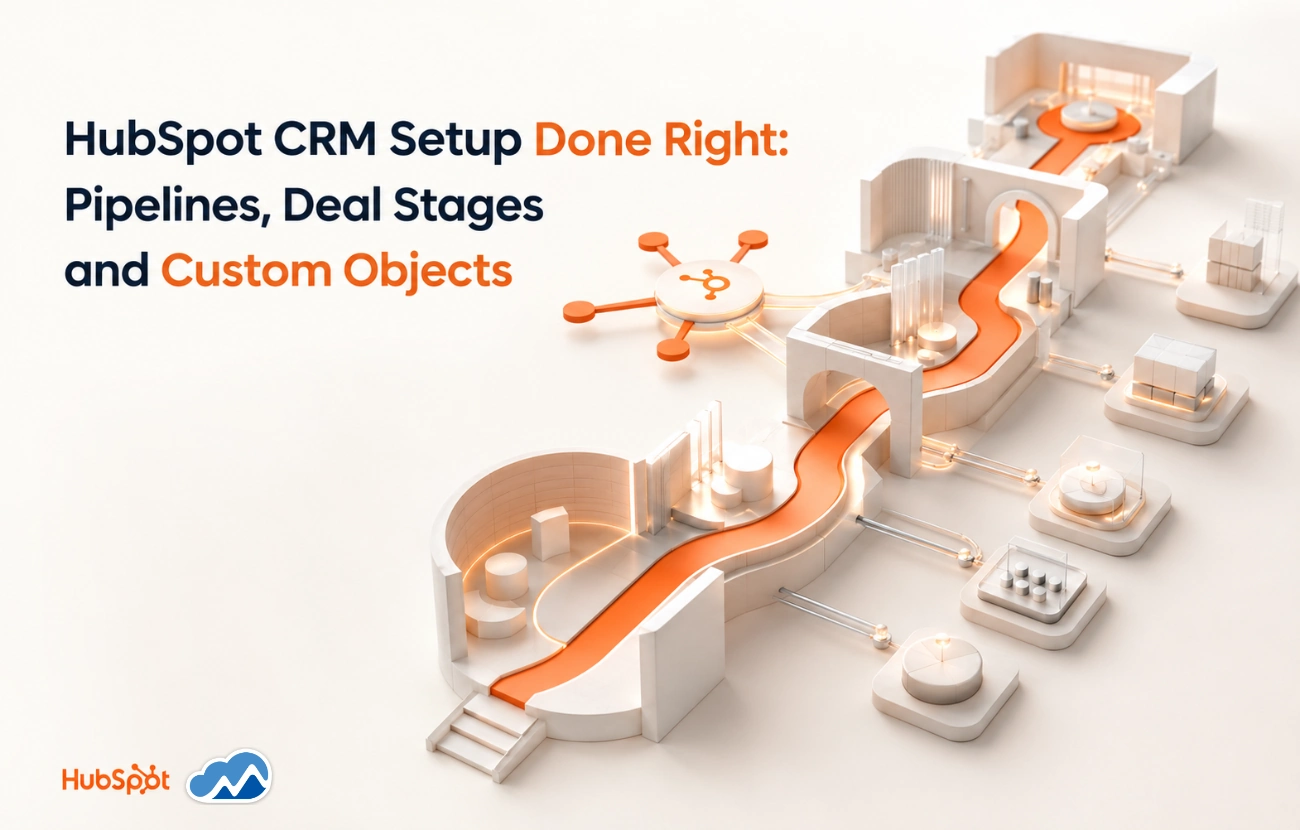
Open a brand new HubSpot portal and it already has a pipeline, deal stages and a handful of default properties waiting for you. That's the trap. It looks ready to use, so plenty of teams start entering deals into stages called “Appointment Scheduled” and “Contract Sent” without ever asking whether that's actually how their sales process works. A few months in, reports don't match reality, reps invent their own workarounds, and someone finally asks why the pipeline doesn't reflect what the team actually does. Proper HubSpot CRM setup means building the pipeline, the stages and the data model around your actual sales process before a single real deal goes into it, not adjusting it after the mess has already started.
Does Your Portal Look Like This?
A quick check before we get into the build itself.
- Your deal stages are still the HubSpot defaults, or close to it, and don't quite match the steps your reps actually go through.
- You've got one pipeline covering sales motions that are genuinely different, new business, renewals, upsells, all mixed into the same stages.
- Reps are using free-text fields or notes to track information that should really be a proper property.
- Reporting takes manual cleanup every time because the underlying data doesn't reliably capture what actually happened.
If two or more of those are true, the rest of this is worth the read before you build anything else on top of the current setup.
Pipelines and Deal Stages, Actually Explained
A pipeline is the overall path a deal moves through, and deal stages are the checkpoints along the way. That sounds obvious until you try to define stages for a real, messy sales process. Good stages represent a genuine change in deal status, not just an internal task getting done. “Proposal Sent” is a real stage because the deal state changed, the prospect now has something concrete in hand. “Follow-up email drafted” is not a stage, it's a task a rep did, and tracking it as a stage just adds noise. The test worth applying to every stage you're considering: would a manager, glancing only at the deal's stage, understand what's actually true about where that deal stands? If not, it's not a real stage.
What Custom Objects Actually Solve
Contacts, companies, deals and tickets cover a lot of ground, but not every business fits neatly into those four buckets. A company managing recurring service contracts might need a Locations object to track multiple sites under one account. A business with subscription renewals might need a Renewals object separate from the original Deal record, so the sales history and the renewal history don't get tangled together. The rule worth following: build a custom object when you have a genuinely distinct type of record with its own properties and its own relationships to track, not just because a spreadsheet tab existed for it once. Overbuilding custom objects creates a data model nobody but the person who built it can navigate.
Building It Step by Step
Doing HubSpot CRM setup properly follows a sequence, and skipping steps is exactly how you end up with the mismatched-defaults problem in the first place.
- Map the real sales process first: sit with actual reps and write down every step a deal genuinely goes through, before opening HubSpot at all.
- Design pipeline stages around that map: each stage should represent one real, observable change in deal status, nothing more, nothing less.
- Decide which properties are actually required: every mandatory field is friction for a rep filling it in. Require only what reporting or handoffs genuinely depend on.
- Build custom objects only where the standard objects don't fit: check whether a property on an existing object solves the problem before reaching for a whole new object type.
- Set permissions and ownership rules: decide who can edit which stages and properties before reps start entering live data, not after someone accidentally wipes a field.
- Test with a handful of real deals before rolling it out fully. A pipeline that looks right in theory sometimes reveals a gap the moment an actual rep tries to use it.
Skipping straight from step one to step six is the single most common shortcut teams take, and it's usually why a “finished” setup needs a redo within the year.
Picture This
A 12-person sales team had one pipeline handling both new business and renewals, with the same five deal stages trying to describe two genuinely different processes. Renewal deals sat awkwardly in stages named for a first-time sale, and reports on renewal performance were essentially unusable without manual filtering every month. After splitting into two pipelines, one for new business with stages that reflected a first sale, one for renewals with stages built around contract timing and risk, both teams could finally see accurate numbers without a spreadsheet cleanup first. Nothing about the underlying deals changed. The structure just finally matched how the two processes actually worked.
When You Actually Need Multiple Pipelines
A second pipeline isn't automatically the right call just because a team feels crowded in one. It's worth it when the sales motions are genuinely different, not just when the team is. New business and renewals is the classic case, since the steps, the timeline and the risk factors are fundamentally different. A separate self-serve or partner-referral pipeline is another common one, since those deals move through very different checkpoints than an outbound sale. If two motions share nearly identical steps, they usually belong in the same pipeline with maybe a property to distinguish them, not a full second pipeline duplicating structure that doesn't need duplicating. A rough test that works well in practice: if you can't describe the second process without using different verbs than the first, it probably deserves its own pipeline. If it's basically the same steps with a different label, it probably doesn't.
Where Setups Go Wrong
A handful of patterns show up again and again in HubSpot portals that need a redo.
- Too many required fields: reps route around mandatory fields they don't understand by entering junk data just to move past them, which is worse than an empty field.
- Deal stages that don't match real handoffs: if marketing, sales and service disagree about what a stage actually means, reporting across teams falls apart immediately.
- Custom objects built too early: building an object for a use case that turns out to be rare adds ongoing maintenance for a problem that didn't need solving that way.
- No naming conventions: properties named inconsistently by whoever built them that week make reporting and automation far harder to maintain later.
A properly planned HubSpot CRM setup avoids all four by mapping the real process first and only building what that process actually requires. It's worth revisiting that list every six months or so, since a setup that avoided these problems at launch can still drift into them as the team grows and new reps join without the same context the original build had.
What Changes Once It's Done Right
The clearest sign a setup is working is how little anyone has to think about it. Reports pull cleanly without manual cleanup because the stages and properties actually reflect what happened. Reps spend less time arguing about what a stage means because the definitions are unambiguous. And when leadership asks a question about pipeline health, the answer comes from the dashboard directly instead of someone building a one-off spreadsheet to sanity-check it first.
Properties Worth Getting Right Early
Beyond pipelines and objects, the individual properties themselves deserve some care before reps start typing into them. Dropdown properties with a fixed set of options keep reporting clean, since “Enterprise,” “enterprise,” and “Ent.” don't get counted as three different values the way free text does. Number and currency properties should be used for anything you'll ever want to sum or average, deal value obviously, but also things like employee count or contract length if those matter to your reporting later. And it's worth deciding early which properties are genuinely required versus merely useful, because a form with fifteen mandatory fields trains reps to rush through data entry carelessly just to get past it, which defeats the purpose of collecting that data in the first place.
Keeping the Data Clean After Launch
A well-built pipeline doesn't stay well-built on its own. Duplicate contacts and companies creep back in as new leads come through more than one channel, so it's worth setting up deduplication rules rather than relying on someone noticing manually. Stale deals, ones sitting untouched in a stage for months, quietly distort your pipeline reporting unless something flags them for review or automatically nudges them toward closed-lost. And as your process evolves, which it will, someone needs to own periodic reviews of whether the stages and properties still reflect how the team actually sells, rather than assuming a setup from a year ago is still accurate. None of this is complicated, but it does need an owner, or the clean setup you built slowly drifts back into the mess you started with.
Why Reporting Depends on Getting This Right
Every dashboard HubSpot can build sits directly on top of the pipeline and property structure underneath it. A beautifully designed report pulling from deal stages that don't mean anything consistent will still produce numbers nobody trusts, no matter how the chart looks. This is the part that's easy to underestimate during the initial build, since the setup work and the reporting work feel like separate projects when really the second one only works because the first one was done properly. Teams that skip straight to building dashboards on top of a shaky data model usually end up redoing both the structure and the reports a few months later, which costs more time overall than getting the foundation right from the start.
Build It Yourself, or Bring in Help?
A small, simple pipeline is reasonable to set up in-house, especially with a single straightforward sales motion. Where it gets harder is exactly what's covered above: knowing when a custom object is actually warranted, designing stages that hold up across multiple teams, and avoiding the required-field sprawl that creeps in over time. If you're weighing that decision, look at how a provider actually approaches HubSpot CRM Setup projects day to day, not just whether it's listed as a service. Ask how they map your sales process before touching the portal. Ask how they decide when a custom object is warranted versus overkill. Ask whether they document the data model so your team can maintain it afterward, and ask what a typical handoff looks like once the build itself is finished.
How This Fits Into the Bigger Picture
CRM setup is usually the first piece of a broader HubSpot engagement, and it's the foundation everything else gets built on, marketing automation, reporting, RevOps alignment across teams. Get the pipeline and data model wrong here and every later project inherits that mess. For the fuller picture of what a HubSpot engagement covers beyond setup, our HubSpot Consulting Services Guide walks through the platform more broadly, including where AI fits into the picture through Breeze.
Getting HubSpot CRM setup right isn't about making the portal look impressive on day one. It's about a pipeline that quietly tells the truth about where every deal actually stands, months after the initial build is a distant memory and nobody's thinking about it anymore.
Frequently Asked Questions
.webp)




















Agentforce for Financial Services: AI-Driven Banking & Insurance Solutions














.webp)



















n8n Workflow Automation: From Lead Capture to CRM in Minutes, Not Hours






%20(1).webp)