Salesforce for IT & Technology Companies: Scaling Growth with Smarter CRM

Table of content
Here's a paradox worth sitting with: technology companies build the tools that run everyone else's business, and yet a surprising number of them run their own go-to-market on a tangle of half-connected apps and spreadsheets. The company selling seamless software internally has marketing in one tool, sales in another, customer success in a third, and billing off doing its own thing. Growth papers over it for a while. Then it doesn't.
That's the quiet problem behind a lot of stalled scale-ups, and it's exactly what Salesforce for technology companies is built to fix. Not by adding another tool to the pile, but by putting the whole revenue engine, from first click to renewal, on one connected platform that can actually keep up with how fast a tech business moves.
Because tech doesn't sell like other industries. It runs on subscriptions, renewals, usage and speed, and a generic CRM built for one-off deals misses most of what matters. Let's look at what a purpose-built approach changes.
What "Salesforce for Technology Companies" Actually Means
This isn't a stock CRM with a tech logo on it. Salesforce for technology companies means shaping the platform around how software and IT businesses actually make money: recurring revenue, not one-time sales; the full lifecycle from lead to renewal, not just the initial close; and the speed and volume that come with product-led and high-growth motions.
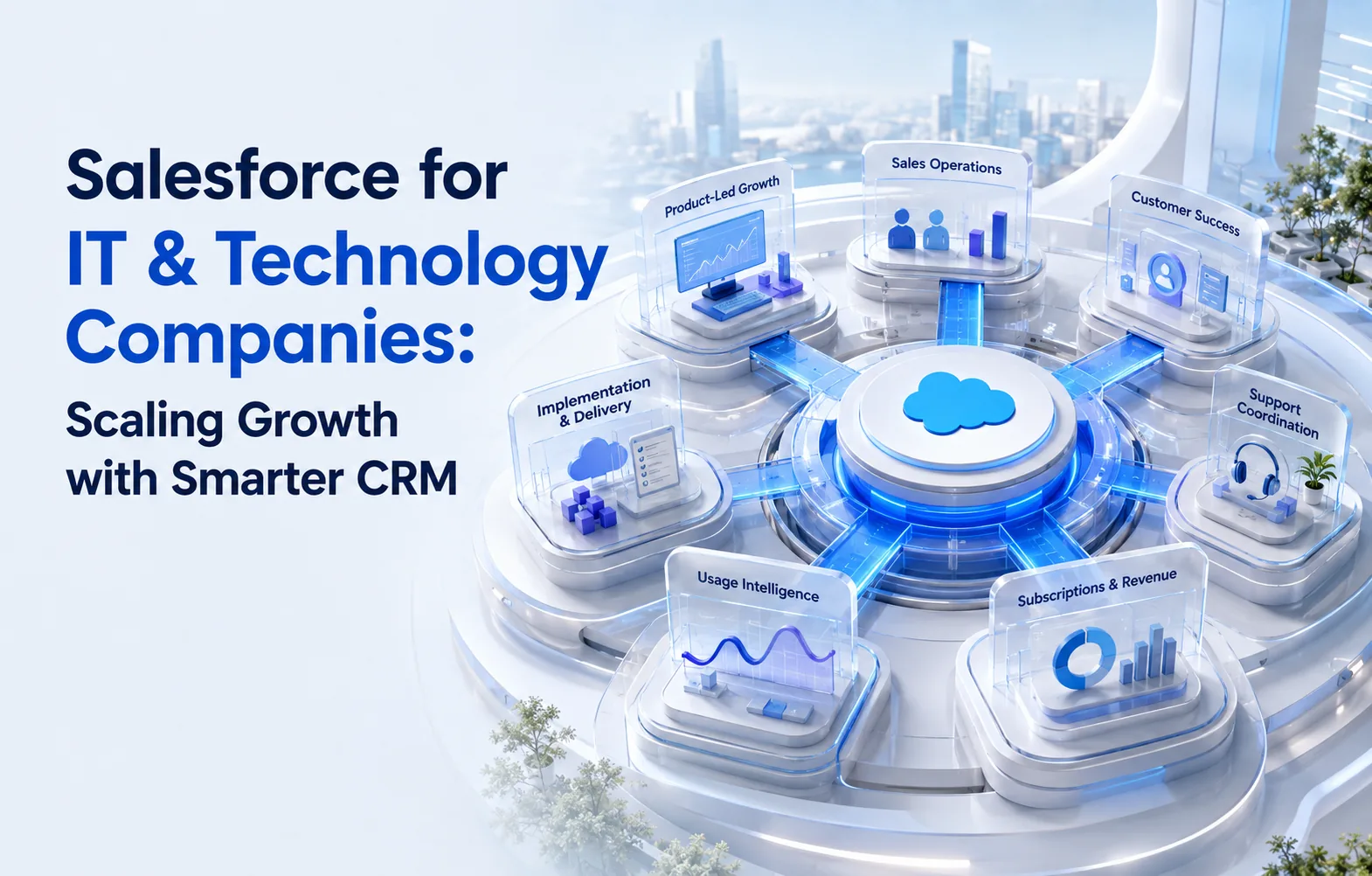
In practice that means Sales Cloud running the pipeline, Service Cloud and customer success keeping accounts healthy, subscription and renewal management giving you real visibility into recurring revenue, and the whole thing joined up so marketing, sales and customer success finally share one view of the customer. Where a generic CRM tracks deals and forgets them, Salesforce for technology companies tracks the entire relationship over its whole, renewing lifetime, which is where the real money in tech lives.
Technology is one of many sectors Salesforce is tailored for. For the broader picture, our Salesforce Industry Solutions guide covers how the industry approach works. This one is specifically about IT and technology companies.
The Problems Tech Companies Actually Have
A few pain points show up in nearly every software and IT business we talk to.
A disconnected go-to-market stack. Marketing, sales, customer success and billing each live in their own tool, so nobody sees the full customer journey and the handoffs leak.
Renewals and churn managed by memory. Recurring revenue is the whole model, yet renewals often depend on someone remembering, and churn gets noticed after it happens instead of before.
No clear view of recurring revenue. Leadership can't easily see committed ARR, upcoming renewals and expansion in one place, so forecasting the thing that matters most is guesswork.
Scaling chaos. Processes that worked at twenty people break at eighty, and a stack held together by manual work and goodwill can't keep pace with fast growth.
How Salesforce Helps
A well-built Salesforce for technology companies setup goes straight at those problems. One connected platform gives marketing, sales and customer success a shared view, so leads, deals and accounts flow through the funnel without falling through the cracks. Subscription and renewal management brings recurring revenue into the open, with renewals tracked automatically rather than remembered. Customer success tooling and health signals surface churn risk early, while your CRM shows expansion opportunities inside the existing base. And because it's built to scale, the platform grows with you instead of buckling at the next headcount milestone.
The throughline is simple: connect the whole revenue lifecycle in one place, and a fast-growing tech business finally gets the visibility and control that a patchwork stack can never give it.
RevOps: Where Tech Companies Win or Leak
It's worth dwelling on this, because RevOps, revenue operations, is where a lot of tech growth quietly leaks away. In a disconnected stack, a lead marketing generates, a deal sales closes and an account customer success manages are three separate stories in three separate tools, and the seams between them are where deals stall and renewals slip.
Bringing marketing, sales and customer success onto one platform turns those three stories into one continuous journey. Everyone works from the same customer record, handoffs are clean, and leadership can see the whole funnel from first touch to renewal. That alignment is one of the clearest reasons a scaling tech company invests in Salesforce for technology companies, because at speed, the leaks in the seams add up fast.
Where AI Fits
Tech is a natural home for AI, and it earns its place here in practical ways. Einstein can predict which accounts are at risk of churning and which are ripe for expansion, so customer success acts before a renewal is lost. Lead scoring helps a high-volume top of funnel focus on the prospects most likely to convert. And Agentforce agents can handle routine support and onboarding questions instantly, which matters enormously when a product-led motion sends thousands of users your way.
As always, the value depends on clean, unified data underneath, which is another reason to get the connected foundation right first. Built in the right order, AI turns a tech company's own funnel and usage data into sharper forecasting, earlier churn warnings and support that scales without a matching rise in headcount.
Getting the Implementation Right
The value is in the design, not just the deployment. A sound implementation starts by mapping how your revenue actually flows, from lead through close to renewal and expansion, and where it currently leaks. Then it builds the pipeline, the subscription and renewal model, the customer-success signals and the RevOps alignment around those realities, with the stack integrations that a tech company inevitably needs. And because tech moves fast, it's built to be extended and maintained, not shipped and forgotten. A partner who only talks features and never asks how your revenue engine works is one to be wary of.
Mistakes We See, and Signs You Need This
The common mistakes are predictable: treating a tech build like a generic deal-tracking CRM, ignoring the renewal and recurring-revenue model that defines the industry, and leaving marketing, sales and customer success in their silos.
As for whether you need it, be honest. Your go-to-market stack is a patchwork nobody fully sees across. Renewals depend on someone remembering, and churn surprises you. You can't easily see committed recurring revenue in one place. Processes that worked last year are breaking as you scale. Two or three of those, and Salesforce for technology companies isn't over-engineering, it's the control your growth is currently missing.
Choosing a Technology Salesforce Partner
A few things separate a partner worth keeping. They understand recurring-revenue and renewal models, not just one-off pipelines. They think in RevOps, aligning marketing, sales and customer success rather than automating one in isolation. They plan for the integrations and the scale a fast-growing tech business demands. And they build for the long term, so the platform keeps pace as you grow.
Frequently Asked Questions
.webp)
















Agentforce for Financial Services: AI-Driven Banking & Insurance Solutions











.webp)













n8n Workflow Automation: From Lead Capture to CRM in Minutes, Not Hours


%20(1).webp)