Retrieval-Augmented Generation Explained: How Claude Answers from Your Own Knowledge Base

Table of content
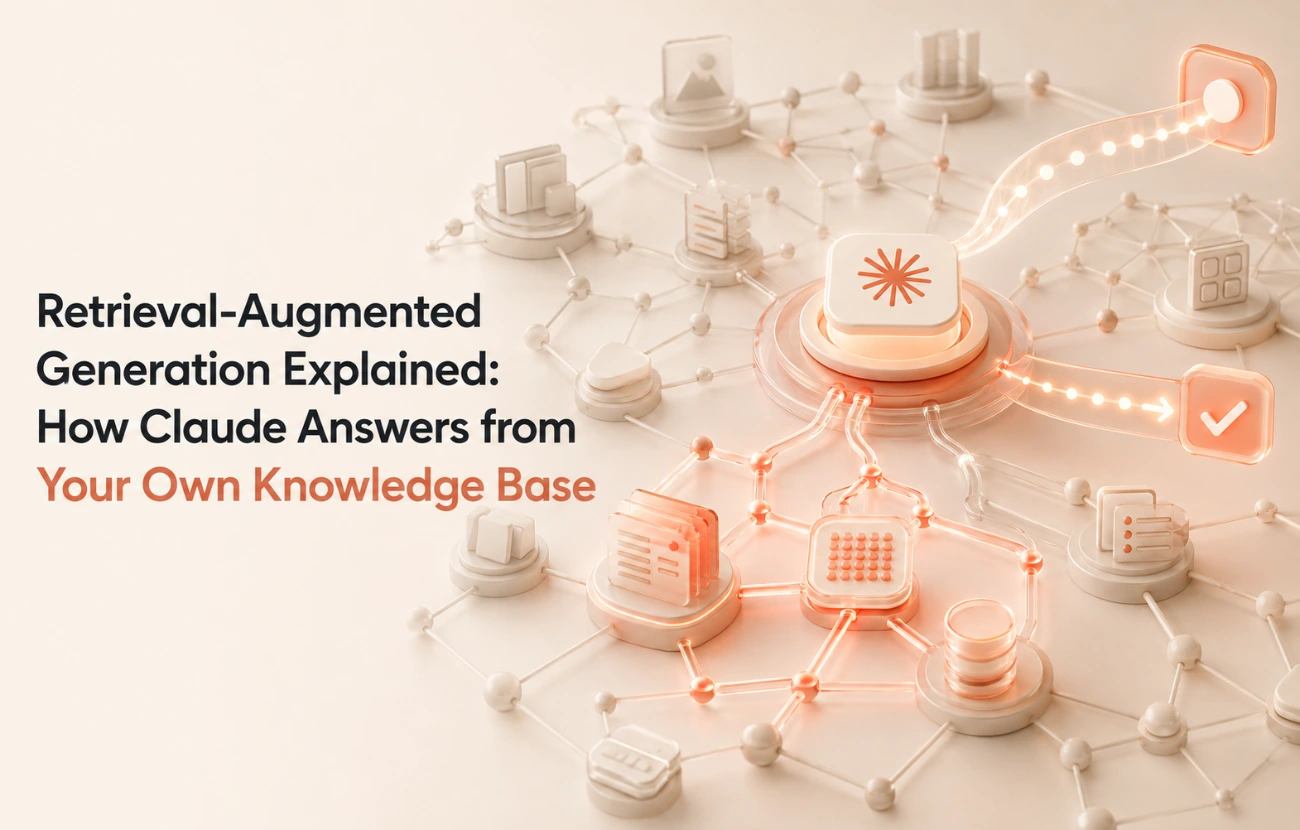
Ask a general AI model a question about your own company's return policy and it will answer confidently, fluently, and quite possibly wrong, because it has never actually seen your return policy. It's working from general training, not your specific documents, and it has no way to tell you that. RAG Claude AI setups exist to fix exactly this gap, grounding every answer in your own knowledge base, your docs, your policies, your product content, so the response is tied to something real your business actually wrote, not a plausible-sounding guess.
Does This Sound Like a Problem You've Hit?
A quick check before we get into how retrieval-augmented generation actually works.
- You've tried an AI tool and it confidently stated something about your own product or policy that simply wasn't true.
- Your internal documentation, wikis, PDFs, help articles, is scattered across enough tools that even your own team struggles to find the right answer quickly.
- You'd like an AI assistant for customers or staff but you're nervous about it making things up in front of someone who trusts the answer.
- Updating documentation feels pointless because whatever AI tool you've tried doesn't reflect the update anyway.
If two or more of those are true, the rest of this is worth the read before you build or buy anything else.
Retrieval-Augmented Generation, Actually Explained
The name sounds technical, but the idea underneath it is simple. Instead of an AI model answering purely from what it learned during training, months or years ago, RAG has it search your own content first, pull the specific, relevant passages, and then generate an answer grounded in what it just found. Think of the difference between asking someone to answer from memory versus handing them the actual manual and asking them to find the relevant page first. The second approach is slower by a fraction of a second, and dramatically more likely to be right, especially about anything specific to your business that a general model was never trained on in the first place.
Why This Matters More Than It Might Seem
A model answering from memory alone has two problems, and they compound each other. First, its knowledge has a cutoff date, so anything that changed since then, a new policy, a new pricing tier, a new product feature, simply isn't in there. Second, when it doesn't actually know something, it doesn't reliably say so. It generates a fluent, confident-sounding answer anyway, because that's what the underlying pattern-matching produces by default. RAG Claude AI addresses both at once: the retrieval step pulls current content, not stale training data, and grounding the answer in specific retrieved passages makes it far more likely the model sticks to what's actually there instead of filling gaps with a plausible guess.
How It Actually Works, Step by Step
Breaking retrieval-augmented generation into its real steps makes it far less mysterious.
- Your content gets indexed: documents, policies, product pages, support articles get processed and stored in a form that can be searched by meaning, not just exact keyword matches.
- A question comes in: someone, a customer or an employee, asks something in plain language, however they'd naturally phrase it.
- Relevant passages get retrieved: the system searches your indexed content and pulls back the specific chunks most relevant to that particular question, not the whole document library.
- Claude generates an answer from those passages: rather than answering from general training, the model reads the retrieved content and constructs a response grounded specifically in it.
- Sources can be cited: a well-built system shows which document or passage the answer came from, so a person can verify it rather than just trusting it blindly.
- Low-confidence cases get flagged: if nothing relevant was actually retrieved, the system should say so rather than falling back on an ungrounded guess.
The whole sequence typically takes a couple of seconds, invisible to whoever's asking the question, who just experiences it as getting a fast, accurate answer.
A Worked Example: Internal Support, Not Just Customer-Facing
RAG gets talked about mostly for customer chatbots, but internal use is just as valuable and often easier to justify first.
- An employee asks a casual question about expense policy, phrased naturally, not the exact wording used in the official document.
- The system retrieves the relevant policy section from indexed HR and finance documentation addressing that scenario.
- Claude answers in plain language, with a link back to the actual policy document for verification.
- Recent updates reflect immediately, since the answer pulls from the current document, not a stale training snapshot.
- Genuine gaps get flagged honestly rather than guessed at, and can route to a person who actually knows.
- Documentation gaps surface over time, since a question nobody's content actually answers is useful signal for what to write next.
Employees stop pinging HR for questions the documentation already answers, and HR gets a clearer picture of what's actually confusing people, both from the same system.
Picture This
A software company's support team was fielding the same handful of technical questions repeatedly, each time requiring someone to dig through scattered documentation to find the accurate current answer. After building a RAG system grounded in their actual product docs and past support resolutions, a meaningful share of those repeat questions started getting accurate, sourced answers immediately, day or night, without a support agent involved at all. The documentation didn't get any better on its own. What changed was that the right piece of it now surfaces automatically, in seconds, exactly when someone actually needs it.
Where RAG Builds Go Wrong
A handful of patterns show up repeatedly in retrieval-augmented generation projects that don't perform well.
- Poor content chunking: splitting documents into badly sized or badly bounded chunks means the system retrieves fragments that are technically relevant but missing crucial context.
- Stale or duplicate content in the index: if your knowledge base has three outdated versions of the same policy sitting around, retrieval might surface the wrong one with total confidence.
- No source citation: a system that gives answers without showing where they came from is harder to trust and impossible for a person to double-check quickly.
- No fallback for genuine gaps: if nothing relevant exists in the knowledge base, the system needs to say so, not quietly fall back to an ungrounded general answer.
Getting RAG Claude AI deployments right means treating the underlying content and the retrieval quality as seriously as the generation itself, since a perfect model reading badly retrieved content still produces a bad answer.
Keeping Your Knowledge Base Actually Current
A RAG system is only as good as what's sitting in the index, and content quietly going stale is one of the most common reasons a promising deployment degrades over time. It's worth setting up a real process for re-indexing content when documents change, rather than treating the initial index as a one-time setup. It's also worth periodically auditing for duplicate or conflicting versions of the same document sitting in different places, since retrieval can't tell which one is authoritative if both look equally relevant to a given question. Treating the knowledge base as a living thing that needs maintenance, not a folder you index once and forget, is what keeps answers accurate six months in instead of just on launch day.
RAG Versus Just Giving the Model a Bigger Context Window
A reasonable question worth addressing directly: why not just paste your entire knowledge base into the prompt instead of building a retrieval system at all? For a handful of short documents, that can genuinely work. It falls apart fast at real scale. A knowledge base of any meaningful size costs more to process in full on every single question than retrieving just the relevant handful of passages, and stuffing everything into context tends to bury the actually relevant section among a lot of irrelevant material the model has to sift through anyway. Retrieval solves both problems at once: it's cheaper per question since only relevant chunks get processed, and it's more accurate since the model is working from a focused set of passages instead of hunting through everything you own. For a small, static set of documents, the simpler approach is fine. For anything that grows or changes regularly, retrieval is what keeps the system both affordable and accurate as your content scales.
Measuring Whether Retrieval Is Actually Good
It's possible to have a RAG system that generates fluent, well-cited answers while still quietly retrieving the wrong content half the time, so it's worth measuring retrieval quality directly rather than just eyeballing whether answers sound reasonable. Track how often the system retrieves the passage a human reviewer would agree is actually the right source for a given question, not just whether an answer got produced at all. Track how often a person accepts the cited source as sufficient versus digging further on their own, since that gap reveals whether citations are genuinely useful or just decorative. And keep a running list of questions the system couldn't answer well, since that list is often the clearest roadmap for what documentation to write next.
Build It Yourself, or Bring in Help?
A small, single-source RAG setup is reasonable to attempt in-house, especially with a technical team and a modest, well-organized document set. Where it gets harder is exactly what's covered above: chunking content in a way that preserves context, keeping the index current as documents change, and building genuine fallback behavior for questions the content simply doesn't answer. If you're weighing that decision, look at how a provider actually approaches RAG with Claude projects day to day, not just whether retrieval is mentioned as a feature. Ask how they handle chunking for your specific content types. Ask how they keep the index synced as documents change. Ask whether the system cites sources and how it behaves when nothing relevant is found.
For how this same grounding approach applies to customer-facing conversations, our Claude AI Chatbot guide covers lead qualification and FAQ deflection, and our Claude Document Processing guide covers turning contracts and invoices into structured data using many of the same underlying principles.
How This Fits Into the Bigger Picture
Retrieval-augmented generation is the grounding layer underneath a lot of what makes a Claude deployment trustworthy, whether that's a customer chatbot, an internal assistant, or document-heavy automation elsewhere in the business. For the fuller picture of what a Claude engagement covers, including how it compares to other models and what to check before choosing a solution provider, our Claude AI for Business Guide is the place to start.
The point of RAG Claude AI was never to make answers sound more impressive. It's to make sure an answer is actually tied to something true your business wrote down, so the confident response someone gets is confident because it's grounded, not because a model is good at sounding sure of itself either way.
Frequently Asked Questions
.webp)
















Agentforce for Financial Services: AI-Driven Banking & Insurance Solutions














.webp)

















n8n Workflow Automation: From Lead Capture to CRM in Minutes, Not Hours



%20(1).webp)