Salesforce Service Cloud in 2026: The Complete Implementation Roadmap

Table of content
Think about the last time you contacted a company's support and had to explain your problem three times, to three different people, because none of them could see what the last one had done. Frustrating, wasn't it? Now consider that your own customers may be having exactly that experience with you, and you might not even know.
That disconnect, agents working blind, customers repeating themselves, tickets vanishing into a black hole, is the problem Salesforce Service Cloud implementation services are built to solve. Not by buying software, but by designing support properly around it.
Because here's the thing. Service Cloud can absolutely deliver the joined-up, fast, genuinely helpful support experience everyone wants. But only if it's implemented with a plan. Bolt it on without one and you've just given your agents a more expensive way to be disorganised. So let's walk through the roadmap that actually gets it right.
What Service Cloud Is (and What It Isn't)
Service Cloud is Salesforce's platform for customer service and support. Cases, channels, routing, knowledge, automation and reporting, all sitting on the same customer record your sales team uses. When a customer calls, the agent sees who they are, what they've bought, what they've asked before and what's still open. No repetition, no blind spots.
What it isn't is a magic fix you switch on. Out of the box it's a powerful, empty framework. Your channels, your case types, your routing rules, your SLAs and your knowledge base all have to be designed and built. That design work is the implementation, and it's where good support and expensive chaos part ways.
Service Cloud is one of several Salesforce clouds. If you're still mapping which ones your business needs, our Salesforce Clouds Overview covers how they fit together. This guide is the roadmap for getting Service Cloud specifically live.
Why You Need a Roadmap, Not Just a Licence
Support is more interconnected than it looks. A change to routing affects SLAs. Your knowledge base shapes what self-service and AI can deflect. Your channels determine how cases even arrive. Try to build all of it at once, with no sequence, and pieces collide, timelines slip and agents end up with a half-finished system they don't trust.
A roadmap turns that into something manageable: the right things built in the right order, each phase standing on the last. That's why the best Salesforce Service Cloud implementation services lead with a plan, not a feature checklist. It helps to know where Service Cloud sits in the wider stack before you commit to a sequence — our Salesforce Clouds Overview sets out which cloud does what and where the handovers happen. Here's what that plan looks like.
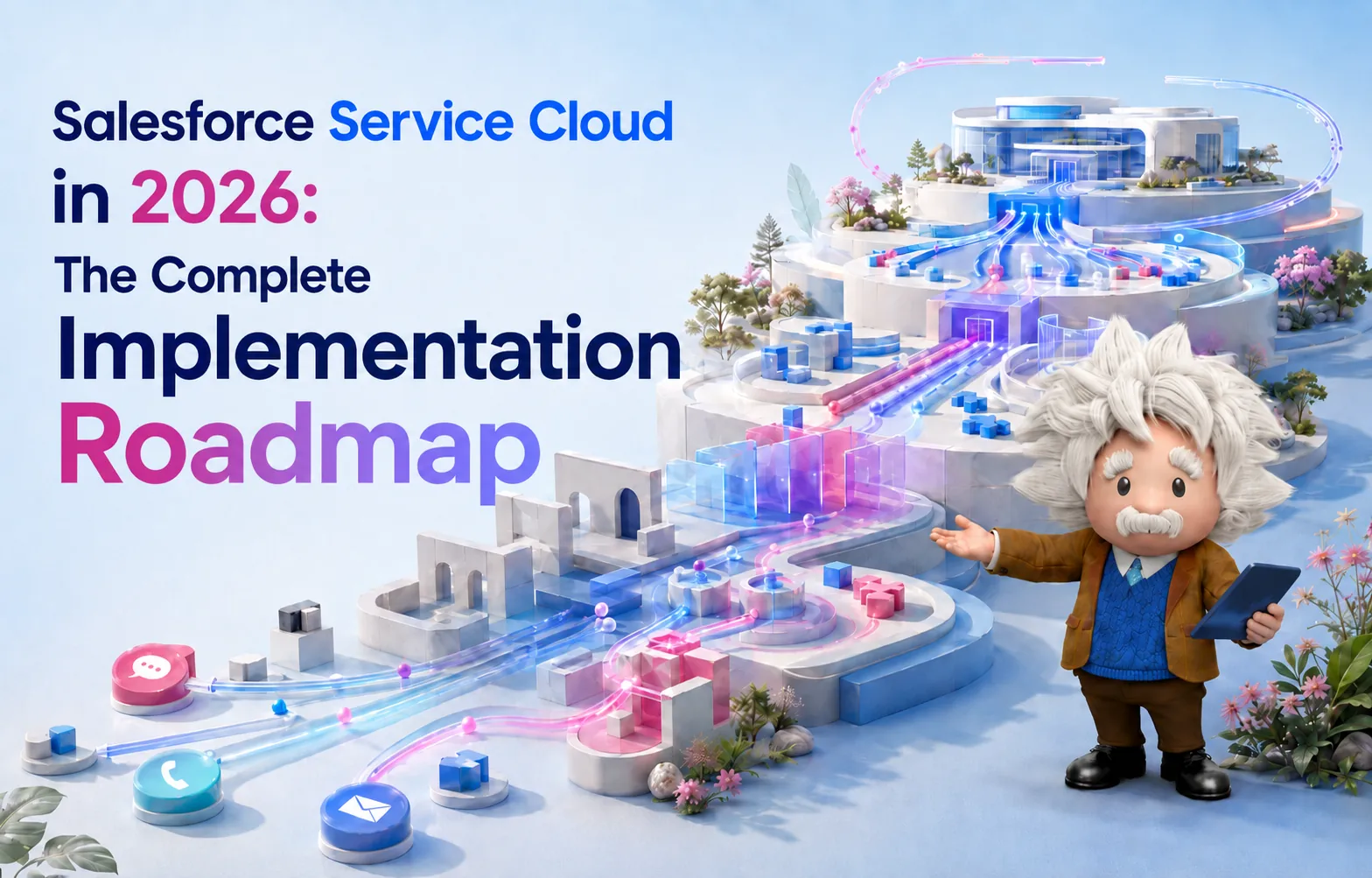
The Salesforce Service Cloud Implementation Roadmap
Phase 1 — Discovery and process mapping. Before anything is built, map how support actually works today: the channels customers use, the types of issue that come in, who handles what and where things currently break. Skip this and you'll automate your existing problems faster.
Phase 2 — Channels. Decide how customers reach you and wire each one in: email, phone, live chat, WhatsApp, social and a self-service portal. Every channel lands in the same place so no request falls through a gap.
Phase 3 — Case management and routing. The engine room. Case types, queues and Omni-Channel routing that sends the right issue to the right agent based on skill, workload and priority, instead of everything piling into one shared inbox.
Phase 4 — Knowledge base. Build the articles that let agents answer consistently and, just as importantly, power self-service and AI deflection. A good knowledge base is what stops your team answering the same question a thousand times.
Phase 5 — Automation and SLAs. Escalation rules, milestone tracking, macros and auto-responses. This is where response times become promises you can keep rather than hopes, with alerts before a breach instead of apologies after.
Phase 6 — AI. With clean data and solid knowledge in place, layer in Einstein for case summaries and next-best-action, and Agentforce service agents that can resolve routine Tier-1 cases autonomously while handing the hard ones to humans. Order matters here: AI on top of a good foundation is powerful; AI on top of chaos is just faster chaos.
Phase 7 — Reporting and dashboards. Give team leads a live view of volumes, response times, backlog and CSAT, so the operation is managed on evidence rather than gut feel.
Phase 8 — Go-live, adoption and iteration. Roll out with real training, watch how agents actually use it and refine. Support processes evolve constantly, so the launch is the start of the relationship, not the end of the project.
Where AI Changes Service in 2026
This is the phase generating the most excitement, and for once it's mostly justified. Agentforce service agents can now handle a genuine share of Tier-1 volume, resetting passwords, answering known questions, checking order status, resolving the routine cases that used to eat your team's day, and escalating anything they can't handle with the full context attached.
Done well, that frees human agents for the complex, high-value work where they actually make a difference. The honest caveat is the same as everywhere else: these agents are only as good as the knowledge base and data behind them. Which is exactly why AI sits at Phase 6 of a proper Salesforce Service Cloud implementation, not Phase 1. Build the foundation, then let the AI stand on it.
The Payoff, Honestly
When the roadmap is followed, the results are tangible. Customers stop repeating themselves because every agent sees the full history. Response times drop because routing and automation do the heavy lifting. Agents are less stressed because the system helps instead of fighting them. Self-service and AI deflect the routine questions, so the team handles fewer tickets but better ones. And leadership finally sees what's really happening in support instead of guessing.
The caveat, as ever, is that none of this comes from the licence. It comes from the implementation and from maintaining it afterwards. Skip the roadmap and you get all the cost of Service Cloud with little of the benefit.
Mistakes We See in Service Cloud Implementations
A few patterns come round again and again.
Building channels with no routing behind them. Adding chat and WhatsApp is easy; if cases from them just pool in one queue, you've added noise, not capability.
Ignoring the knowledge base. Teams rush to launch and treat knowledge as optional, then wonder why self-service and AI deflect nothing. The knowledge base is the foundation, not a nice-to-have.
Reaching for AI first. Switching on service agents before the data and knowledge are ready produces confident, wrong answers and erodes customer trust fast.
SLAs that look good on paper. Promising response times with no automation or alerting to enforce them just means you break them without noticing.
No owner after go-live. Support changes weekly, new products, new issue types, new channels. Without someone owning the org, it drifts out of step with reality.
Signs You're Ready (or Overdue) for This
Not sure whether it's time? Run through these honestly.
Customers regularly repeat information they've already given. Agents work from several disconnected tools and inboxes. You can't reliably say how long your team takes to respond. The same questions get answered manually over and over. Tickets slip because nothing routes or escalates automatically. Two or three of those, and proper Salesforce Service Cloud implementation services aren't a luxury, they're overdue, and you're already paying for the gap in churn and agent burnout.
Choosing a Service Cloud Implementation Partner
If you bring in help, a few things separate a partner worth keeping from one you won't.
They start with your support process, not a feature list. If the first conversation skips how your customers actually get help, be cautious.
They insist on the knowledge base and adoption. A partner who treats those as optional is setting you up to under-use the platform.
They sequence AI sensibly. Anyone promising to lead with autonomous agents before the foundation exists is selling a demo, not a result.
And ideally they understand the whole customer journey, because the person your support team helps in Service Cloud is the same one your reps sold to in Salesforce Sales Cloud. A partner who sees both sides builds support that connects to sales rather than sitting in its own silo.
Frequently Asked Questions














Agentforce for Financial Services: AI-Driven Banking & Insurance Solutions











.webp)









n8n Workflow Automation: From Lead Capture to CRM in Minutes, Not Hours



%20(1).webp)