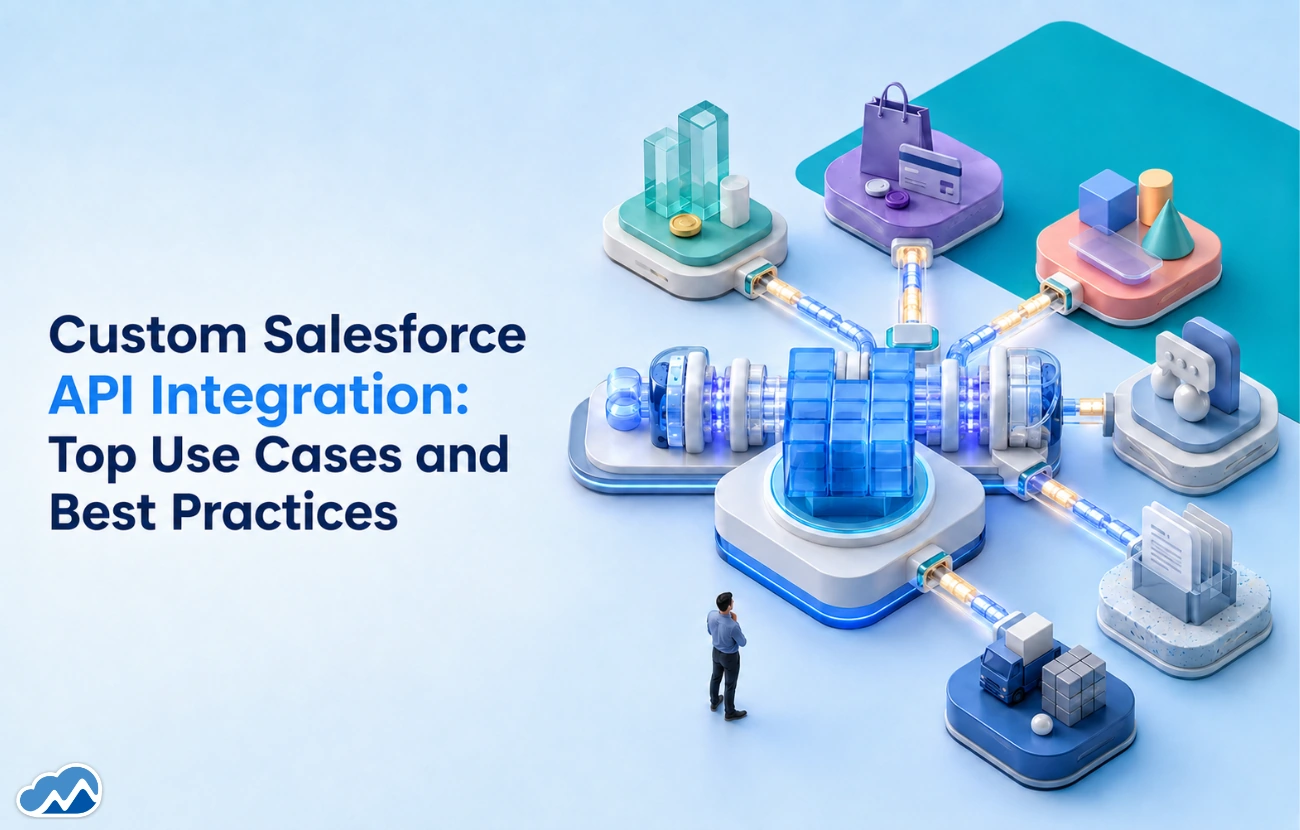
Custom Salesforce API Integration: Top Use Cases and Best Practices

Table of content
Most Salesforce integrations start simple. You connect a marketing tool, wire up a form, sync a spreadsheet, and the prebuilt connectors handle it. Then you hit the wall. The system you need to connect has no off-the-shelf connector, or the logic you need is more specific than any packaged option allows. That is the moment Salesforce custom API integration stops being optional and becomes the way forward.
This is a practical look at when custom integration is the right call, the use cases it solves most often, and the best practices that keep it reliable rather than fragile. No heavy jargon, just what actually matters.
What Custom Salesforce API Integration Means
A prebuilt connector is a ready-made bridge between Salesforce and a common tool, built by someone else, configured by you. Salesforce custom API integration is when you build that bridge yourself, using Salesforce's APIs, because no ready-made one fits. It lets Salesforce talk to almost anything that can expose or consume an API, on your terms, with your logic.
The trade is control for effort. A connector is faster to set up but bends you to its assumptions. A custom build takes more work but does exactly what your business needs. For anything beyond the common cases, that control is usually worth it, which is why Salesforce custom API integration is so common in businesses with real complexity.
If you want the broader picture of how Salesforce integrations work as a whole, our Salesforce API Integration Services Guide covers the full picture. This piece focuses on the custom side specifically.
When You Actually Need Custom Integration
You do not need custom work for everything, and a good partner will tell you when a connector is enough. You reach for Salesforce custom API integration when there is no packaged connector for the system you are integrating, when your logic is too specific for an off-the-shelf tool to handle, when you are connecting a system built in-house, or when you need real-time behaviour that a simple sync cannot provide. If your need is a handful of standard triggers, a connector may be the pragmatic choice. If it is bespoke, custom is the honest answer.
Top Use Cases for Custom Salesforce API Integration
The same requests come round again and again. Here is where custom work most often earns its place.
Salesforce to ERP. Connecting Salesforce to NetSuite, SAP, Dynamics or a similar system so a closed deal becomes an invoice and payment status flows back. This is the big one, usually driven by finance being tired of guessing.
Salesforce to a custom in-house application. A logistics platform, a scheduling engine, an underwriting system, something core that runs part of your business and has no connector waiting for it. These are almost always Salesforce custom API integration work, because nobody has built the bridge for you.
Salesforce to e-commerce and billing. Syncing orders, inventory, subscriptions and payments so a rep is never quoting stock that sold out or an amount that does not match billing.
Salesforce to telephony and messaging. Wiring in phone systems, WhatsApp or SMS so customer interactions land against the right record in real time.
Real-time, event-driven flows. Pushing an update the moment something happens rather than waiting for a scheduled sync, useful anywhere a delay is genuinely expensive, like a support system that needs to know instantly that an account went into arrears.
Which Salesforce API for Which Job
Part of doing Salesforce custom API integration well is picking the right API, because the wrong choice leads to slow syncs or hitting limits. REST API is the sensible default for most modern web and mobile integrations. SOAP API still shows up when the system on the other end is an older enterprise or banking platform that only speaks it. Bulk API is for volume, loading or syncing large numbers of records without burning through your limits one record at a time. And Streaming API or Platform Events handle the real-time cases, pushing changes out the moment they happen instead of making other systems ask repeatedly.
Best Practices That Keep It Reliable
A custom integration that works on day one but breaks quietly three months later is worse than no integration at all. A few practices keep it solid.
Use OAuth, never hardcoded credentials. Hardcoding is faster on day one and a liability forever after. Proper authentication is not optional when you are connecting to customer data.
Scope permissions to what the integration genuinely needs. If it only needs to read leads and write responses, it should not be running with full admin rights. This takes an extra hour and saves you an incident report.
Build error handling and retries from the start. Integrations fail quietly, a token expires, an API changes, and nobody notices until a customer does. Log every run, alert a real person on failure, and add sensible retry logic so a blip does not become a silent outage.
Design for API limits from day one. Salesforce caps API calls based on your edition and users. A poorly designed Salesforce custom API integration that polls every record every few minutes will hit those limits mid-quarter. Design for call volume upfront and use Bulk API for anything large.
Consider middleware when the stack grows. One or two connections can be point to point. Once you have several systems, or you know more are coming, middleware gives you one place for the logic, monitoring and retries you would otherwise rebuild in every connection.
Common Mistakes to Avoid
A few patterns cause most of the pain. Hardcoding credentials because it is quicker. Giving an integration far more access than it needs. Skipping error handling, so failures go unnoticed for weeks. Ignoring API limits until a sync falls over in production. And syncing everything because you can, which adds cost and noise without adding value. Avoid these five and most of the risk in Salesforce custom API integration disappears.
Frequently Asked Questions
.webp)
.webp)
.webp)

















Agentforce for Financial Services: AI-Driven Banking & Insurance Solutions













.webp)















n8n Workflow Automation: From Lead Capture to CRM in Minutes, Not Hours





%20(1).webp)