From Case to Closed: How Salesforce, Claude and n8n Automate Support End to End

Table of content
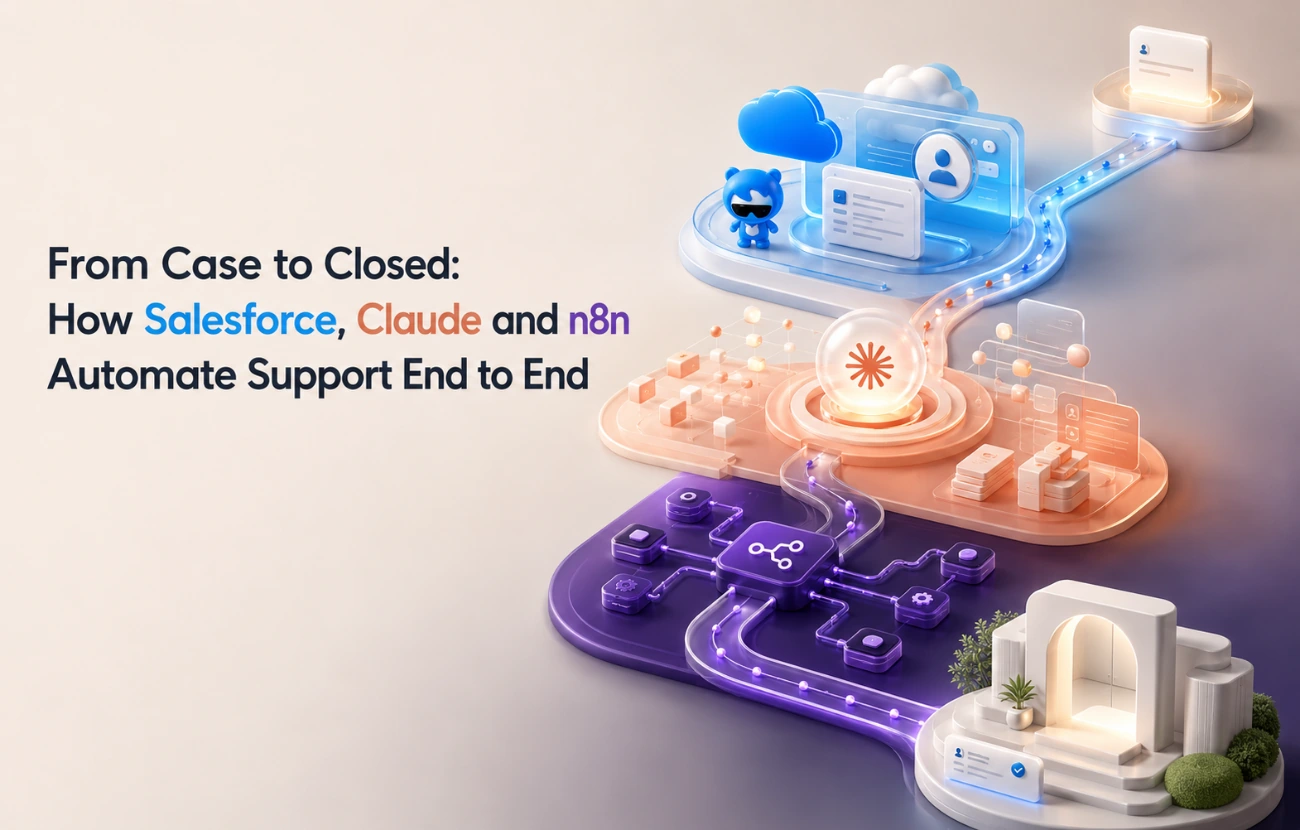
A customer emails in with a problem at 4pm on a Friday. By the time anyone reads it, replies, and closes it out, it's Monday afternoon, and the customer has already called twice asking why nobody's responded. Multiply that gap across every case your support team handles and it adds up to a lot of frustrated customers and a lot of reps doing repetitive reading and typing instead of solving actual problems. Salesforce Claude n8n automation exists to close exactly that gap, connecting the system that holds the case, the AI that reads and drafts, and the automation layer that ties the outcome back together, so a case moves from opened to closed with a person only stepping in for the decision that actually needs them.
Does This Sound Like Your Support Queue?
A quick check before we get into how the pieces fit together.
- Cases sit unread for hours after hours because nobody's actively watching the queue outside business hours.
- Reps spend more time reading through case history and drafting a reply than actually deciding what to tell the customer.
- The same handful of question types come up constantly, and someone still writes each response from scratch every time.
- There's no clean record of what happened case to case, so patterns in what's actually going wrong stay invisible.
If two or more of those are true, the rest of this is worth the read before your next support headcount conversation.
Three Layers, One Job
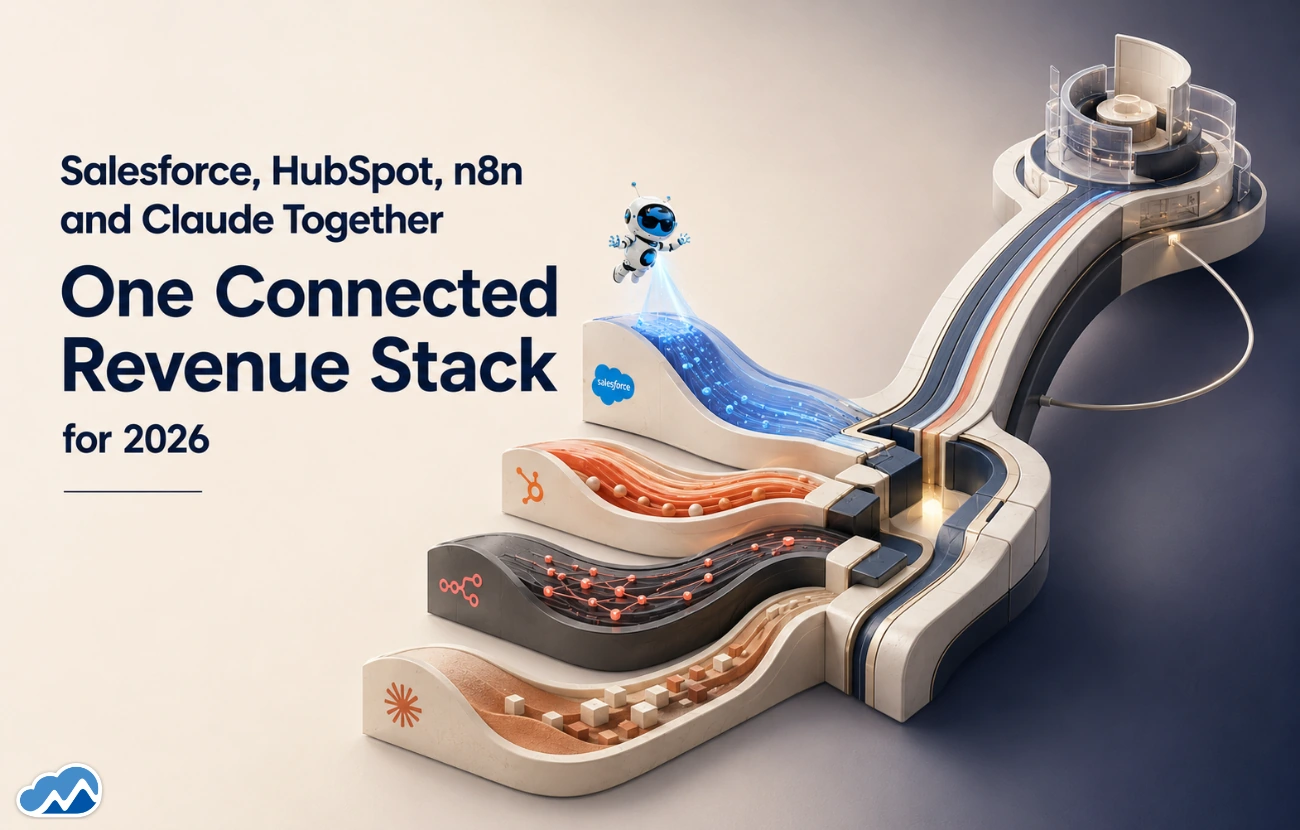
It helps to be clear on what each piece is actually doing before looking at the full flow. Salesforce is the system of record, holding the case, the customer history, and the eventual outcome, the single place everything refers back to. Claude is the reasoning layer, reading the case, understanding what's actually being asked, and drafting a response grounded in your own documentation rather than guessing. n8n is the connective tissue, watching for the case to be created, triggering Claude's involvement, and writing the approved outcome back into Salesforce and anywhere else it needs to land. None of the three pieces alone gets you end-to-end automation. Connected, they behave like one system instead of three separate tools a person has to bridge manually.
How the Flow Actually Works, Step by Step
Seeing this as an actual sequence removes most of the mystery.
- A case gets created in Salesforce, through a support form, an email, or a chat handoff, and n8n picks up the trigger immediately.
- Claude reads the case, along with relevant history and documentation, and classifies it: routine question, technical issue, or something that needs escalation.
- Claude drafts a suggested reply for routine and technical cases, grounded in your actual documentation, not a generic template.
- The draft lands in a review queue for a rep, not sent automatically, so a person always has the final say before anything reaches the customer.
- n8n writes the outcome back into Salesforce once approved, updating the case status, logging the resolution, and closing the loop.
- Escalations route directly to a person with full context attached, not a blank case number, for anything Claude wasn't confident about.
Nobody had to manually read the case from scratch, hunt through documentation, and type a reply by hand. A rep reviewed a draft and made the actual judgment call, which is a fundamentally smaller job.
A Worked Example: Weekend Coverage Without a Weekend Shift
Seeing this in a specific scenario makes the value clearer.
- A customer submits a case on Saturday morning about a common configuration question your documentation already covers thoroughly.
- Claude drafts an accurate, grounded reply within moments of the case landing, recognizing it against your knowledge base.
- The reply queues for a lightweight review rather than requiring deep investigation, since it's routine and well-documented with high model confidence.
- A rep approves it Monday morning, and n8n sends the reply and closes the case automatically.
- The customer gets useful information in hours rather than waiting until Monday afternoon for a person to manually work through the backlog.
Nobody staffed a weekend shift to make that happen. The system handled what it could confidently handle and left the rest genuinely waiting for a human, honestly, rather than pretending to be always-on everywhere.
Picture This
A software company's support team was drowning in a backlog of repetitive configuration questions, the kind with answers sitting clearly in their own documentation, alongside the smaller number of genuinely complex cases that needed real investigation. After connecting Salesforce case creation to Claude for drafting and classification, with n8n handling the handoffs, the repetitive cases started getting accurate draft replies within minutes, freeing reps to spend their actual time on the complex ones instead of splitting attention across both. The backlog that used to grow every Monday simply stopped accumulating, not because the team got faster at typing, but because they stopped needing to type the same answer for the fortieth time.
Where This Usually Goes Wrong
A handful of patterns show up repeatedly in support automation builds that don't hold up.
- No grounding in real documentation — a draft reply generated from general knowledge instead of your actual docs will eventually confidently state something wrong about your own product.
- Auto-sending without review — skipping the human approval step on customer-facing replies is how a subtly wrong answer reaches a customer before anyone catches it.
- No confidence-based routing — treating every case the same, whether it's routine or genuinely complex, either overloads reps with unnecessary reviews or lets tricky cases slip through with too little scrutiny.
- Silent failures in the handoff — if the connection between Salesforce, Claude, and n8n breaks quietly, cases can sit stuck with nobody noticing until a customer complains.
Getting Salesforce Claude n8n automation right means designing for all four from the start, since retrofitting review gates and confidence routing after a bad reply has already gone out is a much harder conversation.
What Changes for the Support Team Itself
The most noticeable shift isn't speed, though that improves too. It's what reps actually spend their day doing. Instead of splitting attention evenly across routine and complex cases, reps spend most of their time on the genuinely hard ones, the cases that need real investigation, judgment, or a difficult conversation. Reviewing a well-drafted response takes a fraction of the time writing one from scratch does, which means the same team can handle a meaningfully larger case volume without every rep feeling stretched thinner. It's less a story about replacing people and more about removing the part of the job that never needed a skilled person doing it in the first place.
Keeping the Connection Reliable, Not Just Clever
A three-system flow is only as strong as its weakest handoff, and it's worth being deliberate about what happens when something doesn't go to plan. If n8n can't reach Salesforce for a moment, the case shouldn't just vanish from the process, it should retry or alert someone rather than silently stalling. If Claude's confidence on a classification is borderline, the routing logic should lean toward a human review rather than assuming the best case. And it's worth logging every step of the automated path, not just the final outcome, so that if a customer ever asks “what happened to my case,” the answer is a quick lookup rather than a reconstruction project. None of this is exotic engineering, but it does need to be part of the build from day one, since a flow that works beautifully in a demo and falls over the first time an API call times out isn't actually production-ready.
Measuring Whether the Automation Is Actually Helping
It's easy to feel like an automation is working just because cases are moving faster, without checking whether they're moving faster in a way that actually holds up. Time to first response is the obvious number, and it should drop meaningfully once routine cases stop waiting for a person to notice them. Reopen rate matters just as much: if closed cases are getting reopened more often than before, that's a sign drafts are going out without enough scrutiny, not a sign the system is working well. And it's worth tracking how many cases actually get auto-classified with high confidence versus how many route to a human, since that ratio tells you whether the system is genuinely handling the routine work or just adding a review step to everything and calling it automation.
Build It Yourself, or Bring in Help?
A narrow, single-case-type automation is reasonable to attempt in-house, especially with a technical team and well-organized documentation. Where it gets harder is exactly what's covered above: building confidence-based routing that actually reflects risk, wiring the review step so nothing customer-facing skips it, and keeping the connection between all three systems monitored so failures surface immediately. If you're weighing that decision, look at how a provider actually approaches Salesforce Claude n8n Automation projects day to day, not just whether each piece is listed as a service separately. Ask how they handle the handoff between systems when something breaks. Ask how confidence thresholds get tuned for your specific case types. Ask whether they document the full flow so your team can maintain and extend it later, and ask to see what happens on their test system when a step deliberately fails.
How This Fits Into the Bigger Picture
Support case automation is one concrete play inside a much broader idea, connecting Salesforce, HubSpot, n8n, and Claude so they behave like one system instead of four separate tools. For the fuller picture of what a connected stack looks like, including the other plays worth building and what to check before you start, our Connected AI Automation Stack Guide walks through the platform combination more broadly.
The point of Salesforce Claude n8n automation was never to make support feel less human. It's to make sure the human attention your team has gets spent on the customer who actually needs a real conversation, not retyping the same documented answer for the fortieth time this month, while the case that came in at 4pm on a Friday doesn't have to wait until Monday for someone to even open it. That's the whole trade: less time spent reading and retyping, more time spent actually solving the problems that need a person to solve them.
Frequently Asked Questions
.webp)













Agentforce for Financial Services: AI-Driven Banking & Insurance Solutions












.webp)











n8n Workflow Automation: From Lead Capture to CRM in Minutes, Not Hours


%20(1).webp)