n8n Workflow Automation: From Lead Capture to CRM in Minutes, Not Hours

Table of content
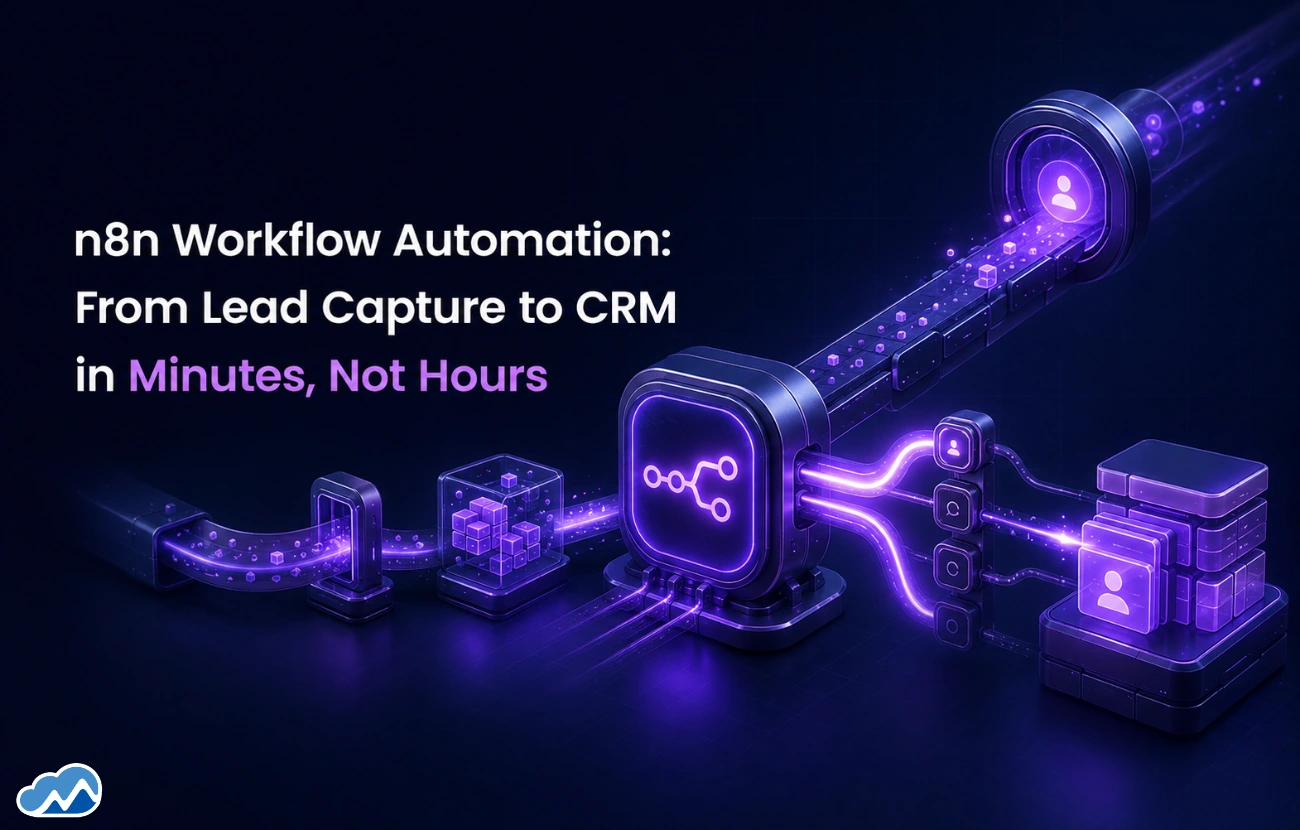
Here's a scenario most teams will recognise: a lead fills out a form on your site at 11pm on a Tuesday. Nobody sees it until Wednesday morning. By the time a sales rep manually copies the name, email and company into your CRM, it's almost noon. That's thirteen hours of silence on a lead who was ready to talk at 11pm. This is the gap that n8n workflow automation closes, and it takes less work to set up than most teams expect. This guide walks through what a lead-capture-to-CRM workflow actually looks like in practice, what it takes to build one, and where teams usually get it wrong.
Does This Sound Like Your Team Right Now?
Before the how-to, a quick honest check. See how many of these describe your current setup.
- Someone on your team manually copies form submissions into the CRM at some point during the day, not the moment they arrive.
- Leads from more than one source, your website, ads, a chat widget, land in different places and get combined by hand.
- You've had a lead go cold because nobody followed up fast enough, and everyone quietly knows it.
- Your CRM has duplicate contacts because two people entered the same lead from two different channels.
If two or more of those are true, the workflow below will save real hours every single week, not hypothetical ones you'll never actually notice.
What “Minutes, Not Hours” Actually Means
The phrase sounds like marketing copy until you see the mechanics. A well-built n8n workflow watches for a trigger, a form submission, a new row in a spreadsheet, a webhook from an ad platform, and reacts to it the moment it happens, not on some batch schedule someone remembers to run. There's no queue, no end-of-day upload, no person deciding when they have time to get to it. The lead lands, the workflow fires, and a clean record shows up in your CRM while the person who submitted the form is still on your website.
How the Workflow Actually Works, Step by Step
Strip away the buzzwords and a lead-capture-to-CRM build is a short, repeatable sequence.
- Trigger: something happens, a form submission, a webhook from a landing page tool, a new entry in a spreadsheet, a message from a chat widget, and n8n picks it up instantly.
- Capture and clean: the raw data gets pulled in and tidied up: names get properly cased, phone numbers get formatted consistently and obviously junk submissions get filtered out before they ever reach your CRM.
- Enrich: optional but common. n8n can call an enrichment service to fill in a company name, job title, or company size from just an email address, so your sales team isn't starting from a blank profile.
- Dedupe and match: before creating a new record, the workflow checks whether this person already exists in your CRM and updates the existing record instead of creating a duplicate.
- Route: the lead gets assigned to the right owner or queue based on rules you set, territory, deal size, product interest, instead of landing in one shared inbox for someone to sort through later.
- Land in CRM: a clean, complete, correctly owned record appears in Salesforce or whatever CRM you run, usually within seconds of the original form submission.
- Notify: a Slack message or email pings the right rep the moment a hot lead lands, so follow-up happens while the lead is still actively thinking about you.
None of these steps are complicated on their own. What n8n workflow automation adds is the link between them, so the whole sequence runs unattended, every time, without someone remembering to kick off step two.
Picture This
A 15-person sales team gets leads from a website form, a Facebook lead ad, and a chat widget on their pricing page. Before automation, three different people were responsible for checking three different places and manually entering what they found into the CRM, usually once or twice a day. Leads from the chat widget, the least-watched of the three, regularly sat for a full day before anyone noticed them. After the team built a single n8n workflow across all three sources, every lead lands in the CRM within about ninety seconds of submission, pre-tagged with its source and pre-assigned to the right rep by territory. Nobody checks three separate places anymore. There's one dashboard, and it's always current.
Where the Leads Actually Come From
A useful workflow needs to account for wherever leads genuinely show up, not just the obvious form on the contact page.
- Website forms: the most common source, and usually the easiest to connect since most form tools support webhooks out of the box.
- Paid ad platforms: Facebook and Google lead ads generate submissions inside the ad platform itself, not on your site, so they need their own connection into the workflow or they sit invisible in a dashboard nobody checks.
- Chat widgets: conversations that end with contact details shared mid-chat often never make it into a CRM at all unless something is watching for that specific pattern.
- Spreadsheets and manual lists: trade show sign-ups, webinar registrants, anything collected outside your usual tools, can still feed into the same workflow with a simple trigger on the file itself.
- LinkedIn and outbound tools: leads sourced through sales engagement platforms can route into the same pipeline instead of living in a separate system sales has to check on its own.
Where This Usually Goes Wrong
A workflow that looks solid in testing can still fail quietly in production. A few patterns show up again and again.
- No deduplication logic: without a proper check against existing records, the same person filling out two different forms creates two different contacts, and now two reps might reach out separately.
- Silent failures: if a lead source changes its field names or an API call fails, a workflow without alerting just stops working, and nobody notices until someone asks why the numbers look low.
- Missing fields treated as fine: a workflow that pushes a record into the CRM even when a required field is blank creates a database full of half-complete contacts that are hard to work later.
- Everything routed to one person or queue: skipping the routing logic defeats a lot of the purpose. Speed only helps if the right person actually sees the lead.
Getting proper n8n workflow automation in place means building for these cases up front, not patching them after a rep notices something's missing three weeks in.
What Changes in the Numbers
Speed is the obvious win, but it's not the only one worth tracking. Response time is the easiest to measure: pull the average gap between form submission and first outreach before the workflow goes live, then check it again a month later. Teams that automate lead capture typically see that gap collapse from hours to minutes, sometimes from a full business day down to under five. Duplicate rate is the second number worth watching. Before automation, it's common to see a meaningful share of contacts in a CRM that are actually the same person entered twice from two channels. A workflow with real deduplication logic drives that toward zero, which matters because reps calling the same lead twice from two different reps looks unprofessional and wastes everyone's time. Lead-to-response time and duplicate rate together tell you most of what you need to know about whether the automation is actually working, separate from how it feels day to day.
Keeping Lead Data Secure Along the Way
Lead data is still personal data, names, emails, phone numbers, sometimes company financials if your forms ask for revenue ranges, and a workflow moving it automatically needs to treat it that way. A properly built n8n workflow should only pull the fields it actually needs from each source, rather than grabbing an entire payload and sorting it out later. Credentials for connected tools, your CRM, your ad platforms, your chat widget, belong in n8n's credential store, not hardcoded into a workflow where anyone with edit access can see them in plain text. If you're self-hosting, that data never leaves your own infrastructure at all, which matters if you're in a regulated industry or just prefer not to have customer data passing through a third party's cloud by default. None of this is complicated to get right, but it does need to be part of the build from day one rather than something bolted on after a client or a compliance review asks about it.
Build It Yourself, or Bring in Help?
Plenty of teams start by building a version of this themselves, and for a single simple source, that's often reasonable. Where it gets harder is exactly the parts covered above: deduplication logic, error handling that actually alerts someone, and routing rules that hold up as your team grows past a handful of people. If you're weighing that decision, it's worth looking closely at how a provider actually builds n8n Workflow Automation projects day to day rather than just whether the phrase appears on their site. Ask what happens when a source changes its data format without warning. Ask how duplicate leads get handled. Ask whether you'll get documentation you can actually read and maintain yourself, or whether the workflow becomes something only they can touch.
A Few Questions Worth Asking Any Provider
- Do they build in monitoring and alerting by default, or is that an extra you have to request?
- Can they show you a real example of routing logic, not just a diagram of “trigger goes to CRM”?
- Will the finished workflow be documented well enough that your own team could modify it later?
- Do they have experience connecting the specific lead sources you actually use, not just the popular ones?
If the answers are vague, that tells you something useful before you commit budget to it. A short conversation with a provider usually surfaces this fast. If someone can answer the four questions above in specific, concrete terms within the first fifteen minutes of a call, that's a decent sign they've actually built workflows like this before rather than reading about them the night before your meeting.
How This Fits Into the Bigger Picture
A lead-capture workflow is usually the first thing teams build with n8n, but it's rarely the last. Once one process runs reliably without anyone touching it, the same approach tends to spread to invoice processing, support ticket routing and reporting that used to be a manual weekly task. If you want the fuller picture of what n8n can handle across a business, our n8n Automation Services Guide covers the platform more broadly, how it compares to Zapier and Make, self-hosting versus cloud and where AI fits into the workflows themselves.
The real test of whether n8n workflow automation is working isn't a dashboard full of green ticks. It's whether anyone still needs to think about it. Leads should just arrive, clean, owned and logged, while your team spends its time actually talking to the people behind them instead of typing their details into a form. Go back to that 11pm lead from the start of this guide. With the right n8n workflow automation in place, that lead is sitting in your CRM, correctly tagged and assigned, before the prospect has even closed the browser tab.
Frequently Asked Questions
.webp)



















Agentforce for Financial Services: AI-Driven Banking & Insurance Solutions














.webp)














n8n Workflow Automation: From Lead Capture to CRM in Minutes, Not Hours






%20(1).webp)