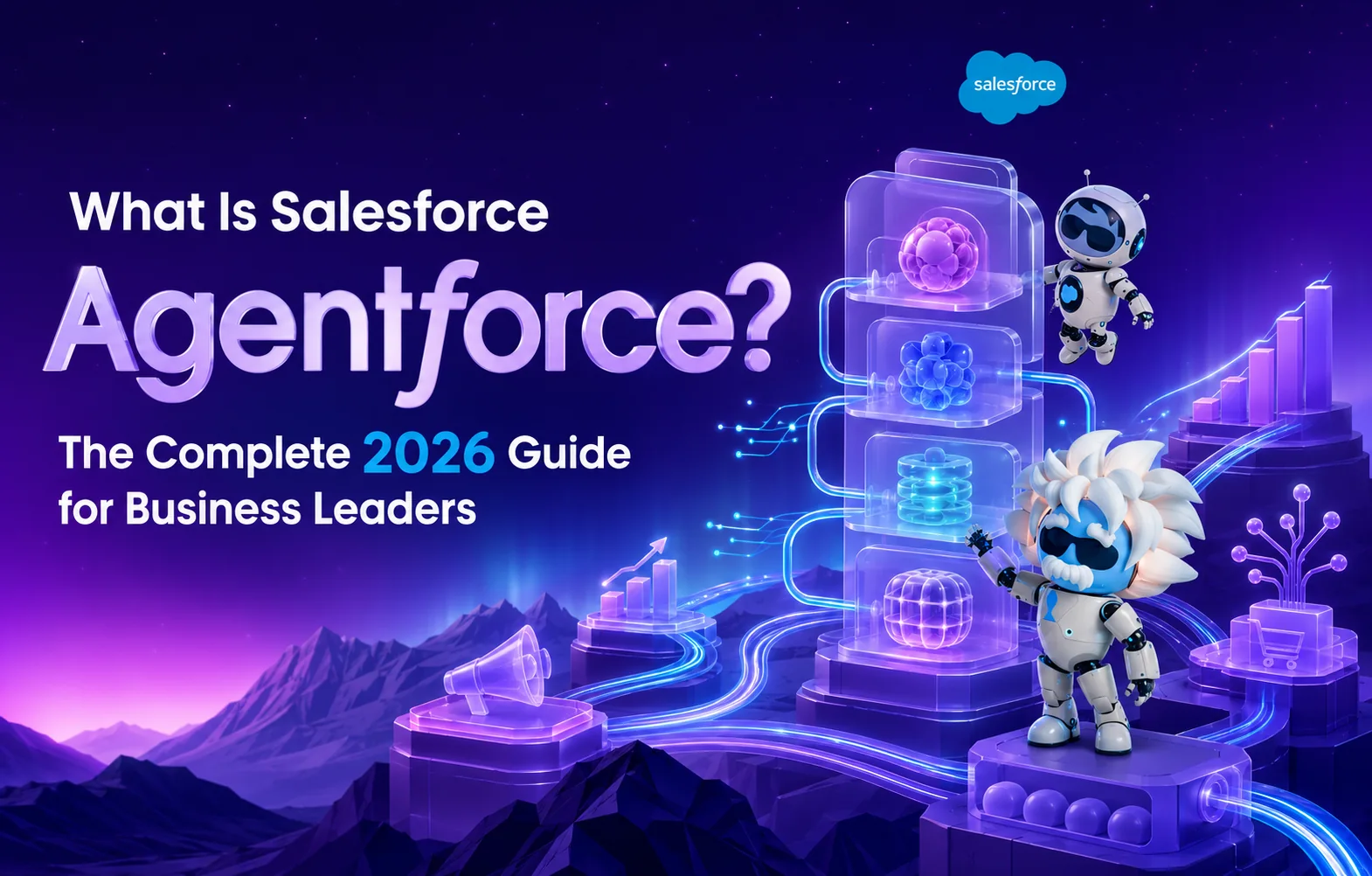
What Is Salesforce Agentforce? The Complete 2026 Guide for Business Leaders

Table of content
If you've been anywhere near a Salesforce conversation in the last year, you've heard the word Agentforce, probably a lot, and possibly without anyone explaining what it actually is. It's become the kind of term that gets nodded at in meetings while everyone quietly hopes someone else understands it. So let's clear that up properly, without the buzzwords.
In plain English, Salesforce Agentforce is Salesforce's platform for building AI agents, software that doesn't just answer questions but actually gets work done. Not a smarter chatbot. Not an assistant that drafts a suggestion for a human to approve. An agent that can take a task, reason through it and complete it, inside the systems your business already runs on.
That's a genuinely bigger deal than it sounds, and it's worth understanding what's real, what's hype and where it fits. Here's the complete picture for business leaders.
What Salesforce Agentforce Actually Is
Salesforce Agentforce is a layer that lets you build, deploy and manage autonomous AI agents on the Salesforce platform. The key word is autonomous. Where earlier AI tools waited to be asked and then produced text, an Agentforce agent is given a job, a goal and a set of actions it's allowed to take, and it works through the task on its own, calling on your data and your systems, escalating to a human only when it needs to.
Crucially, it's grounded in your business. Because Salesforce Agentforce sits on the Salesforce platform and draws on your unified data, an agent isn't guessing from the open internet, it's working from your customers, your records and your rules. That grounding, plus built-in guardrails, is what separates it from a generic chatbot bolted onto a website.
It also helps to be clear about what Agentforce is not. It isn’t a general-purpose automation tool and it isn’t a replacement for the rest of your stack. Plenty of businesses run Salesforce alongside HubSpot for marketing, n8n for workflow plumbing and a model like Anthropic’s Claude for reasoning-heavy work. Agentforce doesn’t ask you to throw any of that out. It gives you a place to build agents that sit close to your customer data and act on it, while the surrounding tools carry on doing what they already do well. Knowing that boundary early saves a lot of wasted effort later.
Agentforce is the headline act in a wider shift towards AI in the enterprise. For the bigger trends picture, see our Agentforce & AI Trends Master guide. This one focuses on what Agentforce itself actually is.
Agentforce vs Chatbots vs Copilots
The easiest way to understand Salesforce Agentforce is by what came before it. A chatbot follows a script: ask it something outside the script and it falls over. A copilot or assistant is smarter, it drafts, summarises and suggests, but a human still has to approve and act on everything. An agent goes a step further: within clear boundaries, it can actually take the action, resolve the case, update the record, book the follow-up, and only involve a human when the situation calls for it.
That's the leap. Chatbots talk, copilots assist, agents act. Salesforce Agentforce is squarely in that third category, which is why it's generating so much more excitement, and so much more confusion, than the AI features that came before.
It’s worth saying that the model underneath is not the differentiator people assume it is. Ask Claude or any other strong model a question and you’ll get a capable answer, but the answer is where it stops. What makes an agent an agent is the wiring around the model: the permitted actions, the grounded data, the guardrails and the ability to write back into a live system. Agentforce is that wiring. The model is one component inside it, not the whole thing.
What Agentforce Agents Actually Do
In practice, businesses use Salesforce Agentforce to put agents to work on the repetitive, high-volume tasks that eat human time. A service agent can resolve routine support cases, answering known questions, checking order status, handling common requests, around the clock, and hand the hard ones to a person with full context attached. A sales agent can qualify inbound leads, research accounts and tee up outreach. Agents can sit in marketing, in operations, anywhere there's structured, repeatable work.
The pattern is consistent: let the agent handle the routine volume so your people focus on the complex, high-value work that genuinely needs a human. Done well, that's not about replacing your team, it's about giving them a tireless colleague for the grunt work.
How It Works Under the Hood
You don't need to be technical to grasp the shape of it. A Salesforce Agentforce agent is built from a few parts: the topics it's allowed to handle, the actions it can take, the data it's grounded in, and the guardrails that keep it in bounds. A reasoning engine works out, for a given request, which topic applies and which actions to take to resolve it, then does so, checking against your rules as it goes.
The important business takeaway is that this is configurable and controllable. You decide what an agent can and can't do, what data it sees, when it must escalate and how it's monitored. Salesforce Agentforce isn't a black box you unleash and hope, it's a system you scope, govern and supervise, which is exactly what you want when AI is touching customers.
Actions are where most of the practical work sits. An action might be a Salesforce flow, an Apex method or a call out to something else entirely. That last part matters, because it’s how an agent reaches beyond Salesforce. If the record it needs lives in HubSpot, or the task ends with a note in Slack and a row in a finance system, that step is usually a call to an integration layer. Plenty of teams use n8n for exactly this, exposing a webhook the agent can trigger and handling the sequence of API calls behind it. The agent decides what needs to happen and the integration layer carries it out.
The Honest Caveats
Here's the part the hype tends to skip. An agent is only ever as good as the data and the design behind it. Point Salesforce Agentforce at messy, fragmented data and it will confidently do the wrong thing, at scale and around the clock. Skip the guardrails and you've automated risk. Treat it as a magic switch rather than a system that needs scoping, grounding and oversight, and it will disappoint.
None of that is a reason to avoid it. It's a reason to do it properly. The businesses getting real value from Salesforce Agentforce are the ones that got their data foundation right, scoped the agents carefully, kept humans in the loop where it matters and treated it as a serious implementation rather than a demo. Sober beats shiny here, every time.
Where Agentforce Fits Alongside Your Other Tools
Very few businesses run on Salesforce alone, so the fit question comes up quickly. If your marketing sits in HubSpot, the useful move is not to migrate everything but to decide which system owns which record and keep the two in sync, so an Agentforce agent answering a customer isn’t working from a stale picture. If you already have automations running in n8n, treat them as hands the agent can borrow rather than something to rebuild inside Salesforce. And if your team has standardised on Claude for drafting, research or internal tooling, that can carry on alongside Agentforce, which handles the customer-facing work where governance and audit trails matter most.
The line that holds up in practice is a simple one. Use deterministic automation for anything with a fixed set of steps, because a workflow in n8n is cheaper, faster and far easier to debug than an agent reasoning its way to the same result. Use an agent when the request arrives in language, the path isn’t fixed and some judgement is needed to pick the next step. Getting that split right is most of the difference between an Agentforce project that pays back and an expensive way to do something a workflow was already doing.
Getting Started Sensibly
If Agentforce is on your radar, the sensible path isn't to agent-ify everything at once. It's to pick one well-defined, high-volume use case, usually in service, get the data and guardrails right underneath it, and prove the value on something contained before expanding. That approach builds confidence, surfaces the real issues early and stops you betting the business on a first attempt. If that first use case leans on data sitting in HubSpot or on steps that already run in n8n, wire those in from the start rather than treating integration as a phase two problem.
Frequently Asked Questions
.webp)










Agentforce for Financial Services: AI-Driven Banking & Insurance Solutions









.webp)




n8n Workflow Automation: From Lead Capture to CRM in Minutes, Not Hours

%20(1).webp)