Claudeforce Explained: Salesforce and Anthropic’s AI Partnership, Salesforce in Claude and Agentforce

Table of content
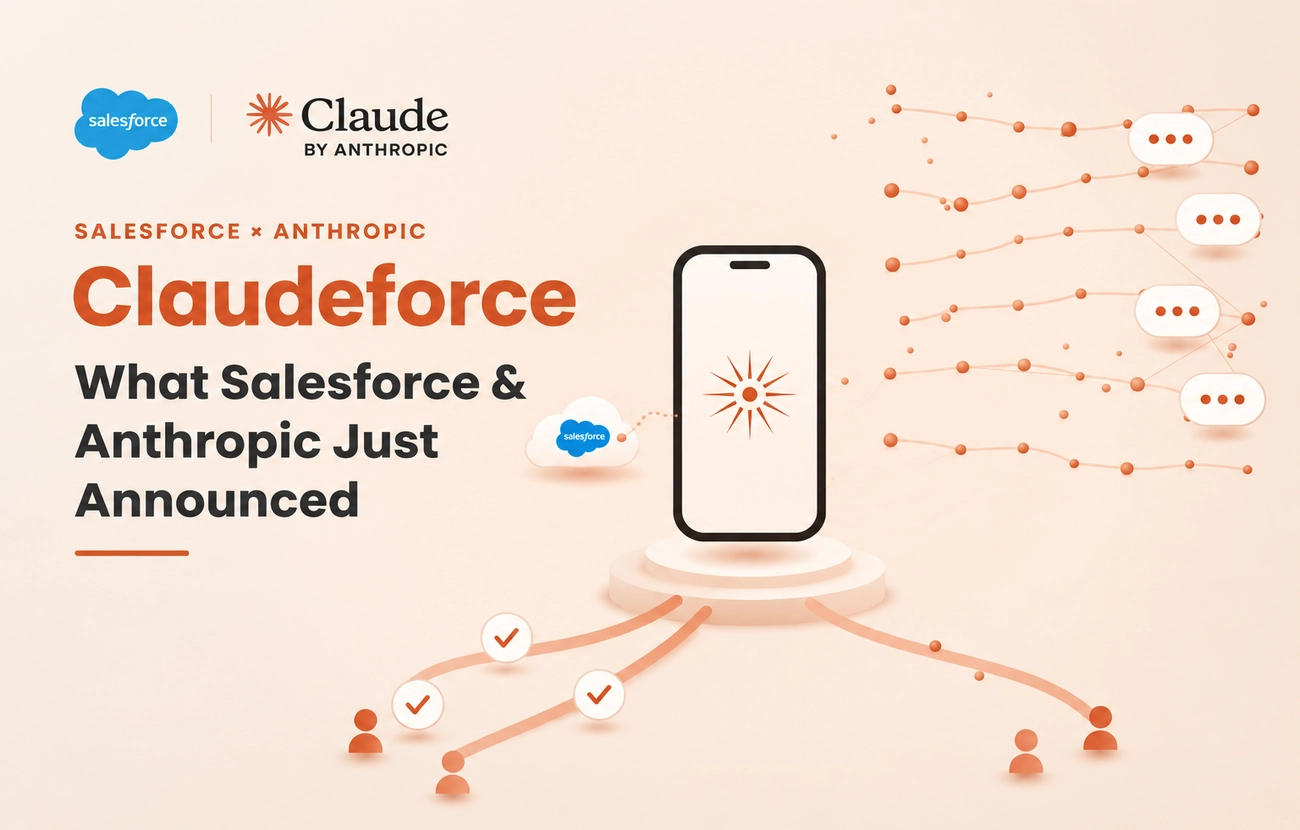
Claudeforce is the first time in more than two decades that Salesforce has put its "force" suffix on another company's product. Sales, Service, Agent and Data have always used Salesforce's own naming system. On 26 August 2026, Salesforce and Anthropic announced Claudeforce, and the name shows how strategically both companies view this partnership.
If you run your business on Salesforce, this announcement is worth reading properly rather than skimming. Not because you need to act tomorrow, but because it signals where the platform is heading. Below, we cover what Claudeforce actually is, what shipped in each direction, when it becomes available and what to do about it now.
Claudeforce at a Glance
The short version, for anyone who wants the answer before the detail:
- What it is: an expanded strategic partnership between Salesforce and Anthropic, announced 26 August 2026.
- Salesforce in Claude: a plugin that brings the revenue cycle into Claude with 37 prebuilt sales skills.
- Claude in Salesforce: Claude is a reasoning model for the Atlas Reasoning Engine and powers Agentforce Vibes and Agentforce Coworker.
- Slack: Claude is now the default model across Slack, including Slackbot.
- Availability: select pilot customers now, open beta expected September 2026, more skills late 2026.
- What to do: clean and unify your Salesforce data, tighten governance and permissions, map your revenue and service processes.
What Is Claudeforce?
Claudeforce is an expanded strategic partnership between Salesforce and Anthropic, the company behind the Claude AI models. In simple terms, Claude's reasoning connects with Salesforce's data, workflows and governance, and Salesforce's capabilities connect with Claude, so AI can take trusted, governed action where work happens.
It's easy to dismiss a partnership announcement as marketing, but Claudeforce is more concrete than most. It ships as real, named products going in both directions, plus a deeper tie-up through Slack and a genuine mutual-adoption arrangement where each company runs on the other's technology. Let's take the pieces one at a time.
This lands squarely in the biggest trend shaping the platform right now, the move to agentic AI. For the wider context, see our Agentforce & AI Trends Master guide. This piece focuses on Claudeforce specifically.
Salesforce in Claude: The Flagship of the Partnership
The flagship of Claudeforce is Salesforce in Claude, a plugin that brings your revenue cycle directly into Claude. It launches with 37 prebuilt sales skills, built jointly by Salesforce and Anthropic, covering meeting prep, deal-health review and pipeline review. The pitch is an AI CRO: an assistant that understands a seller's entire revenue picture and can act on it where they work.
The clever part is how it is grounded and governed. When onboarded, it reads a seller's context across Salesforce, Slack and any connector to create a tailored dashboard of accounts, pipeline and live data. Every action routes back through Salesforce, so your business rules are enforced whenever the AI does something. This is powered by what Salesforce calls AIforce, a harness that exposes your business data and workflows to any agent through MCP servers, APIs and CLI tools, without building bespoke integrations. An admin enables it centrally, while access remains permission-scoped, so agents operate with each user's own Salesforce permissions rather than around them.
Claude in Agentforce: AI Reasoning Inside Salesforce
Claudeforce runs both ways. Inside Salesforce, Claude is now available in Agentforce, serving as a reasoning model for the Atlas Reasoning Engine, powering Agentforce Vibes and Agentforce Coworker by default, and available in Agent Builder. In other words, the agents you build on Salesforce can now reason with Claude under the hood.
For regulated industries, the important detail is trust. Through Amazon Bedrock, Claude is available within the Salesforce Trust Boundary, so customers can deploy this AI while keeping data and workloads secure. That combination, frontier reasoning plus enterprise-grade governance, is the whole thesis of Claudeforce: intelligence that can actually be trusted with real business data.
Claude in Slack: Where People and Agents Work Together
The third piece of Claudeforce runs through Slack, which Salesforce frames as the place where people and agents work together. Claude is now the default model across the Slack experience, powering Slackbot, supporting team decisions through Claude Tag and acting as a founding partner for Slack Code. The idea is that a team can reason through a decision with Claude in Slack, then trigger a governed action in Salesforce, without leaving the conversation.
That's a meaningful shift in how work flows. Instead of bouncing between a chat tool, a CRM and an AI assistant, the reasoning and the action happen in one place. It's a small-sounding change that adds up to a very different daily experience.
Mutual Adoption: Each Company Runs on the Other's Technology
One detail that makes Claudeforce more than a press release: the two companies are now genuine customers of each other. Salesforce is Anthropic's preferred CRM, and Claude is the default model powering Slackbot and Slack AI for Salesforce, along with tools across Salesforce's own engineering organisation. Salesforce even reports Slackbot driving millions of hours of annualised productivity internally.
Why does that matter to you? Because it means both sides are building on the same architecture they're selling, which tends to produce better, more battle-tested products than a partnership that exists only on paper. Mutual adoption is a good signal that Claudeforce is built to be used, not just announced.
Why Claudeforce Matters: The UI Is the AI
Step back from the product names and Claudeforce points to a real shift in how enterprise software works. For decades, using business software meant a human clicking through screens to get things done. The premise here is that agents can now reach the data, workflows and rules directly, so the interface becomes something AI drives rather than something you navigate by hand. Salesforce's own framing is that the UI is the AI.
That's a big idea, and it's easy to overhype, so hold it lightly. But the direction is clear: your Salesforce data and the business logic wrapped around it become more valuable, not less, in an agentic world, because they're exactly what makes the AI trustworthy and useful. Claudeforce is a bet that the companies who've been building structured, governed data for years are the ones best placed to actually use AI well.
What Claudeforce Means for Businesses Running Salesforce
The practical takeaways are calmer than the headlines. First, your data foundation matters more than ever. Claudeforce makes Claude's reasoning available over your Salesforce data, and reasoning over messy, fragmented data still produces messy results. The businesses that will benefit are the ones whose Salesforce is clean, well-structured and well-governed.
Second, governance is central, not optional. The entire design of Claudeforce routes AI actions through Salesforce's rules and trust boundary, which shows where the value and the risk both sit. Third, this is early. Salesforce in Claude is with select pilot customers now, open beta is expected in September 2026, and more skills arrive late in the year. This is a direction to prepare for, not a fire drill.
The Honest Take: Limits, Caveats and Timing
A few sober notes to balance the excitement. Claudeforce launches sales-first, and the 37 skills are focused on the revenue cycle. If your priority is service or operations, the immediate relevance is smaller for now. It is also genuinely new, with the usual caveats of pilots and betas: capabilities, packaging and pricing can shift. And none of it removes the fundamentals. Clean data, clear processes and proper governance are still the work that makes any of this pay off.
So the right response to Claudeforce isn't to tear up your roadmap. It's to get your Salesforce foundation into the kind of shape where, when these capabilities become widely available, you're ready to actually use them. The companies that benefit from a shift like this are usually the ones who were already well-organised before it arrived.
What You Can Do With Claude Today, While Claudeforce Matures
Claudeforce is sales-first and still in beta, but Claude itself is already production-ready for the work sitting either side of your CRM. Three patterns we implement most often for Salesforce-led teams:
- Grounded answers from your own knowledge base. Retrieval-augmented generation lets Claude answer from your documentation, policies and past deals instead of guessing. It uses the same grounding principle Claudeforce applies to Salesforce data.
- Documents into structured data. Contracts, invoices and order forms turned into clean fields that land in Salesforce. That is exactly the data hygiene Claudeforce rewards.
- Lead qualification and FAQ deflection. AI chatbots that qualify inbound leads and answer repeat questions before a human is involved, feeding qualified records straight into your pipeline.
How to Prepare for Claudeforce: A Practical Checklist
If Claudeforce has your attention, the highest-value moves are unglamorous groundwork. Work through these four in order:
- Clean and unify your data. Deduplicate accounts, fix ownership and consolidate the fields your reps actually rely on. Claude's reasoning is only as trustworthy as the records underneath it.
- Tighten governance and permissions. Every Claudeforce action routes back through Salesforce's rules, so your sharing model, field-level security and validation logic become your AI guardrails.
- Document your revenue and service processes. AI amplifies whatever process it is pointed at, so an unclear stage definition becomes an unclear agent.
- Pick one measurable pilot. Meeting prep, deal-health review or pipeline hygiene are the obvious first candidates once open beta opens.
Do those four and you are not only ready for Claudeforce, you are better positioned regardless of which direction the platform takes next.
Not sure where your Salesforce foundation stands against this? Book a 30-minute Claudeforce readiness call with Makedian and we will give you a straight, practical read on it.
Frequently Asked Questions
.webp)
.webp)











Agentforce for Financial Services: AI-Driven Banking & Insurance Solutions










.webp)








n8n Workflow Automation: From Lead Capture to CRM in Minutes, Not Hours


%20(1).webp)