From Contracts to Invoices: How Claude Turns Documents into Structured Data

Table of content
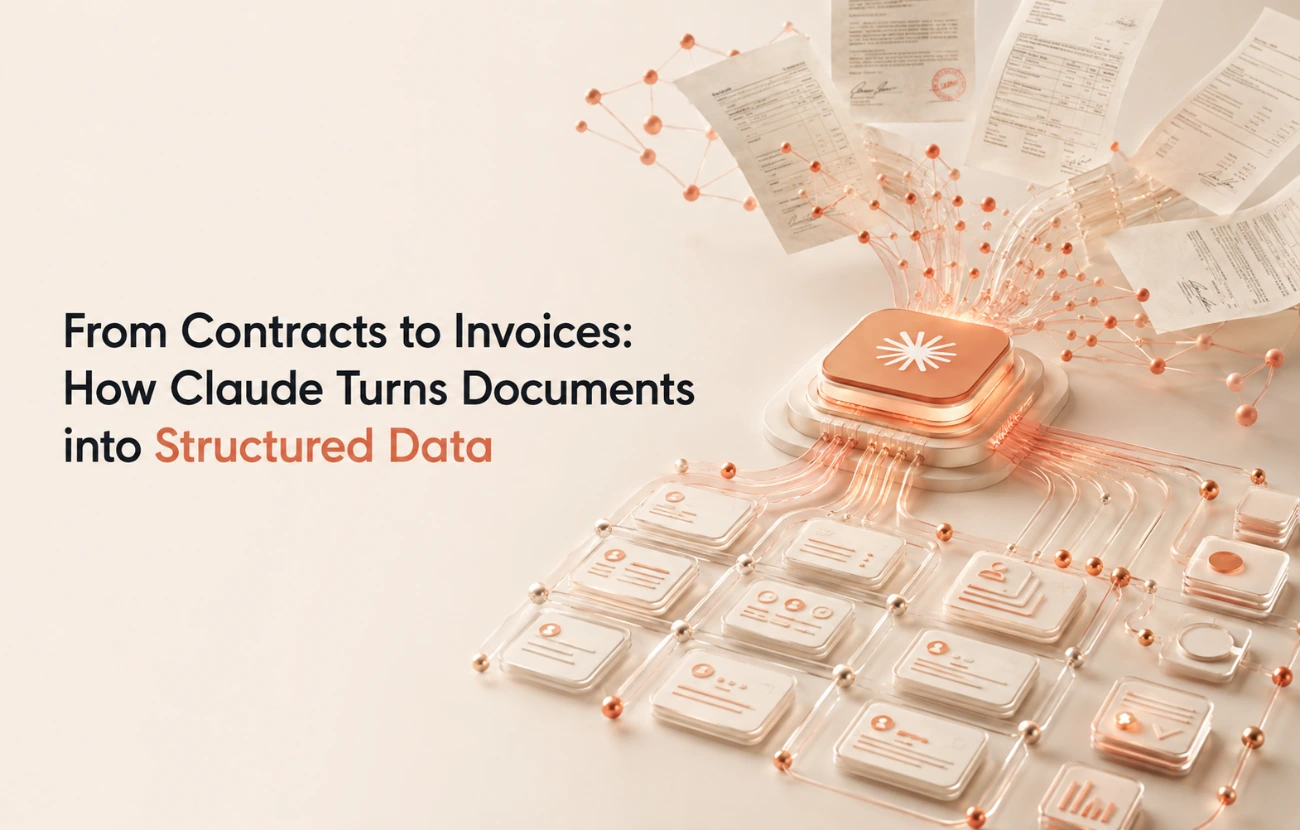
Somewhere in your business, someone is retyping numbers from a PDF into a spreadsheet right now. An invoice arrives, and a person reads the vendor name, the line items, and the total, then manually keys them into your accounting system. A contract lands, and someone scans it for the renewal date and the payment terms before filing it away. This is exactly the kind of work AI document processing Claude is built to remove, reading a scanned or digital document and turning it into clean, structured data your systems can actually use, without a person doing the reading and retyping by hand.
Does This Sound Like a Task on Your Team's Plate?
A quick check before we get into how it actually works.
- Someone manually retypes information from PDFs, invoices, contracts, forms, into a spreadsheet or system of record.
- Documents pile up faster than anyone can process them, creating a backlog that grows every week.
- Data entry errors from manual retyping have caused a real problem, a missed payment, a wrong renewal date, at least once.
- Your team spends time hunting through file folders for a specific document instead of searching structured data.
If two or more of those are true, the rest of this is worth the ten minutes it takes to read.
What “Turning Documents into Structured Data” Actually Means
The phrase sounds abstract until you see what changes. A PDF invoice is, to a computer, just an image or a block of loosely formatted text, no inherent structure a database can use. AI document processing Claude reads that same document the way a person would, understanding that this number is the total, that block of text is the vendor address, this date is the due date, and then outputs it as clean fields: vendor name, invoice number, line items, total, due date, each one landing in the right place. The output isn't a summary or a guess. With structured, schema-validated outputs, the data comes back in a predictable shape your systems can consume directly, without someone reformatting it by hand afterward.
How This Actually Works, Step by Step
Turning a stack of documents into usable data follows a defined sequence.
1. The document arrives — a PDF, scanned image, or photo comes in through email, an upload, or a folder being watched for new files.
2. Claude reads it using vision capability — scanned invoices, contracts, IDs, and even messy photos of paperwork get read directly, not just clean digital text.
3. Fields get extracted against a defined structure — rather than a loose summary, the system pulls specific fields you've defined, vendor, amount, date, into a consistent schema.
4. Confidence gets checked — fields the system is genuinely unsure about get flagged rather than guessed, so a garbled scan doesn't silently produce a wrong number.
5. Structured data lands in your system — clean, validated fields write directly into your accounting software, CRM, or database, ready to use immediately.
6. Exceptions route to a human — anything flagged as low-confidence or unusual goes to a person for a quick check, rather than getting force-fit into the pipeline anyway.
The whole thing runs without anyone opening the PDF themselves, except for the exceptions that genuinely need a human eye.
A Worked Example: Invoice Processing End to End
Seeing this as an actual document's journey makes it concrete.
7. A vendor emails an invoice as a PDF attachment, and it's automatically picked up the moment it arrives.
8. Claude reads the document, including the vendor letterhead, the itemized charges, and the payment terms printed in the footer.
9. Fields get extracted vendor name, invoice number, line items, total amount, and due date into a structured record.
10. The record gets matched against a purchase order already in your system, flagging any mismatch in amount or vendor.
11. Matching invoices move to approval automatically. Mismatches route to a person with the discrepancy clearly noted.
12. Approved data writes directly into your accounting system, with no one retyping a single number.
A process that used to take a person several minutes per invoice, multiplied across dozens or hundreds a month, now takes a few seconds of machine time and a human glance only on the exceptions.
Picture This
A mid-sized logistics company was processing several hundred vendor invoices a month by hand, with two people spending a meaningful chunk of their week just on data entry and matching invoices to purchase orders. After deploying a document processing workflow, the majority of invoices now flow through without anyone touching them, matched automatically and posted directly into their accounting system. The two people who used to spend their week on data entry now spend it reviewing the genuine exceptions, mismatched amounts, unusual vendors, the cases that actually need judgment. The backlog that used to build up every month end simply doesn't happen anymore.
Beyond Invoices: Where Else This Applies
Invoices are the easiest example to explain, but the same pattern extends well past accounts payable.
- Contracts — extracting key terms, renewal dates, payment schedules, and obligations automatically, instead of someone reading the whole document to find them.
- Forms and applications — structured data from intake forms, applications, or surveys submitted as scanned paper or PDFs, without manual transcription.
- Identity and compliance documents — reading IDs, licenses, or certifications to verify and extract required fields for onboarding or compliance checks.
- Receipts and expense reports — pulling amounts, dates, and categories from receipts automatically, instead of an employee typing each one into an expense system.
- Shipping and logistics paperwork — bills of lading, customs forms, and delivery confirmations turned into structured data that feeds directly into tracking systems.
Anywhere a person is currently reading a document and typing what they find into another system is a candidate for this pattern.
Where This Usually Goes Wrong
A few patterns show up consistently in document processing builds that don't hold up.
- No confidence thresholds — a system that extracts every field with equal certainty, even from a blurry scan, will eventually produce a wrong number nobody catches until it causes a real problem.
- Rigid schemas that break on edge cases — a vendor whose invoice format doesn't quite match what the system expects shouldn't cause the whole pipeline to fail silently.
- No human review path for exceptions — genuinely unclear documents need somewhere to go. Force-fitting them into automated processing just moves the error further downstream.
- Treating every document type the same — an invoice and a contract need very different extraction logic, and a one-size-fits-all approach handles neither particularly well.
Getting AI document processing Claude deployments right means designing for all four from the start, since retrofitting confidence thresholds and exception handling after a bad number has already caused a problem is a much harder conversation.
Accuracy, Confidence, and Where to Draw the Line
Not every extracted field deserves the same level of trust, and treating them all equally is a mistake worth avoiding early. A clearly printed total on a standard invoice template is a high-confidence extraction almost every time. A handwritten note in a margin, or a field partially obscured by a coffee stain, is not, and a system that reports both with equal certainty is setting you up for a quiet error somewhere down the line. Setting a confidence threshold, below which a field gets flagged for human review rather than auto-processed, is the single most important tuning decision in a document processing build. Set it too low and your team drowns in unnecessary reviews. Set it too high and genuine errors slip through untouched. Getting it right usually takes a few weeks of real-world tuning against your actual documents, not a one-time setting decided in a planning meeting before the system has seen a single real file.
Keeping Sensitive Documents Secure
Invoices, contracts, and forms often carry sensitive information, banking details, personal data, commercial terms nobody wants leaked, and a pipeline processing them automatically needs real safeguards, not an afterthought. PII redaction should strip or mask sensitive fields before they sit in logs or get passed further downstream than necessary. Audit logging matters too, so there's a clear record of what was extracted, when, and by which process, in case anything ever needs review after the fact. And for regulated industries, deploying through the Anthropic API, AWS Bedrock, or Google Vertex gives you control over data residency and retention that matters for compliance. None of this is exotic, but it does need to be part of the build from day one, not bolted on after a client or an auditor asks the obvious question.
Build It Yourself, or Bring in Help?
A narrow, single-document-type pipeline is reasonable to attempt in-house, especially with a technical team and a stable document format. Where it gets harder is exactly what's covered above: handling edge cases and messy scans gracefully, setting confidence thresholds that actually reflect risk, and building exception routing that doesn't just dump problems on someone's desk unsorted. If you're weighing that decision, look at how a provider actually approaches Claude Document Processing projects day to day, not just whether it's listed as a service. Ask how they handle a document that doesn't match the expected format. Ask what their confidence threshold looks like in practice. Ask how structured output actually lands in your systems, and whether your team can adjust the schema later without starting over, since document formats and business requirements both tend to change more often than an initial scope document accounts for.
For the conversational side of a Claude deployment, our Claude AI Chatbot guide covers how the same grounding and structured-output principles apply to answering questions and qualifying leads rather than processing paperwork.
How This Fits Into the Bigger Picture
Document processing is one concrete application of a broader capability, Claude reading, understanding, and acting on your business's actual content and data. The same principles, grounding, structured outputs, human review for exceptions, apply across chatbots, internal automation, and search over your own knowledge base. For the fuller picture of what a Claude engagement covers, our Claude AI for Business Guide walks through the platform more broadly and what to check before choosing a solution provider.
The point of AI document processing Claude delivers isn't a flashy demo reading one perfect sample invoice. It's a stack of real, messy paperwork, the ones with coffee stains and slightly crooked scans, turning into clean data your systems can use, quietly, every single day, without anyone having to open the file. Go back to that person retyping numbers from a PDF at the start of this guide. With the right pipeline in place, that same document gets read, validated, and posted before they'd have even finished opening the file.
Frequently Asked Questions
.webp)



















Agentforce for Financial Services: AI-Driven Banking & Insurance Solutions













.webp)
















n8n Workflow Automation: From Lead Capture to CRM in Minutes, Not Hours






%20(1).webp)