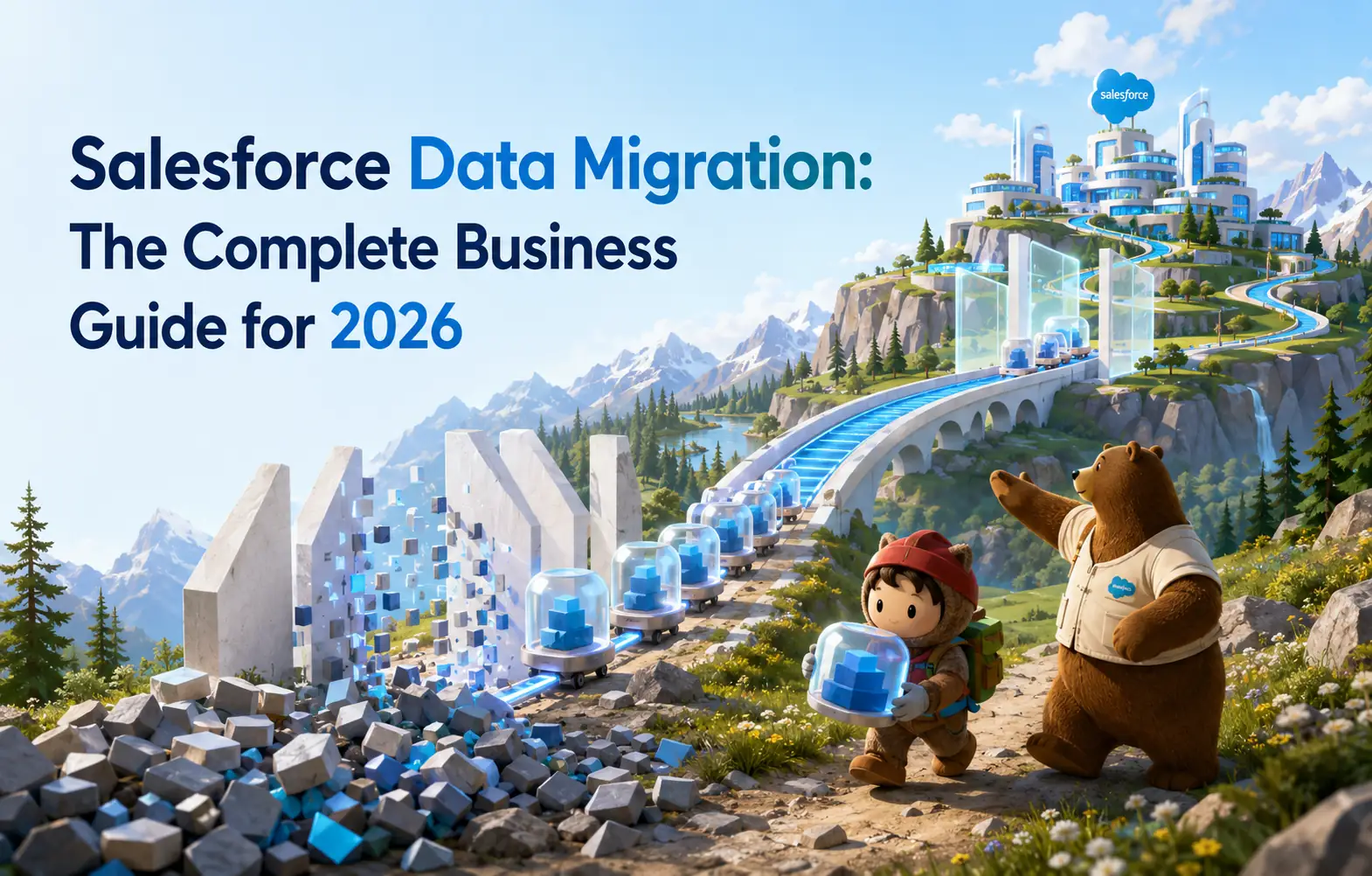
Salesforce Data Migration: The Complete Business Guide for 2026

Table of content
Quick question before we get into it: when's the last time you fully trusted every number in your CRM without double-checking it? If you're mid-migration, or about to start one, the honest answer is probably “not recently.” That's normal. Moving data into, out of, or between Salesforce orgs is one of the riskiest, quietly stressful phases of any CRM project, and it's also one of the most underestimated. A single mapping error can duplicate thousands of records. A missed validation rule can drop a critical field without anyone noticing until a report comes back wrong three weeks later. This guide walks through what proper Salesforce Data Migration Services actually involve in 2026, why the process matters more than the tooling you pick, and how to tell a partner who's done this before from one who's learning on your dime.
Before we get into the process, let's do a quick gut-check. Tick off anything below that sounds like your current situation.
- You've got customer data spread across a legacy CRM, a handful of spreadsheets, and at least one tool nobody officially owns anymore.
- Nobody's fully sure which record is the “real” version of a given contact.
- Your last data cleanup was a one-time project that quietly un-happened over the following year.
- You're planning a Salesforce rollout, and data migration is the part everyone's hoping someone else will handle.
If you checked two or more of those, you're exactly who this guide is written for.
Why Migration Is Harder Than It Looks
Here's the part nobody tells you upfront: legacy systems almost never map cleanly onto Salesforce's object model. Custom fields, inconsistent naming conventions, duplicate contacts, and years of manual data entry all have to be reconciled before a single record moves anywhere. Add in whatever automation is already live in your org, workflow rules, flows, and triggers that fire the instant new data lands, and a job that looks like “just move the files over” quietly turns into a project with its own timeline, its own risks, and its own war stories.
Why 2026 Raises the Stakes
This isn't just an old problem wearing a new year. Salesforce has pushed hard toward AI agents that sit across sales, service, and support, and every one of those agents is only as good as the data underneath it. Clean, unified data has gone from “nice to have eventually” to a hard prerequisite for anything AI-driven to work properly. If your migration leaves duplicate records, orphaned relationships, or half-mapped fields behind, you're not just carrying forward old mess, you're actively setting up whatever automation or AI initiative comes next to fail before it starts.
Data Cloud has made this even more concrete. Salesforce increasingly treats a unified, real-time customer profile as the foundation everything else sits on top of, from AI agents to standard reporting. A migration that leaves data fragmented across duplicate records or inconsistent formats doesn't just look messy, it actively undermines that foundation before it's even built. Getting the underlying data right during migration is no longer just about clean CRM hygiene. It's about whether everything Salesforce builds on top of that data actually works the way it's supposed to.
What a Proper Migration Process Actually Looks Like
So what does “doing it right” look like in practice? A properly run Salesforce Data Migration Services engagement generally moves through the same sequence, whatever the source system happens to be.
- Assess — a full audit of your source data, its volume, its quality, and where the landmines are actually hiding.
- Cleanse — deduplicating and standardizing records before anything gets touched, not after the fact.
- Map — matching source fields to the right Salesforce objects and writing the transformation rules that connect them.
- Test — loading everything into a sandbox first, and genuinely checking it, not just glancing at record counts.
- Migrate — the production cutover itself, with a rollback plan sitting ready in case something goes sideways.
- Validate and sync — confirming record counts, relationships, and business rules all landed intact, then keeping systems in sync afterward.
Ask yourself honestly: does your current plan cover all six of those, or does it jump straight from “export the spreadsheet” to “import into Salesforce” and hope for the best? Step four, sandbox testing, is the one most teams skip under deadline pressure, and it's the single most common reason migrations go wrong in front of real users instead of in testing, where it's safe and nobody's watching.
Where Migrations Quietly Go Wrong
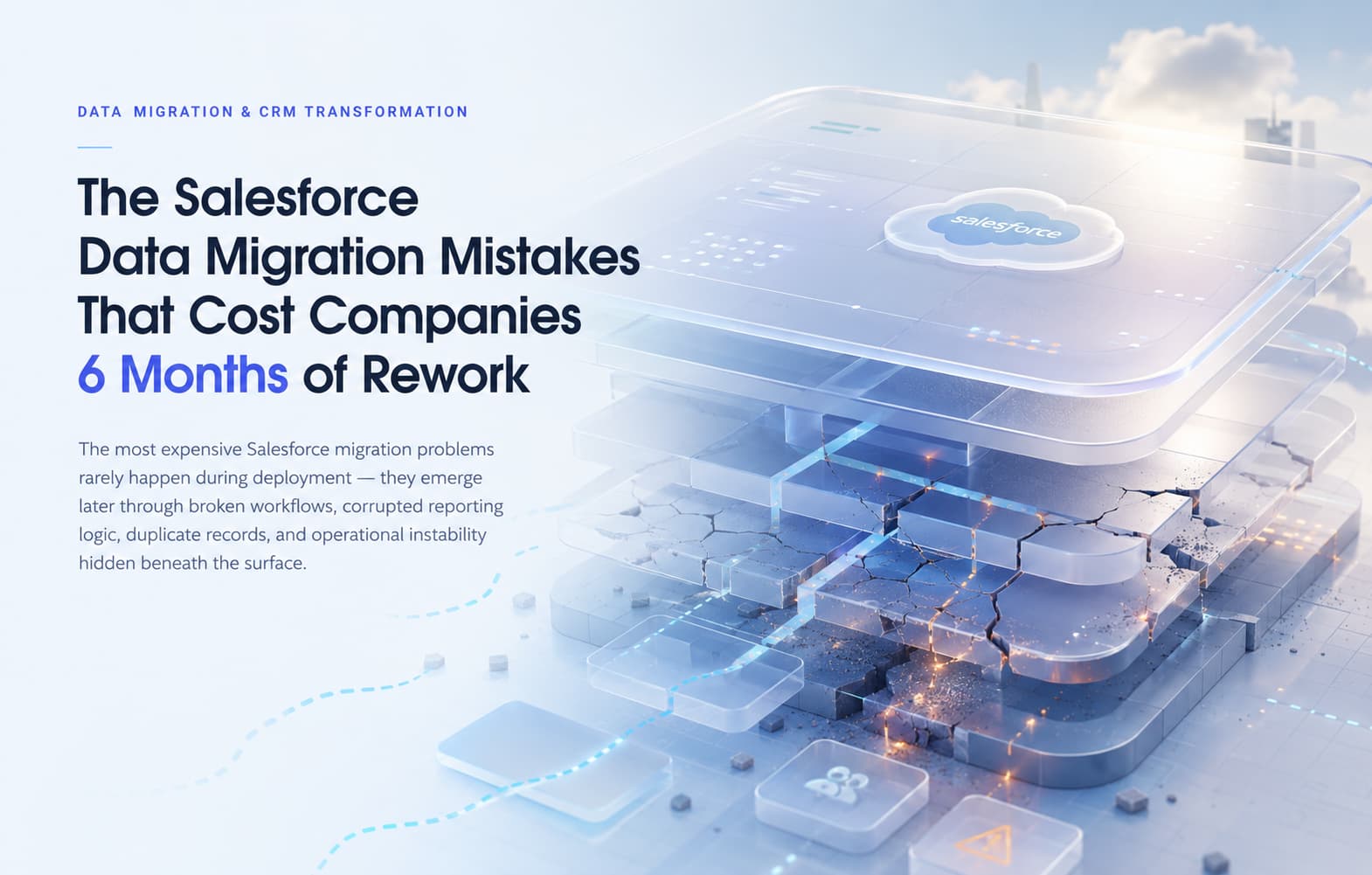
The most expensive mistakes in a migration usually aren't about the data itself, they're about what breaks around it. Sharing rules that quietly expose records to the wrong users. Orphaned child records left behind after a parent object moves without them. Reports and dashboards that silently stop working because a field got renamed somewhere along the way. None of these show up on migration day. They show up two, three, six weeks later, when someone downstream notices a number that doesn't add up, or a client record that three different people can suddenly see. Building validation steps that specifically check for these, not just record counts, is what separates a migration that holds up from one that just looked fine on launch day.
The Problems This Is Actually Meant to Solve
It helps to name the specific pain points a good migration should close off, because “clean data” on its own is a bit abstract.
- Disconnected systems — your customer data is scattered across platforms, and getting one full view of a customer means opening four tabs and cross-referencing by hand.
- Data quality — duplicate records, missing fields, and inconsistent formats quietly erode trust in whatever the CRM tells your team.
- Legacy limitations — an older system was never built with Salesforce's current Sales Cloud, Service Cloud, or Data Cloud workflows in mind, so its data doesn't slot in without real transformation work.
- Manual, spreadsheet-heavy processes — every hour someone spends re-keying data by hand is an hour, and a risk of error, that a proper migration should remove for good.
If more than one of those sounds like your business right now, that's not a personal failing. It's just what happens when systems grow faster than anyone plans for.
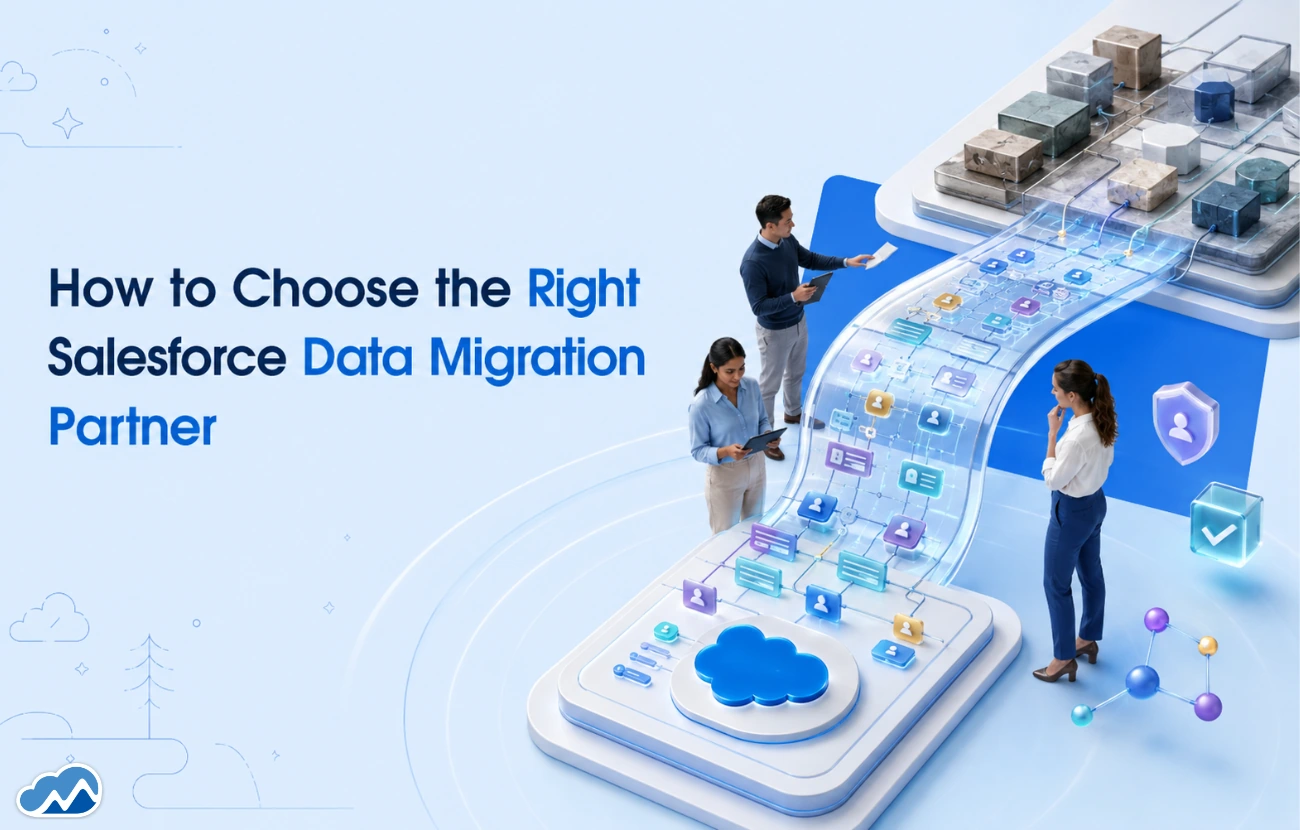
This is exactly the kind of work a specialist team should own end-to-end, rather than something bolted onto a wider implementation as an afterthought. If you're comparing providers, look closely at how they actually run Salesforce Data Migration projects day to day, not just whether the phrase appears on their services page. Ask for their rollback process. Ask how they handle deduplication. Ask how they validate record counts and relationships after the load, not only before it. The answers you get back will tell you more than any pitch deck will.
What Good Providers Actually Migrate From
A useful sanity check on any provider is asking what they've actually moved data out of before. Legacy CRMs like older Dynamics, Zoho, or HubSpot instances are common starting points. So are ERPs, standalone spreadsheets that have quietly become “the system,” and fully custom databases nobody outside one team fully understands anymore. If a provider can only talk confidently about one type of source system, that's worth noting, because real-world migrations are rarely tidy, and the messier your starting point, the more that prior experience actually matters.
How Long Does This Take, and What Does It Cost?
There's no single honest number here, and anyone who quotes you one before seeing your data volume and system count is guessing. As a rough guide: a straightforward migration for a smaller team, one source system, a modest number of objects, tends to land somewhere around four to six weeks. A multi-org, enterprise-scale migration with several integrations can run three to six months. The variables that actually move that number are your data volume, how many source systems are involved, and how many Salesforce objects need to be touched. A partner worth hiring will want to know all three before committing to a timeline, and will build you a milestone-based plan rather than a single delivery date you're just supposed to trust.
Picture this: a 40-person sales team moving off a patchwork of spreadsheets and an aging CRM into Salesforce. On paper it's a small migration, a few thousand contacts, a handful of custom fields nobody's touched in years. In practice, three different reps have been maintaining their own version of the same 200 accounts, none of them fully in sync. Without a proper cleanse-and-map phase, that team goes live with triplicate accounts and no clean way to tell which contact history is accurate. With one, the deduplication happens before go-live, sales reps open Salesforce on day one to a single, trustworthy account per customer, and the migration becomes the thing nobody remembers happening, because nothing broke.
Choosing a Partner: The Questions That Actually Matter
A few questions tend to separate a partner who'll deliver from one who'll just bill hours.
- Do they have a documented, repeatable migration methodology, or does every project start from a blank page?
- Can they explain their rollback plan in specific terms, not just “we have one”?
- Do they treat validation as a formal, signed-off step, or as something that happens informally after go-live if there's time?
- Will a named specialist actually own your project from kickoff through go-live, or does accountability get diffused across a rotating cast?
- Will they hand over clean documentation so your own team can maintain things afterward, or does your org quietly become a black box only they understand?
If a provider gets vague or defensive on any of those, take that as useful information in itself.
How This Fits Into the Bigger Picture
It's worth remembering that migration rarely happens in isolation. It's usually one phase inside a larger Salesforce engagement that also covers configuration, integration, and getting your team genuinely comfortable using the new setup day to day. If you're mapping out that bigger picture, our Complete Guide to Salesforce Consulting walks through how the full scope gets planned, staffed, and priced, which is useful context before you scope a migration on its own.
Here's the honest measure of success: done right, Salesforce Data Migration Services should be almost invisible to your end users. They log in on day one, and their data, their relationships, their reports, are simply there, working exactly as expected. Nobody sends a Slack message asking where their opportunities went. That invisibility doesn't happen by accident. It comes from treating migration as a full lifecycle, assess, cleanse, map, test, migrate, validate, and sync, rather than a weekend data dump between two systems and a lot of hoping for the best.
So, back to that question at the start: how confident are you, right now, in the data sitting in your CRM? If the honest answer is “not very,” that's a genuinely good place to start the conversation.
Frequently Asked Questions











Agentforce for Financial Services: AI-Driven Banking & Insurance Solutions













.webp)







n8n Workflow Automation: From Lead Capture to CRM in Minutes, Not Hours


%20(1).webp)