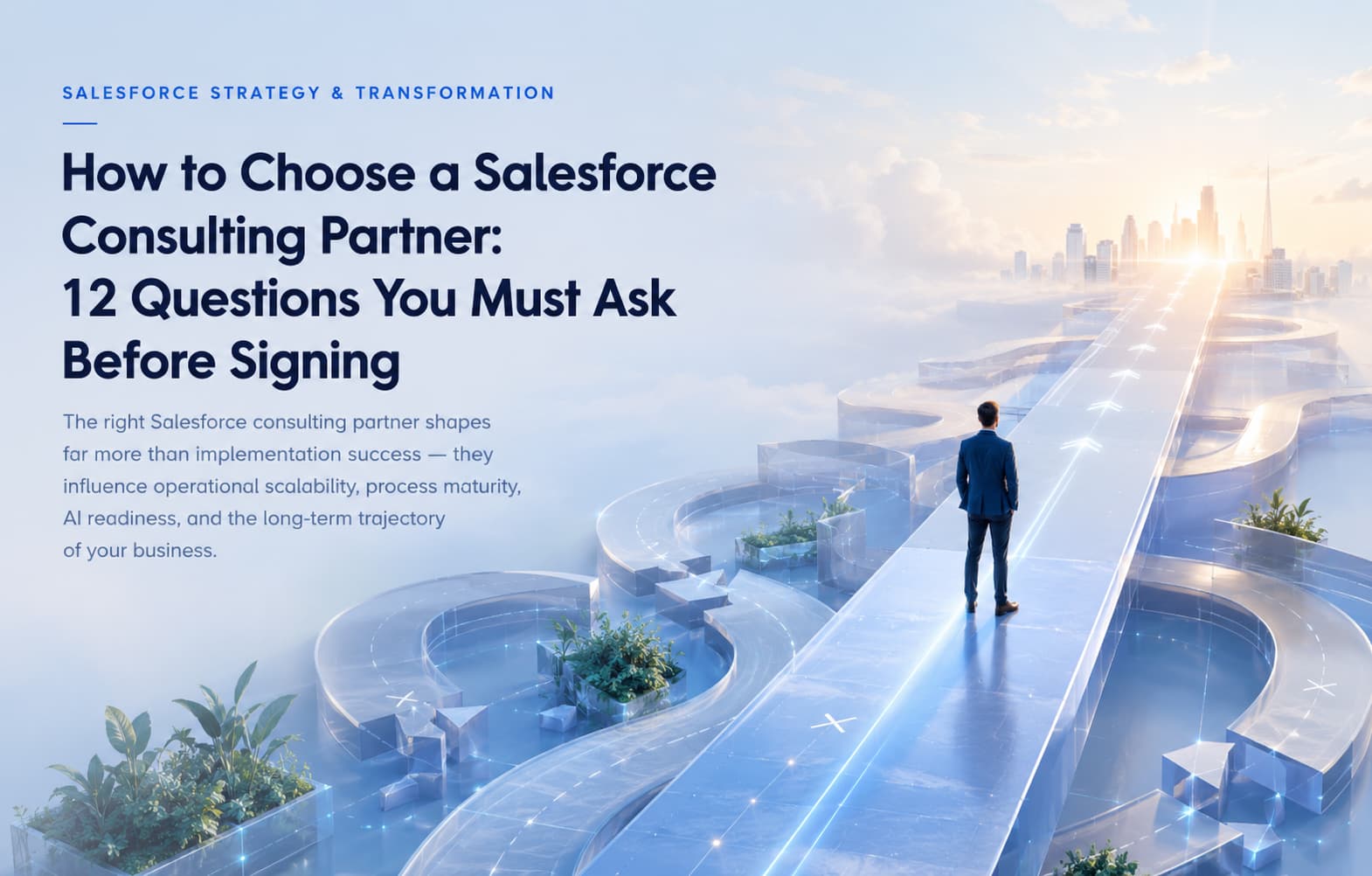
How to Choose the Right Salesforce Consulting Partner in 2026

Table of content

Picking a Salesforce consulting partner is one of those decisions that looks simple until you actually start comparing options. Search the AppExchange partner directory and you'll find thousands of firms: one-person freelance shops, boutique agencies that live inside a single cloud and global systems integrators running delivery teams the size of a mid-sized company. Company size tells you almost nothing about fit. What matters is whether a partner's actual experience lines up with the problem you're trying to solve.
The stakes are higher than the invoice suggests. A partner configures objects and builds flows, but they also make architectural decisions you'll live with long after they've moved on. Poor data model choices, custom code where declarative tools would have done the job and automation nobody documented all become your maintenance burden. What you want is a team that understands your business, tells you when you're wrong and leaves your org in a state your internal admin can actually maintain. The cheapest bid and the biggest logo are both beside the point.
Get Clear on What You're Actually Hiring For
"Consulting partner" covers a wide range of work, and the type of engagement changes who you should be talking to. A greenfield implementation for a company moving off spreadsheets calls for a different skill set than optimizing an org that's been live for six years and has accumulated a decade of workarounds. A "rescue" project, cleaning up after a failed implementation, is its own specialty, and not every partner wants that work or is good at it. Before you request a single proposal, write down whether you need a build, a fix, an integration or ongoing admin support. Firms that lead with "we do it all" often mean they'll say yes to anything, not that they're equally strong at everything.
It also helps to be honest about what you're bringing to the table. A partner can only move as fast as your side can make decisions, and the biggest cause of slipped Salesforce timelines is rarely consultant capacity. It is usually a client team that can't get sign-off on requirements, can't free up a business owner for workshops or can't produce clean data for migration. Decide before you go to market who owns the project internally, how much of their week they can realistically give it and who has authority to settle disputes between departments. If you can't answer those questions, the first thing a good partner will do is make you answer them, and that work is worth paying for on its own.
Certifications Are a Filter, Not a Verdict
Salesforce's partner tiers and individual certifications such as Administrator, Platform App Builder, Application Architect and System Architect are worth checking, but they measure exam-passing, not project delivery. A firm with a wall of certification badges can still staff your project with a junior consultant who's never led an implementation solo. Ask directly who will actually be on your account day to day, what their certifications are and how many similar projects they've personally run. Not the agency as a whole, the individual.
Partner tier deserves similar scepticism. Salesforce's tiering reflects certification counts, revenue contribution and satisfaction scores across a firm's whole portfolio, which means a Summit-tier global integrator can still be a poor fit for a 40-seat Sales Cloud rollout where you'd be the smallest account on the books. A small Registered partner with three consultants may have run twenty projects that look exactly like yours. Use tiers and badges to build a shortlist and to confirm a firm is a real business with a delivery track record. Then stop treating them as evidence and start asking about specific projects.
Industry Experience Matters More Than People Expect
Two firms can both be excellent generalist Salesforce partners and still deliver very different results for a healthcare company versus a manufacturer. Compliance requirements, typical integrations and even which objects and record types make sense vary by industry. If a partner has never touched your vertical, that's not automatically disqualifying, but it does mean you should budget more time for discovery and expect a steeper learning curve on their side.
Ask how vertical knowledge is actually held inside the firm. Sometimes it lives in one person, and if that person isn't staffed on your project you're buying a reputation rather than an asset. Ask which industry-specific products a partner works with, such as Health Cloud, Financial Services Cloud, Manufacturing Cloud or Nonprofit Cloud, and whether they'd recommend one for you or steer you towards configuring standard objects instead. A partner who can argue both sides of that decision against your requirements knows the territory. One who defaults to the industry cloud in every conversation may just be reselling what they know how to install.
How to Read Case Studies and References
Case studies on a partner's website are marketing assets, so read them for structure rather than outcome. The useful ones describe the starting situation, the specific problem, what was built and how long it took. The ones to discount are the ones that lead with a percentage like "42% increase in sales productivity" with no explanation of what was measured or over what period. When you get on a call, ask about a project that went badly. Every firm with real delivery history has one, and how a partner describes it tells you more than any success story: whether they own their part of it, whether they learned something specific and whether they can talk about a client's failings without contempt.
Reference calls are worth doing properly. Ask the referee what they'd do differently, who on the partner's team made the difference and whether the people who sold the work were the people who delivered it. Ask what happened when scope changed, because it always does. And ask whether they'd hire the firm again for a second phase. A hesitation there is more informative than a paragraph of praise. If a partner offers references only from projects far larger or far smaller than yours, in a different industry or from three years ago, treat that as a data point about their recent pipeline rather than an administrative inconvenience.
How the Pricing Models Actually Work
Most Salesforce engagements are priced one of three ways. Fixed-bid works well when scope is genuinely well-defined and unlikely to change, such as a discrete integration or a single-cloud implementation with a locked requirements doc. Time-and-materials suits projects where scope will evolve, which is most of them, but it puts more responsibility on you to track hours and stay close to the work. Retainers make sense once you're past initial implementation and need ongoing admin, small enhancements and support. Be wary of a fixed-bid quote for a project that clearly hasn't been scoped yet, since it usually means change orders later.
Whatever the model, look closely at what the rate actually buys. Blended day rates hide the mix of seniority you'll get; separate rates for architect, consultant and admin time tell you what the staffing plan really looks like. Ask whether project management, testing, training and documentation are billed inside the estimate or on top of it, since those four items routinely account for a third of the effort on a Salesforce implementation. Ask how change requests are priced and who approves them. And compare estimates by hours rather than headline price, because two quotes that differ by 30% on cost often differ by twice that on assumed effort, which means at least one of them has misread the scope.
What Good Discovery Looks Like
Discovery is where most of the value or damage of an engagement is created, so ask to see the shape of it before you commit. A credible process includes stakeholder interviews across every team that will touch the system rather than just the sponsor, a review of your existing org or current tooling, a data audit and a documented set of requirements you sign off on. It should produce artefacts you keep: a process map, a data model, a prioritised backlog and a phasing plan. If the only output is a slide deck and a statement of work, you've bought a sales exercise.
Pay attention to how much a partner pushes back during this phase. The best consultants spend a good part of discovery talking clients out of things: the custom object that should be a picklist, the integration that duplicates a report nobody reads, the phase-one wish list that belongs in phase three. A partner who agrees with everything you propose is either not paying attention or has decided that arguing costs more than it earns. Both are expensive for you later.
Team Structure, Delivery Model and Communication
Ask for the staffing plan in writing: names, roles, allocation and the weeks they're on your project. There's a common pattern where a senior architect appears in the pitch, designs the solution in week one and is then spread across four other accounts while a junior consultant does the building. That can work if the architect stays accountable for review, and it fails quietly if they don't. Find out who your day-to-day contact is, who makes technical decisions when that person is unsure and what happens if a key consultant leaves mid-project.
Offshore and hybrid delivery models are normal now and can be excellent value, but the overlap matters more than the location. Two or three hours of shared working time per day is usually enough for a well-run project; less than that and every clarification costs a day. Ask what the cadence looks like: a weekly demo, a written status report against the plan, a shared backlog you can see without asking for it. Access to the project board is a reasonable request, and reluctance to grant it is worth noticing.
What Happens After Go-Live
Launch is the middle of the project, not the end. Ask what the hypercare period covers, how long it lasts and whether it's included in the price. Two to four weeks of prioritised support after go-live is a reasonable expectation. Ask what documentation you receive: a data dictionary, a list of automations and what triggers them, integration details with credentials handled properly and admin runbooks for the tasks your team will own. If documentation appears as a line item that can be cut to hit a budget, understand that you're the one who pays for it later.
Then decide what happens to ownership. Some organisations want to be self-sufficient within a quarter, which means training and shadowing need to be built into delivery rather than bolted on at the end. Others would rather keep a retainer and let the partner run enhancements indefinitely. Both are legitimate, but they lead to different engagement designs and different partners, so it's worth being explicit about which one you want before the statement of work is drafted. Adoption is also part of the handover. A technically flawless org that sales reps route around is a failed project, and a partner who has no view on user training and change management has only done half the job.
Red Flags Worth Taking Seriously
A proposal that arrives within a day or two of a single discovery call, with no follow-up questions, usually means the estimate is a guess. Reluctance to provide references from projects similar to yours, or references that are all several years old, is worth pushing on. So is a partner who can't clearly describe what happens after go-live. Hypercare, documentation handoff and a support plan should all be part of the conversation before you sign, not an afterthought once the project wraps.
A few others are worth adding to the list. Discomfort with naming the actual delivery team, or a proposal written entirely in generalities about "best practices" with no reference to anything you said in discovery, suggests a template with your logo dropped on it. Heavy pressure to sign before quarter end is a sales problem you'll inherit as a delivery problem. Recommending large amounts of custom development early, before declarative options have been explored, is either inexperience or a preference for billable complexity. And a partner who won't put a phasing plan on paper, insisting everything must ship at once, is avoiding accountability for the sequence they've proposed.
Questions to Ask Before You Sign
- Who specifically will be staffed on this project, and what's their track record?
- What does your discovery process look like, and how long does it typically take?
- Can I speak to a client from a project similar in scope to mine?
- What happens if the timeline slips, and how is that handled contractually?
- What does support look like in the first 90 days after launch?
- Who owns the documentation, and what exactly will we receive at handover?
- How do you move work from sandbox to production, and do you use source control?
- Tell me about a project that went badly. What happened, and what changed afterwards?
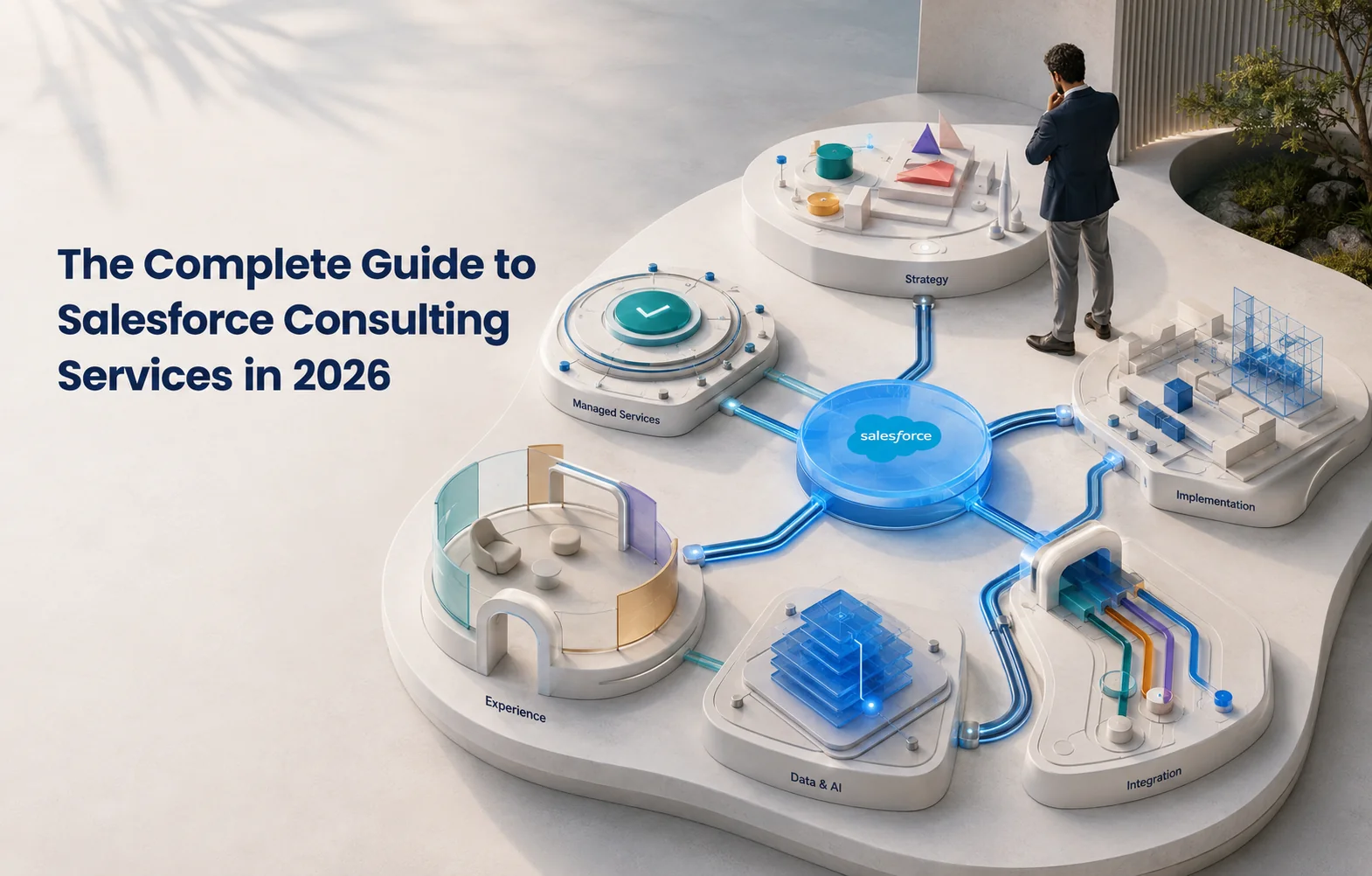
The partner you choose will shape how your Salesforce org works for years, not just for the length of the project. Slowing down at the selection stage to ask pointed questions and check references that actually match your situation tends to save far more time than it costs. For a broader look at what Salesforce consulting engagements typically involve, see our Complete Guide to Salesforce Consulting Services.
A workable process, if you want one: define the engagement type and your internal capacity, shortlist three to five partners whose recent work resembles your problem, pay one or two of them for a short paid discovery rather than asking for free scoping, then choose on the strength of what discovery produced. It takes a few weeks longer than picking from proposals and it removes most of the risk that matters.












Agentforce for Financial Services: AI-Driven Banking & Insurance Solutions










.webp)






n8n Workflow Automation: From Lead Capture to CRM in Minutes, Not Hours



%20(1).webp)