Salesforce Marketing Cloud: Implementation Best Practices for 2026

Table of content
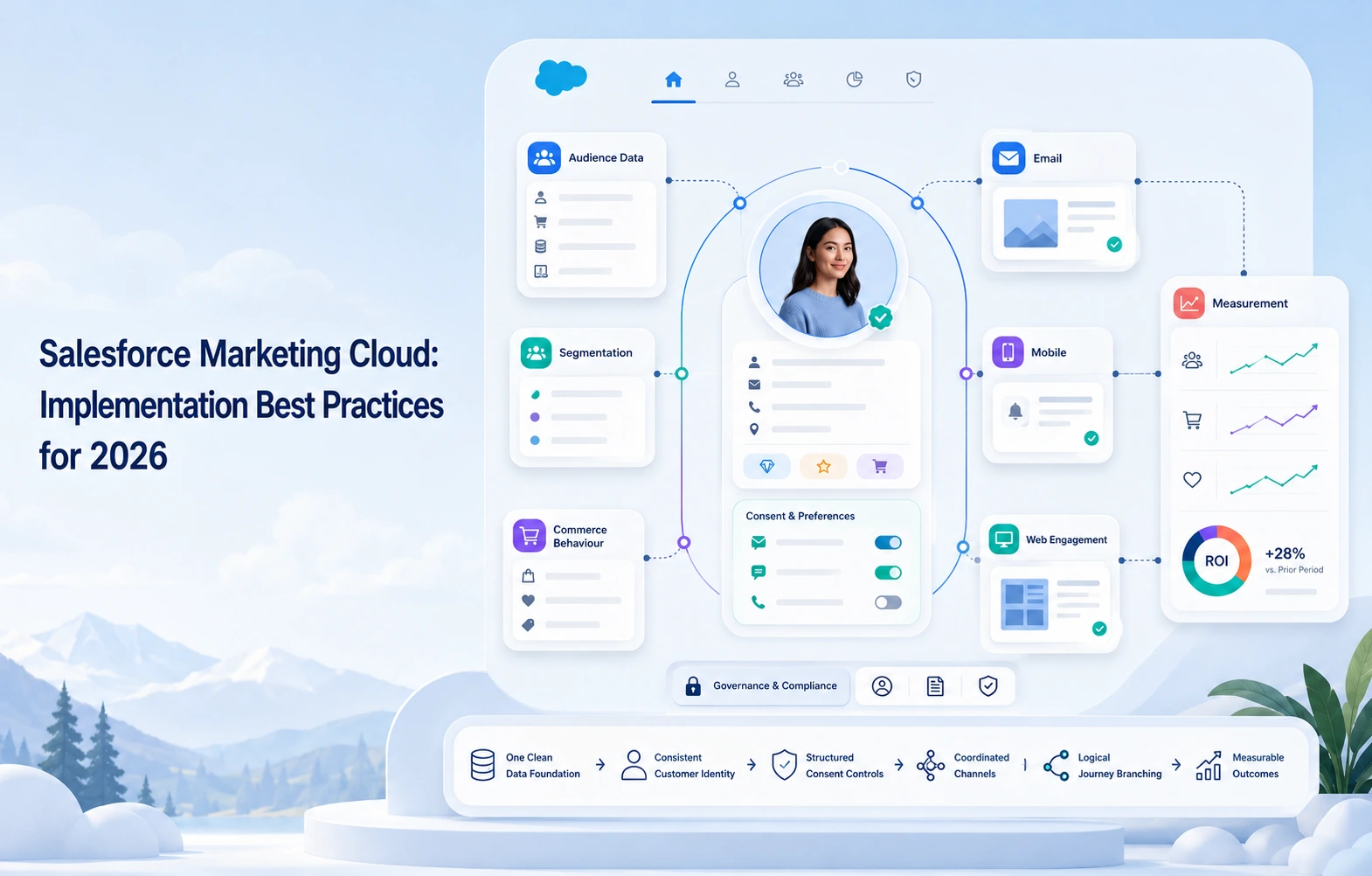
Marketing Cloud has a reputation, and it's a fair one. Ask around and you'll hear the same two sentences: it's one of the most powerful marketing platforms money can buy, and it's one of the easiest to make a mess of. Both are true. The distance between those two outcomes is almost entirely down to how it's set up.
That's the thing most teams learn the expensive way. A Salesforce Marketing Cloud implementation isn't a switch you flip. It's a build, and a fairly deep one, where a handful of early decisions quietly determine whether you end up with beautifully orchestrated, revenue-driving journeys or a very costly way to send emails nobody opens.
So this isn't a feature tour. It's the best practices that separate the implementations that work from the ones that get quietly written off eighteen months later. Let's get into it.
What Marketing Cloud Actually Is (and Why It Trips People Up)
Marketing Cloud is Salesforce's platform for enterprise marketing: email, SMS, push, journeys, segmentation and personalisation, running at a scale and depth that basic email tools simply can't touch. If you've come from a Mailchimp or a HubSpot, the first thing you notice is that it doesn't hold your hand. It hands you power and assumes you know what to do with it.
It's worth knowing there isn't just one Marketing Cloud either. Marketing Cloud Growth runs on the core Salesforce platform and suits smaller, faster teams, while Marketing Cloud Engagement and Advanced are the heavyweight enterprise editions built on the ExactTarget lineage. Which one you're implementing changes the approach entirely, and picking the wrong edition for your size is one of the first mistakes we see. Getting that decision right is where a good Salesforce Marketing Cloud implementation actually starts.
Marketing Cloud is one piece of a much bigger picture. If you're still weighing which Salesforce clouds your business genuinely needs, our Salesforce Clouds Overview lays out how they fit together. This guide assumes you've decided on Marketing Cloud and now want to implement it properly.
Why the Implementation Is Where It Lives or Dies
Here's the uncomfortable truth about any Salesforce Marketing Cloud implementation: the licence gives you an empty, immensely capable engine. It knows nothing about your customers, your data, your brand, your consent rules or your journeys until you build all of it in. And unlike a lighter tool, Marketing Cloud punishes shortcuts. A rushed data model or sloppy deliverability setup doesn't just look untidy, it actively breaks things later.
That's why the best practices below aren't optional polish. They're the difference between a platform your marketing team leans on every day and one they fight with until someone suggests going back to the old tool. Skip the groundwork and you'll pay for it, usually right around the time you're trying to scale up.
Best Practice 1: Fix the Data Model Before Anything Else
This is the single most important decision in the whole project, and the one teams are most tempted to rush past on the way to building pretty emails. Don't. In Marketing Cloud, your data lives in data extensions, related through Contact Builder, and how you structure that foundation determines what you'll be able to do for years.
Get it right and segmentation, personalisation and reporting all become straightforward. Get it wrong and every journey you build afterwards inherits the mess, queries slow to a crawl, and "can we just target customers who did X" turns into a two-week project. A serious Salesforce Marketing Cloud implementation spends real time here before a single email is designed. It's not glamorous. It's just what everything else stands on.
Best Practice 2: Treat Deliverability as a Day-One Priority
You can build the most beautiful journey in the world and it means nothing if your emails land in spam. Deliverability is the quiet killer of marketing programmes, and it's almost always neglected until the open rates crater and everyone panics.
Set up sender authentication properly, SPF, DKIM and DMARC, from the start. If you're on a dedicated IP, warm it up gradually rather than blasting your whole list on day one, which is the fastest way to torch your sender reputation. Keep your lists clean and your engagement healthy, because mailbox providers watch how people react to your mail far more than they watch your content. Nail this during implementation and you avoid the single most demoralising failure mode in email marketing: doing everything right and still not reaching the inbox.
Best Practice 3: Build Journeys Around the Customer, Not the Campaign
Journey Builder is where Marketing Cloud earns its price, and also where good intentions go to die. The temptation is to recreate your old batch-and-blast habits with a nicer interface: same email, same time, whole list. That wastes the platform entirely.
The point of a journey is that it responds to the individual. Someone downloads a guide, they enter a nurture path; they go quiet, they get a re-engagement track; they buy, they move to onboarding. Design around what the customer actually does, not around the campaign you wanted to send. That shift, from broadcasting to responding, is the whole reason a Salesforce Marketing Cloud implementation is worth the effort. Build it customer-first and the platform starts to feel less like an email tool and more like a marketing team that never sleeps.
Best Practice 4: Segment Like You Mean It
Related to the point above, and worth its own line: stop sending everything to everyone. Marketing Cloud gives you serious segmentation power, and the whole return on the platform depends on using it. A relevant message to a smaller, well-chosen audience beats a generic one to your entire database every single time, and your deliverability will thank you for it too, because engagement goes up when people actually care about what you send.
Best Practice 5: Connect It to Your CRM
Marketing Cloud on its own is powerful. Marketing Cloud wired into the rest of Salesforce is transformative. When your marketing platform can see what sales and support are doing, and vice versa, you stop treating the same customer as three different strangers.
Marketing Cloud Connect links Engagement to Sales and Service Cloud, so a lead your campaigns nurture flows cleanly into the pipeline your reps work in Salesforce Sales Cloud, and a frustrated customer being handled in Salesforce Service Cloud doesn't get a cheerful upsell email the same afternoon. Planning that integration as part of the implementation, rather than bolting it on later, is what turns four disconnected tools into one joined-up view of the customer.
Best Practice 6: Add Personalisation and AI Once the Foundation Is Solid
Personalisation is where Marketing Cloud gets genuinely impressive, dynamic content, Einstein-driven send-time and content recommendations, and increasingly Agentforce agents that can help build and optimise campaigns. Used well, it lifts engagement in ways a generic send never will.
But note the order. All of it depends on the clean data and solid structure from Best Practice 1. AI and personalisation amplify whatever you feed them, so on a shaky foundation they amplify the problems, confidently, at scale. The teams who win with this layer are the ones who resisted the temptation to lead with it and built the boring groundwork first. Get the Salesforce Marketing Cloud implementation right underneath, then let the clever stuff stand on top.
Best Practice 7: Decide What Success Looks Like Before You Launch
Open rates and click rates feel like results. Mostly they're vanity. The question that matters is whether marketing is driving pipeline and revenue, and you can only answer that if you've set up the tracking and the CRM connection to follow engagement all the way through to a closed deal.
Agree the metrics that actually matter to your business before go-live, and build the reporting to capture them. Otherwise you'll spend a year celebrating open rates while nobody can say whether the platform paid for itself. A good implementation bakes measurement in from the start, not as an afterthought when leadership asks for ROI.
Best Practice 8: Get Consent and Governance Right
This is the boring one everybody nods at and then ignores, and it's the one that turns into a genuine problem. Marketing at scale means handling personal data and consent at scale, and the rules, GDPR and the rest, are not optional.
Build a proper preference centre so people can control what they receive. Honour consent and unsubscribes cleanly across every channel. Keep the data governance tight so you're not one audit away from a bad week. Baking this into the Salesforce Marketing Cloud implementation from the start is far cheaper and calmer than retrofitting it after a complaint. It also, quietly, makes your marketing better, because people who chose to hear from you are the people who engage.
Mistakes We See in Marketing Cloud Implementations
A few patterns come round so often they're almost inevitable.
Rushing the data model to get to the fun part. Every shortcut here becomes a permanent tax on everything you build later.
Recreating batch-and-blast in Journey Builder. Buying a Ferrari to sit in traffic. If every journey targets the whole list, you've wasted the platform.
Ignoring deliverability until it's a crisis. By the time open rates collapse, your sender reputation is already damaged and recovery is slow.
Leading with AI and personalisation on messy data. Impressive-looking, wrong at scale, and it erodes trust with your audience fast.
No CRM integration. Marketing Cloud in a silo is a fraction of what you paid for.
Treating go-live as the end. Marketing programmes evolve constantly; an unmaintained setup drifts out of usefulness within a year.
Signs Your Marketing Cloud Needs a Rethink
Not sure whether yours is pulling its weight? Run through these honestly.
Your open rates have been quietly sliding and nobody's sure why. Every send still goes to more or less the whole list. Marketing can't tie its activity to actual revenue. Your data extensions are a tangle nobody fully understands. Marketing Cloud can't see what sales or support are doing. Two or three of those, and you don't have a platform problem, you have a Salesforce Marketing Cloud implementation that never quite landed, and it can be fixed.
Choosing a Marketing Cloud Implementation Partner
If you bring in help, a few things separate a partner worth keeping from one you'll be redoing the work after.
They start with your data and your strategy, not your email templates. If the first conversation is all about creative and nothing about the data model, be wary.
They take deliverability and consent seriously. A partner who treats those as afterthoughts is setting you up for the two most painful failure modes.
They plan the CRM integration from the start. Marketing rarely lives alone, and a good Salesforce Marketing Cloud implementation is built to connect to the rest of your org, not to sit in a corner.
They build for maintenance. Ask what happens after go-live. If the answer is "we hand it over," you're buying a project, not a partnership.
Frequently Asked Questions














Agentforce for Financial Services: AI-Driven Banking & Insurance Solutions













.webp)









n8n Workflow Automation: From Lead Capture to CRM in Minutes, Not Hours



%20(1).webp)