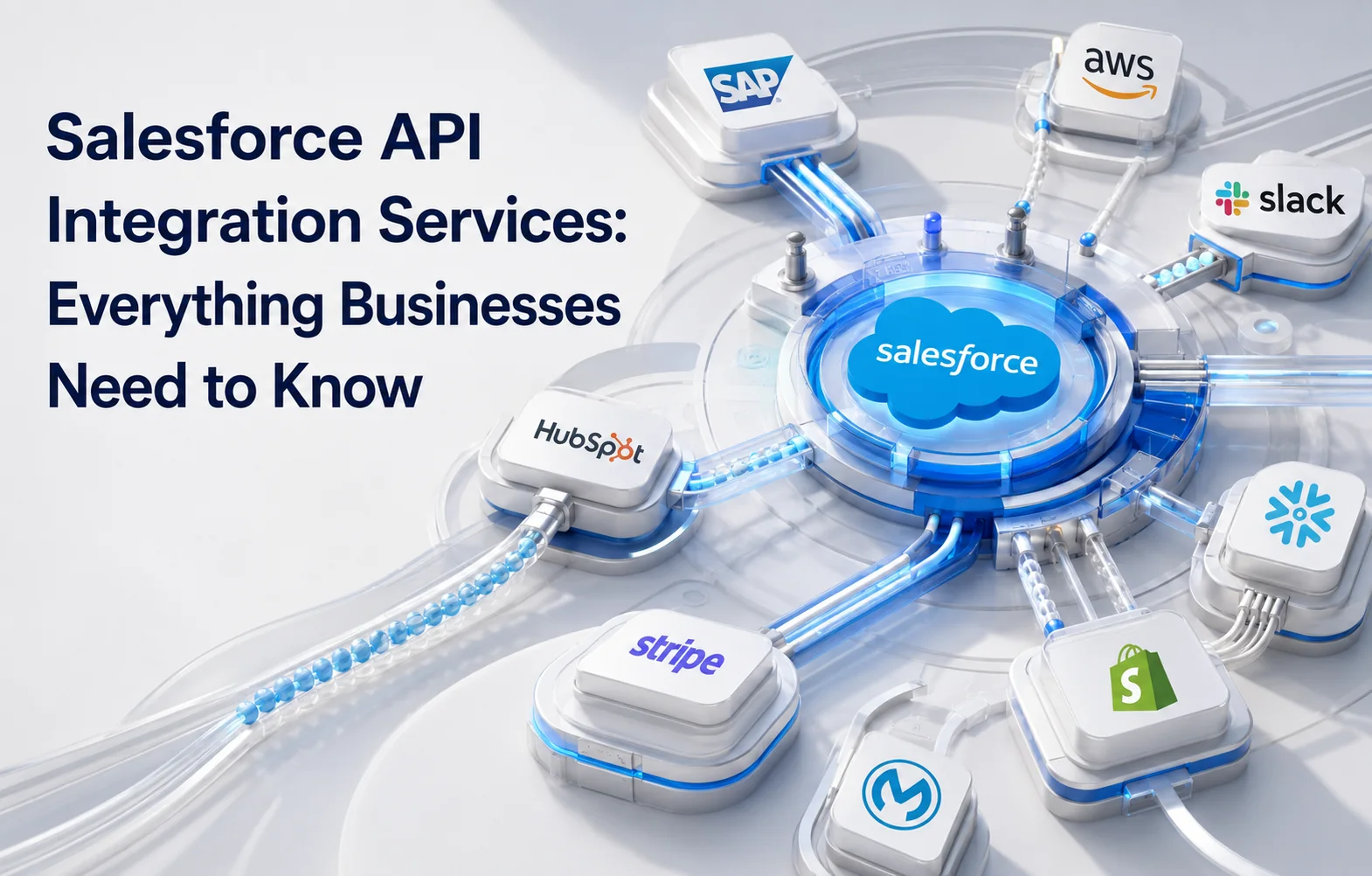
Salesforce API Integration Services: Everything Businesses Need to Know

Table of content
Quick question before we get into any of this: how many times this week did somebody on your team type the same customer detail into two different systems?
If the answer isn't zero, that's the problem Salesforce API integration services exist to solve.
Here's the thing about Salesforce. On its own, it's a very good CRM. But almost nobody runs it on its own. There's an ERP somewhere handling invoices and revenue. Marketing has its own platform firing campaigns. Support is living inside a ticketing tool. And there's usually one weird internal app that somebody built years ago which nobody wants to touch but everybody depends on.
When those systems don't talk, people become the integration. Someone exports a CSV on Friday. Someone else pastes it in on Monday. And in between, the numbers quietly drift apart until two teams show up to the same meeting with two different versions of the truth.
Sound familiar? Good. Let's fix it.
How Your Systems Got Disconnected In The First Place
Nobody sat in a room and decided to build a mess. That's worth saying out loud, because teams tend to get a little defensive about their tech stack when this conversation starts.
What actually happens is much more ordinary. You needed a CRM, so you bought Salesforce. Six months later finance needed better reporting, so an ERP came in. Then marketing needed automation. Then support volume grew and a helpdesk tool got added. Each decision made complete sense on the day it was made.
Integration was always on the list. It just never made it to the top, because it's the one project without a screaming stakeholder behind it. Nobody wakes up angry about data plumbing until the plumbing breaks.
And then it breaks in very specific ways. Sales quotes a product that's actually out of stock. Finance spends three days reconciling closed-won opportunities against real invoices. A customer calls support and gets asked to repeat information they already gave a sales rep two weeks ago. None of these feel like integration problems in the moment. They feel like people problems. They aren't.
The uncomfortable part is that untangling this later costs more than building it properly early. Every new tool you add is one more connection you'll eventually need, and connections don't scale politely. Two systems, one link. Five systems wired directly to each other, ten links. You can see where that goes.
So What Does An API Actually Do Here?
If you're technical, skip ahead. If you're the person who has to explain this project to a finance director, stay with me for sixty seconds.
An API is a doorway with a bouncer on it. Your ERP knocks and says "give me every opportunity that closed yesterday." Salesforce checks whether the ERP is allowed to ask, checks whether it's allowed to see that particular data, then hands over exactly that and nothing else. No screen, no login, no human clicking export.
That's genuinely all it is. The complexity in an integration project almost never sits in the API itself. It sits in the decisions around it. Which system wins when both have been edited? Does this need to happen instantly or is overnight fine? What counts as a duplicate? Those are business questions wearing a technical costume, which is exactly why so many of these projects stall.
The Salesforce APIs, And When You'd Reach For Each One
Salesforce gives you several APIs rather than one, and the choice matters more than people expect. Pick wrong and you'll hit governor limits, or wait four hours for a sync that should take four minutes.
REST API is your default. It's lightweight, it speaks JSON, and it's what most modern web and mobile integrations use. If someone asks you what to use and you have no other information, the answer is probably REST.
SOAP API is the older sibling. It's more rigid, more verbose and still very much alive, because a lot of enterprise systems were built to speak SOAP and are not going to learn anything new. If you're integrating with an older ERP or a bank's system, don't be surprised when SOAP shows up.
Bulk API exists for volume. Loading two million historical records? Running a nightly job that touches hundreds of thousands of rows? Doing that through REST one record at a time is how you burn through your API limits before lunch. Bulk batches the work asynchronously and gets out of its own way.
Streaming API and Platform Events handle the "tell me the moment it happens" cases. Instead of your other system asking Salesforce every five minutes whether anything changed, Salesforce pushes the event out the second it occurs. Useful for anything where a delay is genuinely expensive, like a support system that needs to know instantly that an account went into arrears.
There's also Metadata API and Tooling API, which are less about business data and more about the org itself, configuration, fields, deployments. Most business integrations won't touch them. Your development team will.
One practical warning. API limits are real, they're tied to your edition and user count, and hitting them mid-quarter is a genuinely bad afternoon. Whoever designs your integration should be thinking about call volume from day one, not discovering it in production.
The Integrations People Actually Ask For
After enough of these projects, you start to notice the same requests coming round again. Here's what tends to land on the desk.
Salesforce to ERP. NetSuite, SAP, Dynamics, Business Central. This is the big one, and it's usually driven by finance being tired of guessing. Closed-won opportunity becomes an invoice, invoice status flows back, and suddenly sales can see whether a customer has actually paid before promising them anything else.
Salesforce to marketing automation. HubSpot, Marketo, Pardot, Mailchimp. Leads flow in, campaign engagement flows back, and marketing finally gets to see which campaigns produced revenue rather than just clicks. Expect an argument about lead ownership rules during this one. There's always an argument about lead ownership rules.
Salesforce to e-commerce. Shopify, Magento, WooCommerce, a custom storefront. Orders, inventory and customer records sync so a rep isn't quoting stock that sold out three days ago.
Salesforce to support and ticketing. Zendesk, Freshdesk, ServiceNow, Jira. This one has the fastest visible payoff, because the moment a rep can see open tickets on an account before a renewal call, the value is obvious to everyone in the room.
Salesforce to your own custom application. A logistics platform, a scheduling system, an underwriting engine, something built in-house that runs a core part of the business. These take the most thought because there's no documented connector waiting for you, and the internal knowledge often lives in one developer's head.
Then there's the long tail. Accounting tools, e-signature platforms, telephony, data enrichment, BI dashboards. Individually small. Collectively, the reason your architecture needs a plan rather than a series of favours.
Which of these you prioritise depends heavily on the sector you operate in. A manufacturer's integration map looks nothing like a hospital's, and a lender's looks nothing like a retailer's. If you're working out where your industry's pressure points actually sit, read Salesforce for Every Industry: Tailored CRM Solutions That Drive Real Growth before you finalise the sequence.
Point-To-Point Or Middleware? The Honest Answer
This is where a lot of vendors selling Salesforce API integration services get evasive, so let's be direct about it.
If you have two systems and one clearly defined connection between them, build it point to point. Direct, cheap, fast to deliver, easy for anyone to understand. Do not let anyone sell you an enterprise integration platform to sync one field between two apps. That's a sledgehammer situation.
If you have three or more systems, or you know more are coming, middleware starts earning its cost. MuleSoft is the Salesforce-native heavyweight. Workato, Zapier, Boomi and Celigo cover lighter or mid-sized needs at a very different price point. What you're buying is a single place where all the logic lives, with monitoring, retries and error handling that you'd otherwise be building yourself in every single connection.
The failure mode with point to point isn't that it doesn't work. It's that it works beautifully, so you build another one, and another, and eighteen months later you have eleven bespoke connections, four of them written by a contractor who has left, and nobody can safely change a field name in Salesforce anymore.
A blunt test: could you draw your current integrations on a whiteboard in under two minutes? If not, you're already past the point where middleware would have helped.
Security: The Bit Everyone Nods At And Then Ignores
Every integration you build is a new door into your customer data. Sometimes a door with the key left in it.
Use OAuth, not hardcoded credentials. Yes, hardcoding is faster on day one. It's also how a service account password ends up sitting in a config file that gets committed to a repo, and how nobody can rotate it two years later because four things silently depend on it.
Scope permissions to what the integration genuinely needs. If your marketing platform only needs to read leads and write campaign responses, it should not be running as a system administrator. This takes an extra hour to set up and saves you an incident report later.
Log everything, and put an alert on failures. This is the one people skip, and it's the one that hurts most. A sync that silently fails on a Tuesday and gets noticed six weeks later means six weeks of decisions made on bad data. The fix is boring and cheap: log the runs, alert a real human when something fails and make sure that human isn't on holiday with no backup.
Watch your API call volume too. Set up monitoring against your org's limits before you need it, not during the incident.
How To Scope This Without Blowing The Budget
Here's the part worth reading twice, because it's where most of the money gets wasted.
Integration projects rarely go over budget because the code was hard. They go over because the business logic hadn't been agreed before anyone started building. Developers hit an unanswered question, guess, and get it wrong. Or they stop and wait, and the project drifts for three weeks while two departments negotiate.
So before a single line of code, get answers on paper. Which fields sync, exactly? Not "customer data." The actual field list. Which direction does each field move, one way or both? How often, real time or hourly or nightly? What happens when the same record was edited in both systems since the last sync, which one wins? What defines a duplicate, and what do you do when you find one? What should happen when the connection fails halfway through, retry, roll back or queue it?
That last question in particular. Ask it early.
Once those answers exist, the build is usually the straightforward part. Genuinely. The hard work is the conversation, which is also why an integration partner who only wants to talk about technology and never asks about your process is a partner worth being suspicious of.
Mistakes We See Again And Again
A few patterns show up so often they're almost predictable.
Syncing everything because you can. More data flowing does not mean more value. It means more failure points, more storage, more API calls and more noise in reports. Sync what someone will actually use.
Skipping the sandbox. Testing integrations in production is a decision you make exactly once.
Forgetting about historical data. New records flow beautifully. Then someone asks about last year's orders and the answer is that they were never migrated. Decide early whether history comes along.
No owner after go-live. Integrations aren't furniture, they need maintenance. APIs get versioned and deprecated, fields get renamed, a well-meaning admin adds a required field and quietly breaks a sync at 2am. Somebody needs to own that.
Treating it as purely an IT project. If the people who use the data daily aren't in the scoping conversation, you'll build something technically flawless that nobody's workflow actually fits.
Signs You're Overdue For This
Not sure whether this is urgent? Run through these honestly.
Somebody on your team has a recurring calendar reminder to export a report and re-upload it somewhere else. Two departments regularly disagree about the same number. Onboarding a new hire involves teaching them which system to trust for what. You've heard the phrase "just check both" more than once this month. Reporting requires a person to merge spreadsheets before anyone can see the answer.
Two or more of those, and the integration project is already overdue. You're just currently paying for it in salaries instead of software.
So Where Do You Actually Start?
Start smaller than you think. Pick the single connection causing the most visible pain, usually Salesforce to ERP or Salesforce to support, and do that one properly, end to end, with monitoring and documentation. Nothing builds internal appetite for the next phase faster than one integration that visibly works.
Map the wider architecture on paper first though, even the systems you haven't bought yet. You don't have to build it all now. You just want today's decision to not become tomorrow's rework.
And if you're at the stage of adding tools to a growing stack, plan the integration layer before the stack grows further. It's a much easier conversation now than it will be with five more systems in the mix. And whether you build in-house or bring in Salesforce API integration services, the order of work is the same: map the architecture, fix the connection causing the loudest pain, then scale from something that already works.
For how integration sits inside a broader Salesforce programme, have a look at our Complete Guide to Salesforce Consulting Services. If you'd rather just talk it through with someone who's untangled this before, that conversation is usually shorter than people expect.
Frequently Asked Questions










Agentforce for Financial Services: AI-Driven Banking & Insurance Solutions












.webp)











n8n Workflow Automation: From Lead Capture to CRM in Minutes, Not Hours


%20(1).webp)