Salesforce CRM Development: When to Go Custom vs Out-of-the-Box

Table of content
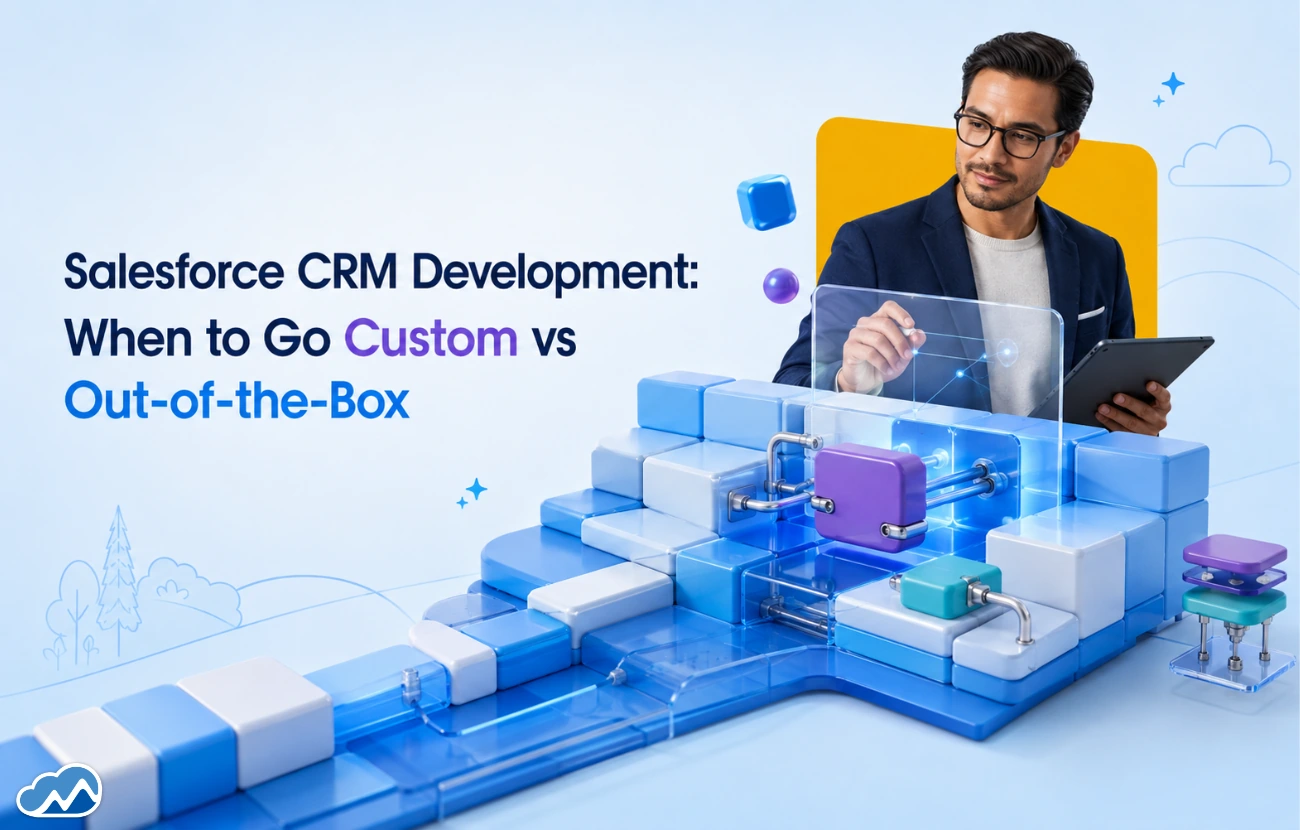
Sooner or later, every Salesforce project runs into the same fork in the road. Do you configure what the platform gives you out of the box, or do you build something custom with code? It sounds like a technical question. It is really a business one, and getting the answer wrong in either direction is expensive. This is a plain guide to making that call, and where Salesforce CRM development services genuinely earn their place.
The short version: start with what the platform offers, and only reach for custom code when you have a real reason. But the detail is where the money is saved or wasted, so let's get into it.
What "Out-of-the-Box" Actually Means
Out-of-the-box is everything you can do in Salesforce through configuration, without writing code. Objects, fields, page layouts, validation rules, reports, and a surprising amount of automation through Flow. Modern Salesforce is genuinely powerful here, and a huge share of what businesses need can be built this way, faster and cheaper than custom work, and with less to maintain.
The appeal is not just speed. Configuration survives platform upgrades cleanly, it is easier for an admin to change later, and it does not accumulate the kind of hidden complexity that code can. For most requirements, this is where good Salesforce CRM development services start, because the cheapest custom feature is the one you did not need to build.
What "Custom" Actually Means
Custom development is when configuration runs out and you write code: Apex for logic the platform cannot express, Lightning Web Components for interfaces beyond the standard ones, and integrations that reach outside Salesforce entirely. This is where the platform stops limiting you, and where you can build almost anything your business genuinely needs.
The power comes with responsibility. Custom code has to be tested, maintained, and kept working through Salesforce's three yearly releases. It can do things configuration never could, but every piece of it is something your team now owns forever. That is not a reason to avoid it. It is a reason to use it deliberately, which is exactly what good Salesforce CRM development services do.
Start Out-of-the-Box, By Default
The sensible default is to solve a requirement with configuration first, and only move to custom when configuration genuinely cannot do the job. This is not laziness, it is economics. Configured solutions are faster to build, cheaper to maintain, easier to change, and safer through upgrades. Every time you can meet a need without code, you avoid a small permanent cost.
A good partner will often talk you out of custom work you thought you needed, because they know the long-term price of it. If a firm reaches for code on every requirement, that is a warning sign, not a sign of skill.
When to Go Custom
Custom development earns its place in specific situations. When your process is genuinely unique and no amount of configuration captures it. When you need an interface or experience the standard components cannot provide. When you are integrating with an external system that has no ready-made connector. When you have hit a real platform limit that only code can work around. And when the volume or complexity of your logic is beyond what Flow can sensibly handle.
In these cases, forcing an out-of-the-box solution is its own kind of expensive, because you end up with fragile workarounds nobody understands. This is where Salesforce CRM development services shift from configuration to real engineering, and where the investment pays off.
The Hidden Cost of Over-Customising
The most common expensive mistake is building custom code where configuration would have done. Every unnecessary line of Apex is something to test, maintain, and fix when a release changes behaviour underneath it. Over-customised orgs become fragile: nobody can safely change a field, automations fight each other, and simple requests turn into engineering projects. The org gets harder to work in over time instead of easier.
Good Salesforce CRM development services treat custom code as a cost as well as a capability, and spend it carefully. The goal is an org that is powerful where it needs to be and simple everywhere else.
The Hidden Cost of Forcing Out-of-the-Box
The opposite mistake is just as real. Refusing to write code when the requirement genuinely needs it leads to teetering towers of configuration: a dozen workarounds bolted together to fake something that a small piece of custom code would have done cleanly. These are hard to understand, hard to change, and often slower and less reliable than the custom solution they were avoiding.
The honest answer is not "always configure" or "always build". It is knowing which requirement calls for which, and that judgement is the real value in experienced Salesforce CRM development services.
How to Decide
A simple test helps. Can configuration meet this requirement cleanly, without a stack of workarounds? If yes, configure it. If configuration can only fake it, and the fake would be fragile, that is your signal to go custom. Weigh the long-term maintenance cost against the value the requirement delivers, and be honest about both. Start simple, add complexity only where it earns its keep, and revisit the decision as your needs change.
Frequently Asked Questions
.webp)
.webp)
.webp)















Agentforce for Financial Services: AI-Driven Banking & Insurance Solutions









.webp)









n8n Workflow Automation: From Lead Capture to CRM in Minutes, Not Hours


%20(1).webp)