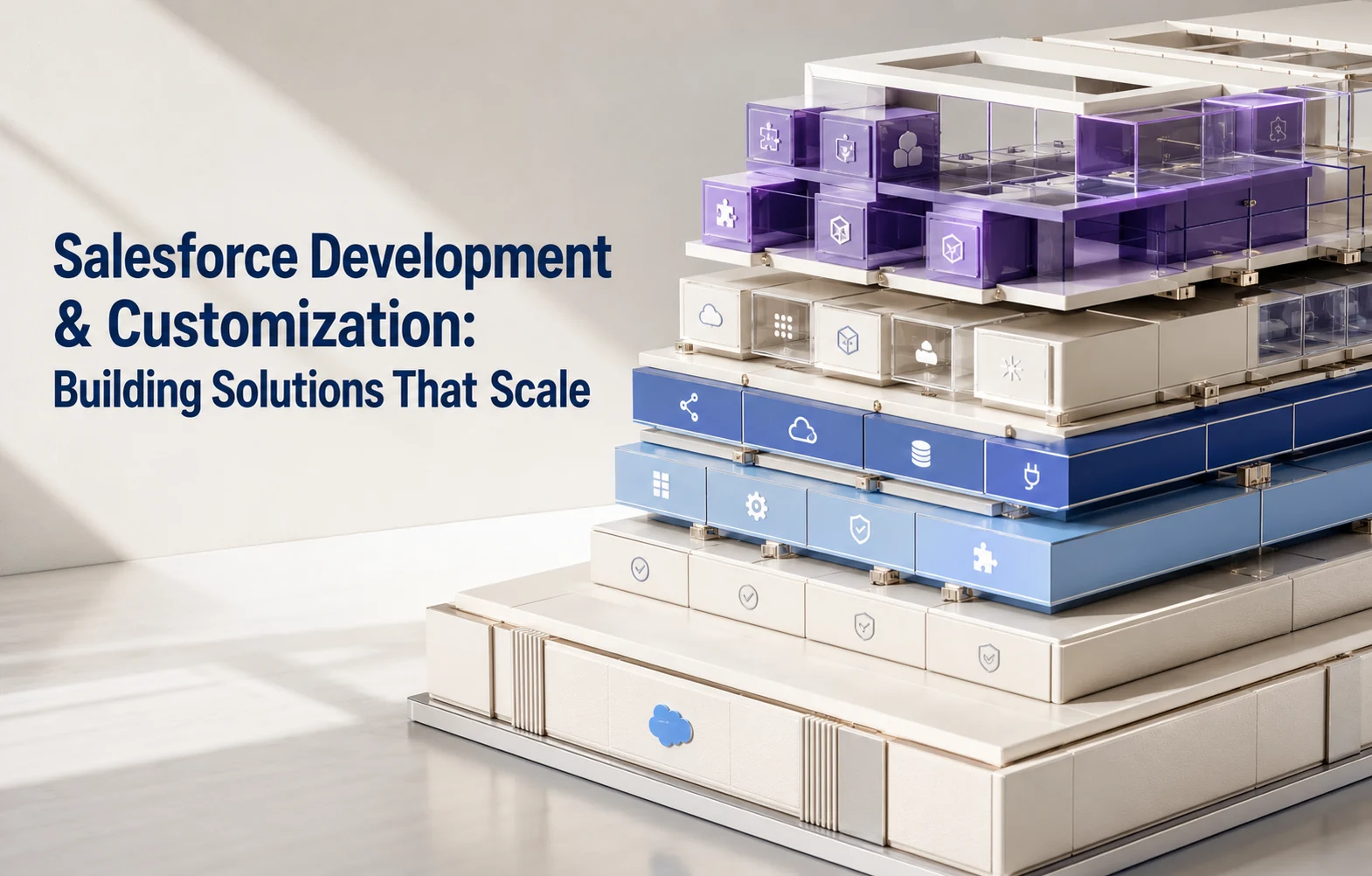
Salesforce Development & Customization: Building Solutions That Scale

Table of content
Let me guess how you got here.
Someone on your team asked for something in Salesforce that sounded simple. Maybe it was an approval that skips a step when the discount is under 10%, unless the customer is in APAC, unless it's a renewal. Maybe it was a portal your customers could log into. Maybe it was one number on a dashboard that has to pull from three different objects and update in real time.
And your admin, who is very good at their job, said the words you were hoping not to hear: "We can't do that with clicks."
That sentence is the front door to Salesforce Development Services. Not a strategy deck, not a digital transformation roadmap. Just a real requirement that config can't reach.
So let's talk about what happens next: when code is the right answer, when it absolutely isn't and how to build the thing without leaving a mess for whoever inherits your org in three years. Grab a coffee. This one's practical.
So Where Does "Just Configure It" Stop Working?
Nobody tells you this upfront: Salesforce is remarkably capable before you write a single line of code. Page layouts, validation rules, permission sets, record types, Flow Builder. You can run an entire sales organization on clicks alone. Plenty of companies do, happily, for years.
So when someone jumps straight to "we need a developer," the first honest question is: do you, though?
This is where projects go sideways, and it happens in both directions.
Direction one: over-engineering. Someone writes 400 lines of Apex to do a field update that Flow would have handled in twenty minutes. Now you own that code forever. It needs test coverage, it needs a developer to change it and it will outlive the person who wrote it.
Direction two: the opposite, and honestly the more painful one. A requirement that genuinely needs code gets forced into config anyway, usually because nobody wanted to open a development budget. What you end up with is nine chained Flows, four of which fire on the same object, none of which are documented. It works. Right up until it doesn't, and then nobody can tell you why.
The rough dividing line looks like this. If you can explain the logic clearly out loud, and it doesn't need to chew through fifty thousand records at once, config is almost always your friend. Reach for development when Flow simply can't do the thing, when performance at scale actually matters or when the logic is important enough that you want it tested and version-controlled like real software, because that's exactly what it is. That boundary is the honest starting point for scoping Salesforce Development Services, long before anyone opens an estimate.
A Two-Minute Gut Check Before You Call a Developer
Try this next time a request lands on your desk. Read the requirement, then ask yourself these five questions honestly:
- Can I describe this logic in three sentences without saying "and then it also"? If yes, lean config.
- Does this need to run on thousands of records at the same time? If yes, lean code.
- Will a real customer or partner see this screen? If yes, you're probably in Lightning Web Component territory.
- If this breaks silently at 2am, does someone lose money? If yes, you want tests around it. Tests mean code.
- Has somebody already built this and put it on AppExchange? Go and look. Seriously, go and look first.
Four out of five pointing the same way is a decent answer. A split verdict usually means the requirement is two requirements wearing one trench coat. Split it up and re-run the check on each half.
And if you're still torn? Build the config version. Config is cheap to throw away. Code is not.
What's Actually in a Salesforce Developer's Toolbox
If you've ever sat in a scoping call and nodded along while someone said "we'll handle it with a trigger and an LWC," this bit is for you. Four things do most of the heavy lifting behind almost all Salesforce Development Services, and you don't need to write any of them to hold your own in the conversation.
Apex is Salesforce's own programming language. Think of it as the engine room. It runs on Salesforce's servers and handles the logic that Flow can't touch. Complex triggers, batch jobs that process a hundred thousand records overnight, custom API endpoints so another system can talk to yours. If a requirement involves the words "every night" or "all records," Apex is usually in the answer.
Lightning Web Components (LWC) is the modern way to build custom screens and interface bits. It's what you use when the standard record page just won't do the job: a guided setup wizard, a live pricing calculator, a slick portal page for customers. If you hear anyone mention Aura, that's the previous generation. It still exists, it still runs, but new work should be LWC.
Flow doesn't retire just because developers show up. In the healthiest orgs I've seen, Flow and Apex work side by side: Flow handles the parts that business users need to see and tweak, Apex handles the parts that need muscle. A developer who wants to rewrite all your Flows in code on day one is telling you something about themselves, not about your org.
Custom objects, fields and record types are how you stretch the data model when standard Salesforce objects genuinely don't fit your business. Note the word genuinely. Every custom object is a thing someone has to maintain, report on and explain to the next admin. Add them on purpose, not on impulse.
Build vs. Buy: When AppExchange Just Wins
Quick story shape you'll recognize. A company decides it needs e-signature inside Salesforce. Somebody scopes a custom build. Six weeks and a decent chunk of budget later, they have something that mostly works, occasionally drops a signature and has exactly one person on earth who understands it.
Meanwhile there were four mature apps on AppExchange, any of which would have been live by Thursday.
So before you commission anything custom, go shopping. The boring, well-trodden categories are already solved: e-signature, advanced quoting and CPQ, field service scheduling, data quality and deduplication, document generation, mass email. These apps have been hammered on by thousands of orgs. Their bugs have been found. Their edge cases have been patched. Yours haven't yet.
When does custom win? Two situations, really.
First, when the logic is genuinely yours: the pricing model your competitors can't copy, the underwriting rules that took the business fifteen years to refine, the workflow that is the actual product. Nobody's selling that on a marketplace, because nobody else needs it.
Second, when an off-the-shelf app almost fits, but the workarounds start piling up. You know the smell: three custom fields to trick the app into behaving, a nightly job to fix its data, a training doc that says "ignore this tab." At some point you're paying license fees for the privilege of fighting software. That's the moment to build.
One caution before you go browsing. "There's an app for that" is not the same as "there's a good app for that." Check install counts, check the review dates, check whether the vendor has shipped anything in the last year and ask for a trial in a sandbox rather than production. An abandoned AppExchange package is technical debt you didn't even write.
Technical Debt, or Why Month Eighteen Hurts
Nobody has ever gone live and thought, "ah, technical debt." Day one is great. Day one, the thing works, the demo lands, everyone claps.
Month eighteen is when the bill arrives. Someone asks for a small change to that approval logic, a developer opens the code and goes quiet. Then comes the question you never want to hear: "Do you know what else this touches?"
Three culprits show up again and again:
- Hardcoded IDs. The code has a record ID typed directly into it. It worked in the sandbox it was written in. It quietly does nothing in production, or worse, points at the wrong record entirely.
- Logic that isn't bulkified. In plain terms: the code was written assuming one record at a time. Then someone imports 5,000 leads, and it either crashes into a governor limit or crawls. This is the single most common Apex sin there is.
- Undocumented triggers. Two triggers on the same object, written eighteen months apart by two different people, firing in an order nobody chose. Changing either one is a coin flip.
The uncomfortable part is this. None of these are visible from the business side. Your dashboards look fine. Your users aren't complaining. The debt is invisible right up until it's expensive, which is why it never makes it onto a roadmap until it becomes an emergency.
Want to know where you stand right now? Ask your admin or partner three questions. How many Apex classes are in the org? What's the overall test coverage percentage? Which of those classes has anyone touched in the last twelve months? You don't need to understand the answers technically. You just need to watch how confidently they come back, and whether anyone can answer at all.
The Boring Governance Stuff That Quietly Saves You
I'll be upfront: this section is not exciting. Nobody has ever been promoted for having tidy deployment practices. But if you compare two orgs five years down the line, one that's still a pleasure to extend and one that everybody tiptoes around, the difference almost always comes down to three unglamorous habits.
Development happens in sandboxes. Never, ever in production. If someone tells you they'll "just make the change live, it's tiny," that's your cue to ask more questions. Tiny changes in production are how Friday evenings get ruined.
Changes go through version control. Usually Git. The point is that your customizations exist somewhere outside the org, with a history showing who changed what and why. Without it, your only record of eighteen months of work is the org itself, and orgs can't tell you what they used to look like last Tuesday.
New code has real test coverage. Salesforce demands 75% to deploy, which means a lot of teams write tests designed purely to hit 75% rather than tests that actually check anything. There's a difference between a test that confirms your discount logic rejects a 90% discount, and a test that just runs the code so the number goes up. Ask which kind you're getting.
None of this makes for a thrilling status update. All of it is the reason your future self doesn't have to rebuild from scratch.
Picking a Development Partner Without Regretting It
When you're buying Salesforce Development Services, one signal beats every certification badge on a partner's website: do they ask why before they ask how?
A good partner hears your requirement and starts poking at it. Why does the approval need five levels? What happens today when someone skips one? Who actually reads that report? Half the time, that conversation ends with a smaller build than you walked in expecting, or no build at all, because a permission set change solves it. That partner just saved you money and talked themselves out of billable hours. Hire them.
A partner who nods, scopes exactly what you described and quotes it back in a week is easier to deal with in the short term. They're also handing you whatever you asked for, including your own mistakes.
When you get to the reference-check stage, don't settle for a screen-share of something pretty. Ask these instead:
- Can you show me code you wrote two years ago that another team has since modified? Answer quality here tells you everything about documentation.
- What's your test coverage on that project, and can I see one of the tests?
- Tell me about a time you talked a client out of custom development. Silence is an answer.
- Who owns the code when we're done, and where does it live if we part ways?
- When something breaks in six months, who picks up the phone and what does that cost?
That last one matters more than people expect. Plenty of development projects are delivered perfectly well and then abandoned, because nobody agreed who maintains the thing once the invoice is paid. Sort it out before the kick-off call, not after the first outage.
So What Should You Actually Do Monday Morning?
Start with the request that's been bugging you, the one your admin already said no to. Run it through the five-question gut check. Search AppExchange for twenty minutes. Then, if it still looks like a genuine development job, write down what breaks if you don't build it. That sentence is your business case for any Salesforce Development Services quote you ask for, and it's also the thing that stops scope creep later.
One more reframe worth carrying with you. Custom development isn't a sign that Salesforce failed you, and it isn't a trophy either. Every line of code you add is a small promise to maintain something. Make the promise deliberately, keep the list short and make sure each item on it earns its place.
Because the best customized orgs aren't the ones with the most code. They're the ones where every piece of code has an obvious reason to exist, and someone who still remembers what it does.
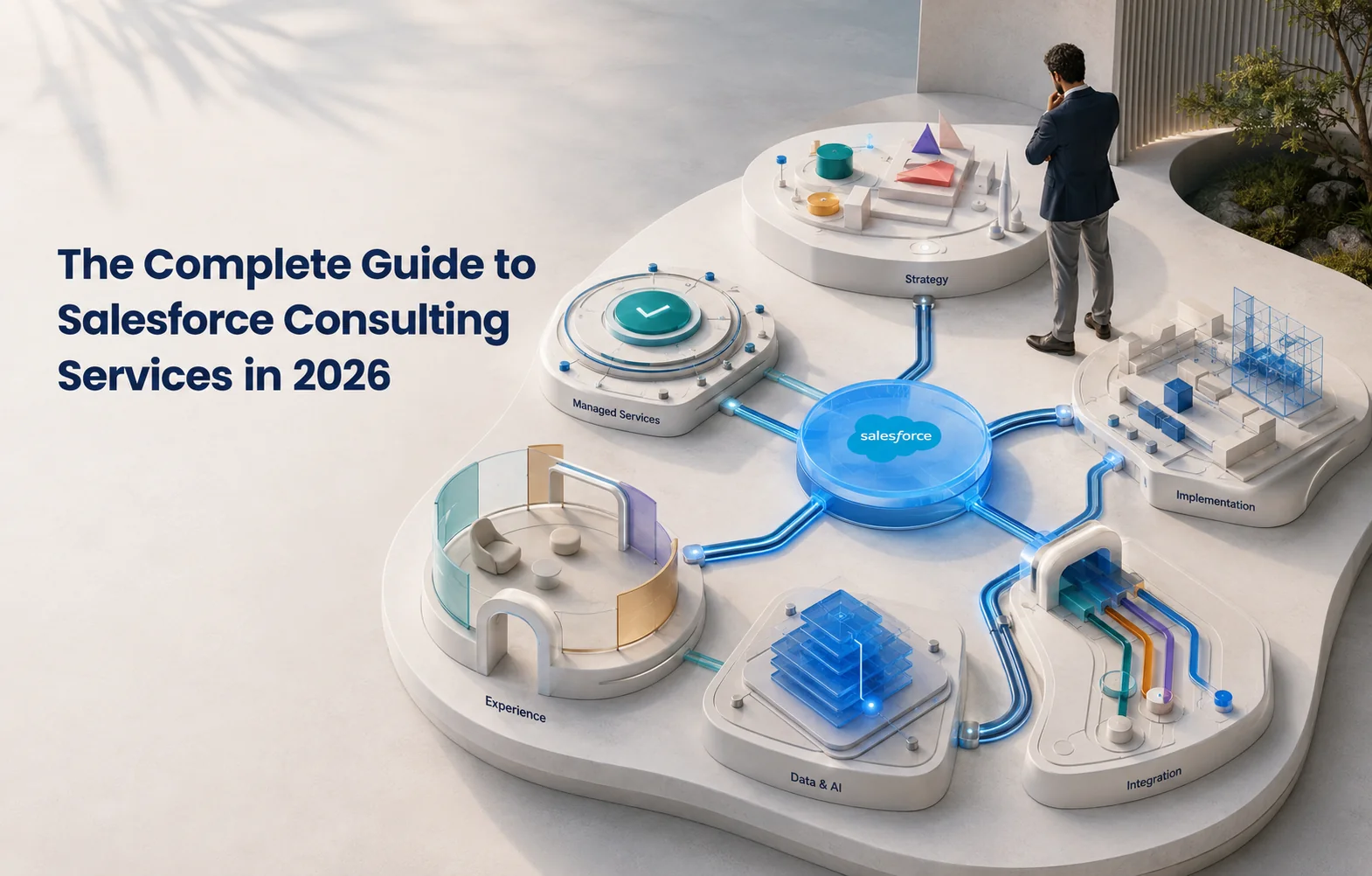
The goal of custom development isn't to build as much as possible. It's to build exactly what standard Salesforce can't already do, in a way that holds up as the business changes. See our Complete Guide to Salesforce Consulting Services for where development fits alongside implementation, integration and ongoing support.









Agentforce for Financial Services: AI-Driven Banking & Insurance Solutions











.webp)








n8n Workflow Automation: From Lead Capture to CRM in Minutes, Not Hours


%20(1).webp)