Salesforce vs HubSpot in 2026: Do You Need One CRM or Both, Connected?

Table of content
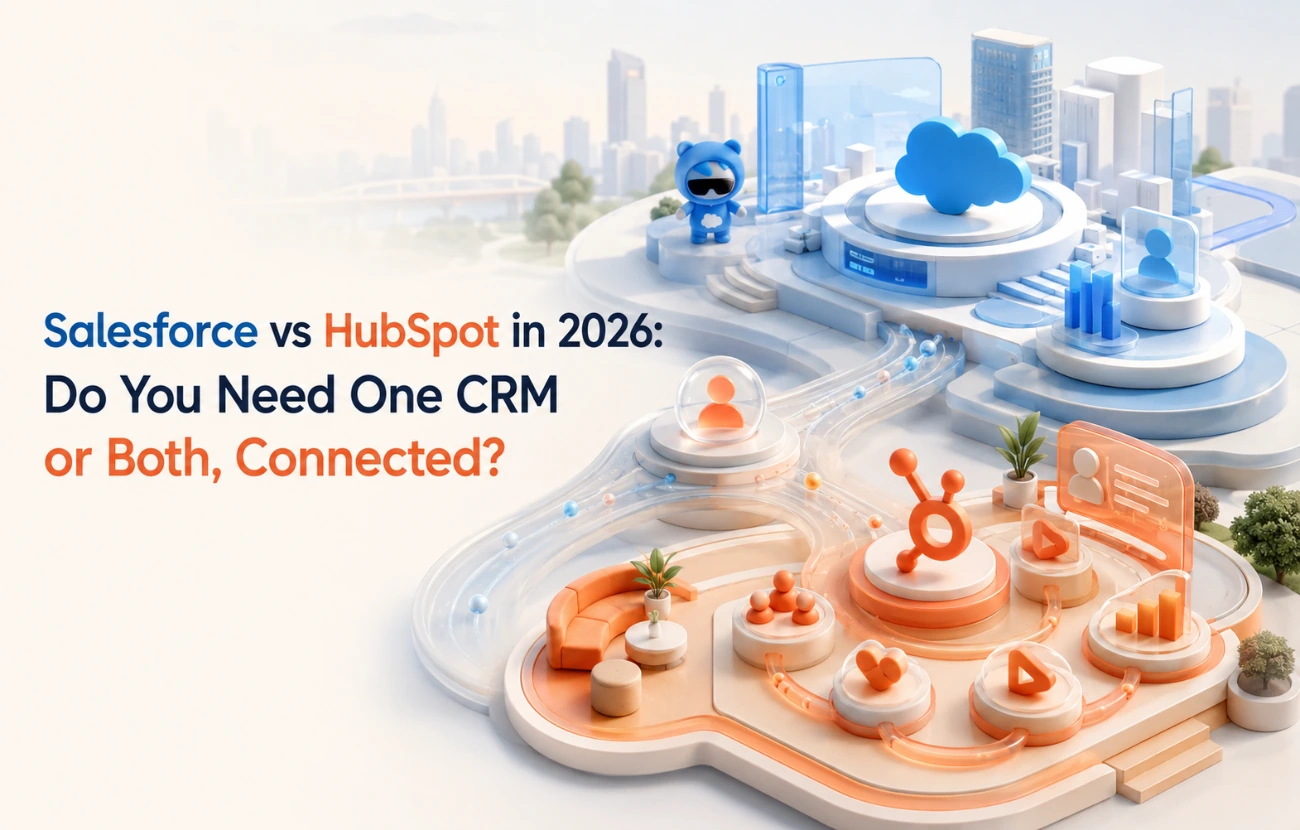
Someone on your leadership team is going to ask this question eventually, if they have not already: should we use Salesforce, HubSpot, or both? It usually comes up after a budget review, after marketing and sales disagree again about whose numbers are correct, or when a renewal invoice forces everyone to look harder at the stack. The honest answer to Salesforce vs HubSpot is not a single winner. It is about understanding what each platform is built for, what your teams actually need day to day, and whether forcing one system to do everything would create more problems than it solves. For many growing businesses, the better answer is both platforms connected properly, instead of picking one and trying to make every team work around that choice.
Does This Sound Like the Debate Happening at Your Company?
A quick check before we get into the actual comparison.
- Someone on your team is pushing to consolidate onto one platform mainly to simplify the tech stack, not because the current setup is failing.
- Marketing and sales are already using different systems and struggling to agree on shared numbers.
- You're evaluating a first CRM purchase and genuinely unsure which platform fits your sales process.
- Budget conversations keep circling back to licensing costs without anyone stepping back to ask what each platform is actually for.
If two or more of those are true, the rest of this is worth reading before your next platform decision gets made in a budget meeting instead of a strategy one.
The point is not to make the decision feel more complicated than it needs to be. The point is to avoid making a permanent-sounding platform decision based on a temporary pain point. A messy handoff between marketing and sales might be a process issue. Poor reporting might be a data governance issue. Expensive licenses might be a usage issue. Before blaming the CRM, it is worth separating platform limitations from operating discipline.
What Each Platform Is Actually Built For
The simplest way to cut through the debate is to separate what each platform is designed to do. Salesforce is built as a system of record for complex business processes, deep customization, approval logic, and enterprise-scale data models. HubSpot is built to help marketing and sales work from one connected system quickly, with a strong focus on ease of use and a free CRM that lets a team start small and move into paid tiers when the need becomes clear. Neither platform is just a weaker version of the other. They serve different priorities, and the right choice depends on which priorities matter most for how your business works.
In practical terms, Salesforce usually appeals to companies that need control, governance, and flexibility at scale. HubSpot usually appeals to teams that value adoption, speed, and a cleaner experience across marketing and sales. That difference matters because CRM value depends less on the feature list and more on whether people actually use the system correctly. A powerful platform that only admins understand can still fail. A simpler platform that everyone uses consistently can outperform a larger system in the right environment.
Salesforce vs HubSpot: Where Each One Actually Wins
Being honest about trade-offs matters more than declaring a winner.
- Salesforce wins on deep customization. Complex approval chains, industry-specific data models, and processes that do not fit a standard mold are where Salesforce's configurability pays off.
- Salesforce wins on enterprise scale. Large, multi-department organizations with complicated permission structures and high data volumes tend to outgrow simpler platforms.
- HubSpot wins on speed to value. A marketing-led team can start running real campaigns and managing a connected CRM within days, without needing a dedicated administrator.
- HubSpot wins on marketing and sales cohesion out of the box. Since both teams work in the same platform natively, lifecycle stages and reporting align without a custom integration project.
- HubSpot wins on cost predictability for growing teams. The free CRM and modular Hub pricing let a business add capabilities as needs become real, instead of paying for enterprise licensing upfront.
Neither list makes the other platform wrong. It makes the decision about matching the platform to what your business actually needs right now, not which one has more features on a comparison chart.
This is also where company size can be misleading. A 50-person business with a complex channel sales model, strict approvals, and multiple revenue lines may need Salesforce sooner than expected. A 300-person company with a straightforward inbound sales motion and a strong marketing-led engine may still be better served by HubSpot. The better question is not how large the company is, but how complex the revenue process has become.
The Case for Running Both, Connected
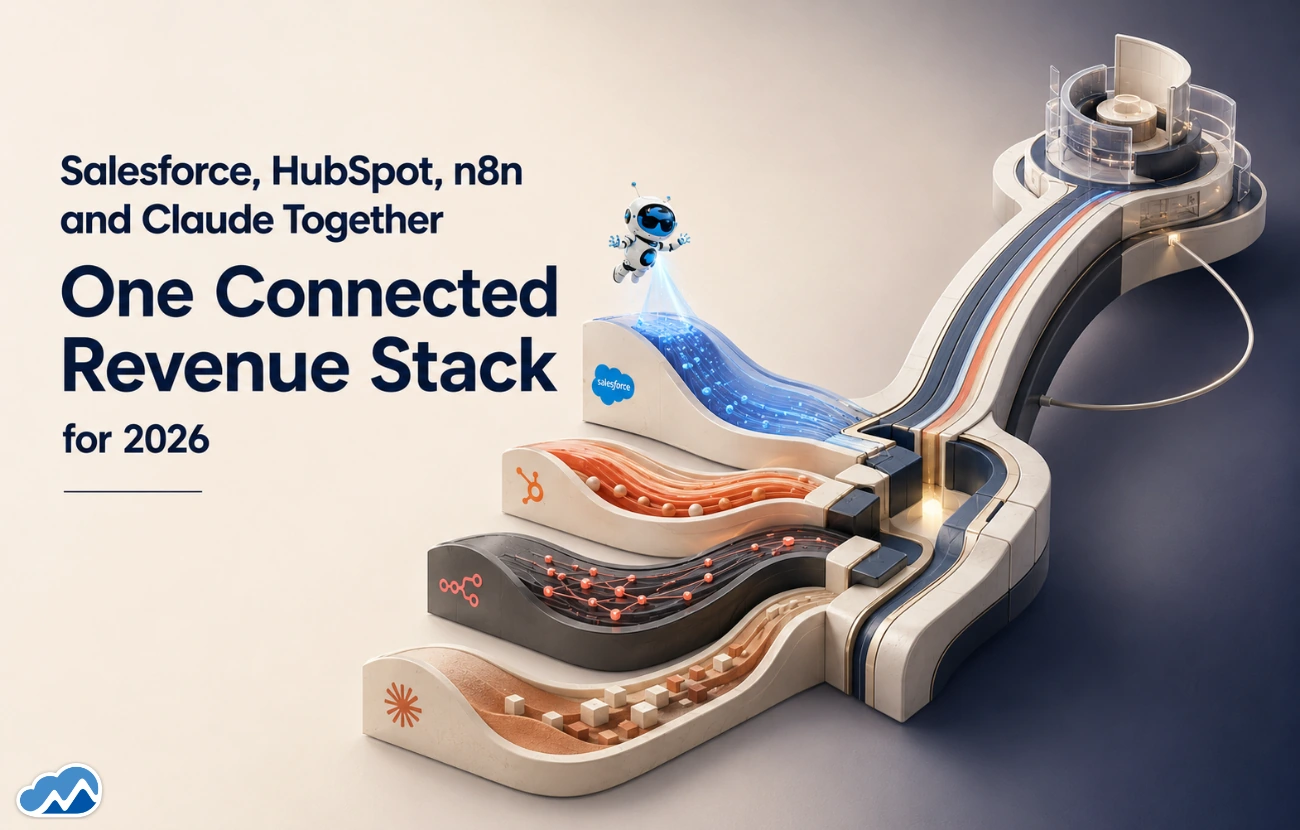
For a specific and fairly common type of business, the honest answer is not Salesforce or HubSpot. It is both, with a reliable sync between them. This tends to make sense when marketing needs HubSpot's ease of use and campaign tools, while sales operates a complex, highly configured process that relies on Salesforce's depth. Instead of forcing marketing to work inside Salesforce's more technical interface, or asking sales to give up customization they depend on, each team works in the tool built for its job, with data flowing between both systems. The catch is that this only works if the sync is reliable. A weak, manually maintained connection recreates the same reporting disagreements a single platform was supposed to fix.
Running both is not a compromise for companies that cannot decide. Done well, it is an operating model. HubSpot can remain the center for campaign execution, lead nurturing, forms, email journeys, and source reporting. Salesforce can remain the center for sales execution, account hierarchy, opportunity management, forecasting, approvals, and revenue operations. The integration then becomes the contract between the two systems. It defines which data moves, when it moves, which platform owns each field, and how conflicts are handled.
A Worked Example: How the Connected Version Actually Runs
Seeing this as an actual data flow makes the concept concrete.
- A visitor converts into a lead through a HubSpot-powered campaign, tracked and nurtured entirely within HubSpot's marketing tools.
- The lead syncs into Salesforce once it crosses an agreed qualification threshold, carrying its full marketing history and engagement data with it.
- Sales works the opportunity inside Salesforce, using the deeper customization and approval logic the sales process actually requires.
- Key status updates sync back to HubSpot as the deal progresses, so marketing's reporting reflects real pipeline outcomes, not just lead volume.
- The final outcome flows back to HubSpot once closed, won or lost, closing the loop so marketing can see which campaigns actually produced revenue.
Both teams work in the tool suited to their role, and leadership gets one accurate view of the funnel instead of two disconnected versions that never quite match.
The details matter here. A good sync is not just a connector switched on in the background. It needs clear rules for lead ownership, lifecycle stages, duplicate handling, field mapping, consent status, campaign attribution, and closed-loop reporting. Without those rules, both systems may technically be connected while the business still operates from inconsistent data. That is usually when teams lose confidence and start exporting spreadsheets again.
Picture This
A growing services company had marketing running HubSpot campaigns while sales operated inside a heavily customized Salesforce org built around a complex, multi-stage approval process specific to its industry. Early attempts to move marketing directly into Salesforce slowed the team down, because the tool was shaped around sales complexity rather than campaign speed. After building a proper two-way sync, both teams kept working in the platform suited to their work, and leadership gained a single, trustworthy view of the funnel from first touch to closed revenue. The debate about which platform to standardize on became less important once the real problem, disconnected reporting, was solved without either team giving up its tool.
Where This Decision Usually Goes Wrong
A handful of patterns show up repeatedly in this decision that lead to regret later.
- Choosing based on internal politics instead of workflow needs. A platform chosen because one department pushed harder in a meeting, rather than because it fits how work actually happens, tends to get resented and worked around.
- Consolidating onto one platform only to cut licensing costs. Forcing a complex sales process into a simpler tool, or pushing a marketing team into an overly technical one, can cost more in lost productivity than it saves in software fees.
- Treating the sync as an afterthought. A weak integration added after both platforms are already deeply embedded is harder and riskier than planning the connection from the start.
- Never revisiting the decision as the business changes. What fit a 20-person startup often does not fit the same company at 200 people, and neither choice should be treated as permanent.
Getting the Salesforce vs HubSpot decision right means evaluating it against how your teams actually work today, not which platform has the longer feature list or the more persuasive salesperson.
Another common mistake is treating adoption as an afterthought. If salespeople see Salesforce as a reporting burden rather than a tool that helps them sell, data quality will suffer. If marketers see HubSpot as only a campaign tool and ignore CRM hygiene, the handoff to sales becomes noisy. The platform decision should include training, ownership, naming conventions, reporting definitions, and a clear process for fixing bad data before it spreads.
What to Actually Evaluate Before Deciding
Rather than starting with the platforms, start with your own process. Map how complex your sales process really is, not how complex people assume enterprise sales should be. Look honestly at whether marketing and sales need to work in the same interface every day, or whether a reliable sync would serve both teams better than forcing one into the other's tool. Be realistic about who is available to administer the platform you choose, since Salesforce's depth comes with real administrative overhead that HubSpot's simpler model mostly avoids. Once your process and team structure are clear, the platform decision becomes much easier.
A useful evaluation should include real examples from your own pipeline. Take five recent deals and trace them from first touch to closed outcome. Where did the lead originate? When did sales first see it? Which fields were missing? Which reports did leadership rely on? Where did someone manually correct the data? This exercise usually reveals more than a generic software comparison because it shows where the current process breaks down in practice.
The Migration Question Nobody Wants to Ask
If the evaluation points toward switching instead of running both, be clear about what that involves before committing. Moving a mature CRM setup, years of deal history, custom fields, and workflows built over time is not a weekend project. Treating it like one is how migrations go wrong. Weigh that cost against the problem you are trying to solve. In some cases, a properly built sync between two existing systems is cheaper and less disruptive than removing one system and rebuilding on the other. The migration itself still needs careful planning, because a rushed cutover can cost more in lost data and broken reporting than the platform switch was meant to save.
Migration risk also depends on how much business logic already lives inside the current system. Custom objects, scoring models, workflow rules, dashboards, lifecycle stages, and integrations with finance or support tools all need to be understood before anything moves. A clean-looking CRM can still hide years of operational decisions. If those decisions are not documented, the migration becomes a discovery project before it becomes a technical one.
A Simple Framework for the Actual Decision
The decision usually comes down to three questions. First, how complex is your sales process really, not how complex you want it to sound in a board meeting? Second, does marketing need deep, native integration with sales every day, or would a reliable sync serve both teams just as well? Third, who will administer and maintain the platform, and does that person or team have the bandwidth for it? A business with a complex sales process, a marketing team that can work well through a sync, and dedicated administrative capacity usually leans Salesforce, or both connected. A business with a simpler sales motion, tight marketing-sales collaboration needs, and no dedicated CRM admin usually leans HubSpot alone. Most real answers sit somewhere between those two, which is why the question deserves a proper evaluation instead of a quick choice based on what a competitor uses.
There is also a fourth question worth asking: what will this decision need to support two years from now? If the business expects new regions, new products, partner sales, enterprise approvals, or heavier reporting requirements, the CRM choice should leave room for that growth. If the next two years are mostly about improving adoption, launching more campaigns, and making marketing-sales handoffs cleaner, simplicity may matter more than future-proofing every possible workflow.
Build It Yourself, or Bring in Help?
A straightforward single-platform decision, especially for a smaller team with a simple sales motion, can often be handled internally. It gets harder when you need to design a reliable sync for running both platforms, or when you need to avoid a costly consolidation decision driven by internal politics instead of workflow fit. If you are weighing that decision, look at how a provider approaches Salesforce vs HubSpot evaluations in practice, not just whether they sell licenses for one platform. Ask whether they have real experience with both platforms or a clear bias toward one. Ask how they would design a sync if both make sense for your business. Ask them to map your actual process before recommending anything.
How This Fits Into the Bigger Picture
Whichever way this decision goes, the connection between your systems matters as much as the platforms themselves. If you run both, or layer AI and automation on top of whichever platform you choose, the same principles that make a connected stack reliable apply either way. Our Connected AI Automation Stack Guide walks through what that looks like in practice, including how n8n and Claude fit on top of Salesforce, HubSpot, or both together.
The honest answer to Salesforce vs HubSpot is not a single winner declared once and used forever. It is a decision that should follow how your teams work today, be revisited as the business changes, and keep the option of running both properly connected on the table. If the choice improves adoption, reporting trust, and revenue team alignment, it is probably the right direction. If it only makes the stack look cleaner on paper, keep asking questions before you commit.
Frequently Asked Questions
.webp)
















Agentforce for Financial Services: AI-Driven Banking & Insurance Solutions












.webp)








n8n Workflow Automation: From Lead Capture to CRM in Minutes, Not Hours



%20(1).webp)