n8n + AI: How to Build Self-Running Workflows with Claude Inside n8n

Table of content
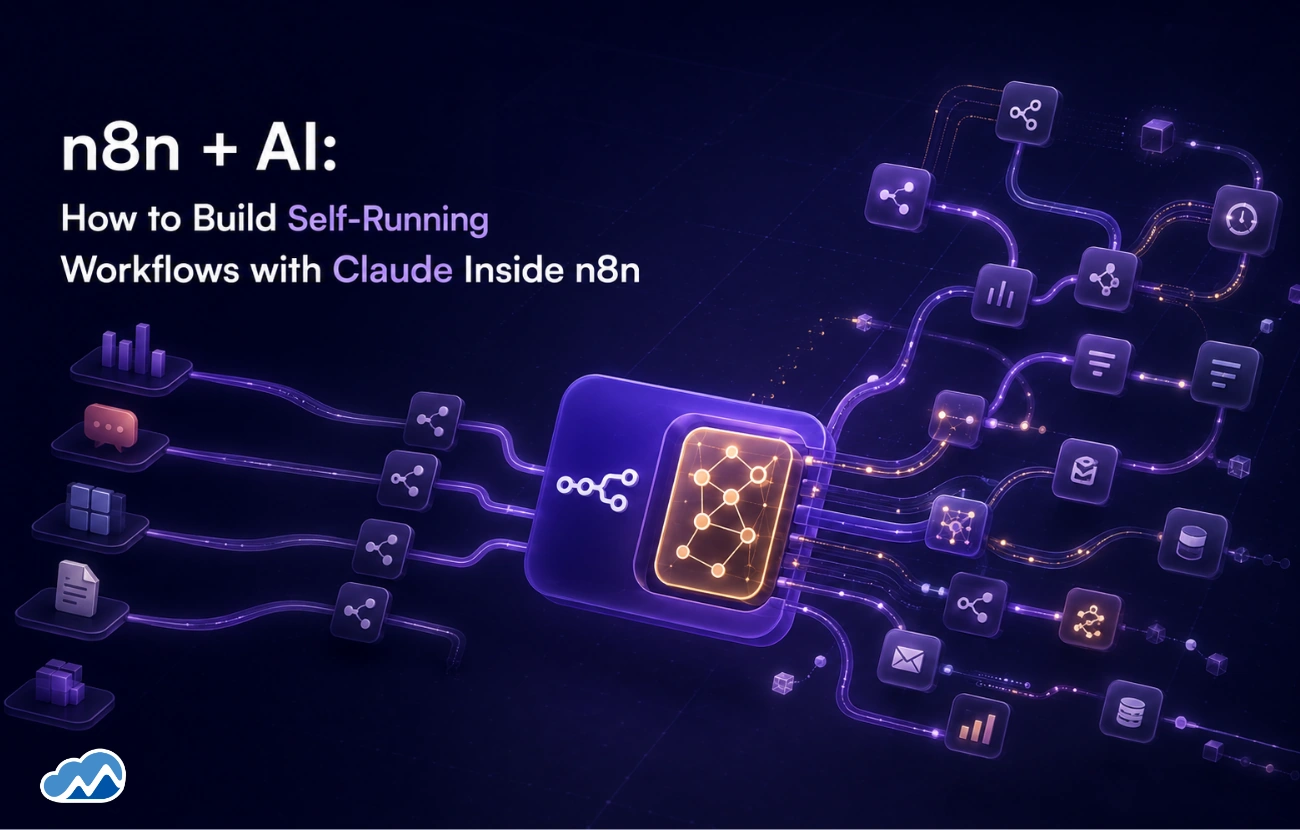
Most automation only moves data around. A form gets submitted, a row gets added, a message gets sent, and none of it requires a decision. But a lot of the work still sitting on someone's desk isn't like that. It's judgment work: reading a support email and figuring out how urgent it actually is, drafting a first-pass reply that sounds like a person wrote it, deciding which lead comment is worth a human's attention right now. That's the gap n8n AI automation is built for, pairing n8n's trigger-and-action backbone with a language model like Claude sitting inside the workflow, making the small judgment calls so a person only has to step in for the ones that actually matter.
Does This Sound Like a Task on Your List?
Before we get into how it works, check how many of these sound familiar.
- Someone on your team reads every incoming support ticket just to figure out which queue it belongs in.
- Drafting a first response to common questions eats up time that could go toward the complicated ones.
- You've got a spreadsheet or inbox nobody's fully triaged in weeks because it's tedious, not because it's hard.
- You've looked at a chatbot demo and thought “that's cute, but our actual workflow is messier than that.”
If two or more of those sound like you, the rest of this guide is worth ten minutes of your time.
What n8n AI Automation Actually Adds
A chatbot demo answers one question at a time, in a box, disconnected from everything else you run. n8n AI automation is different because the AI model is only one step inside a real workflow that already has triggers, data sources, and destinations wired up. Claude reads an incoming email, decides what kind of request it is, and n8n takes that decision and routes the ticket, updates a CRM field, drafts a reply, or flags it for a human, all inside the same sequence that was already running your business. The model handles judgment. n8n handles everything around it.
Where Claude Fits Inside an n8n Workflow
n8n has built native support for large language models directly into its node library, so connecting to Claude doesn't mean bolting on a separate system. A basic setup uses a message node that sends text, an incoming email, a form response, a support ticket, to Claude via an API connection, along with instructions for what to do with it: classify it, summarize it, draft a reply, extract specific fields. More advanced setups use n8n's AI agent nodes, which let Claude call other tools mid-workflow, checking a CRM record, looking something up, or triggering a follow-up step, rather than just returning a single answer and stopping there. Which setup you need depends entirely on the task. A lot of real business workflows only need the simple version.
A Worked Example: Support Ticket Triage
This is easier to follow as an actual sequence. Here's a common one.
- A new support email arrives and triggers the workflow the moment it lands.
- Claude reads the email and classifies it: billing question, technical issue, general inquiry, or something urgent enough to escalate immediately.
- n8n routes the ticket to the right queue or team member automatically, based on that classification.
- Claude drafts a first-pass reply in your team's tone for common, low-risk questions, ready for a human to review rather than send blind.
- The draft lands in a review queue for a quick human check, not straight to the customer, so nothing goes out that a person hasn't glanced at.
- n8n sends the reply and logs it back into your CRM or helpdesk automatically once approved.
Nothing in that sequence requires a person to read every single email start to finish. It requires a person to review the drafts and handle the genuinely hard cases, which is a much smaller job.
Self-Running Doesn't Mean Unsupervised
Let's be clear about the goal here. n8n AI automation doesn't take people out of the loop; it takes the repetitive parts of the loop off their plate. The support ticket example above still has a human checkpoint before anything goes out to a customer. That checkpoint is there on purpose. A model making a judgment call at 2am on a request it's uncertain about should flag that uncertainty and wait, not guess and hope. Workflows that skip this checkpoint tend to look impressive in a demo and cause real problems within a few weeks of production use.
Where These Workflows Go Wrong
A few patterns show up consistently in AI-driven automations that don't hold up.
- No fallback for uncertainty. If the model isn't confident about a classification, the workflow needs a path that routes to a human instead of guessing and moving on.
- No cost controls. Every call to a model costs something, and a workflow processing thousands of records without limits or monitoring can rack up a bill nobody expected.
- Treating the model like deterministic code. A traditional workflow step does the exact same thing every time. A language model doesn't, and workflows built without accounting for that variability break in ways that are hard to debug.
- No review step for anything customer-facing. Drafting a reply is safe. Sending it without a human glance, especially early on, usually isn't.
Getting n8n AI automation right means designing for these from the start, not discovering them after something goes out that shouldn't have.
What's Actually Worth Automating This Way
Not every task benefits from an AI step, and it's worth being honest about which ones do. Good candidates share a few traits: they involve reading unstructured text (emails, tickets, form responses), they require a judgment call rather than a fixed rule, and getting it wrong occasionally is recoverable, not catastrophic. Classifying a support ticket fits. Approving a six-figure refund automatically does not. The workflows that hold up longest tend to start with the lower-stakes, high-volume tasks and expand from there once the team trusts how the system behaves.
Picture This
A 20-person operations team was manually reading every inbound partner inquiry to figure out which of four internal teams should handle it, a fifteen-minute job repeated dozens of times a day that added up to hours nobody had budgeted for. After wiring Claude into their existing n8n workflow, each inquiry gets classified and routed within seconds of arriving, with a short summary attached so whichever team picks it up isn't starting cold. The team didn't remove a person from the process, they removed the fifteen-minute read-and-decide step that used to happen before a person ever got involved. The humans still make every real decision. They just make it starting from a summary instead of a blank inbox.
Common Use Cases Beyond Support Tickets
Ticket triage is the easiest example to explain, but it's far from the only place this pattern fits.
- Lead qualification: Claude reads a new lead's form responses and notes, and flags the ones that match your ideal customer profile for immediate follow-up instead of waiting in a shared queue.
- Meeting and call summaries: a transcript comes in, Claude pulls out action items and key decisions, and n8n drops a clean summary into the right Slack channel or project tool automatically.
- Invoice and document data extraction: Claude reads an incoming invoice or contract and pulls out the fields your finance or legal team actually needs, instead of someone retyping numbers from a PDF.
- CRM record enrichment: a new contact comes in with minimal information, and Claude fills in likely context, industry, role, probable use case, based on whatever public information is available.
- Content and reply drafting: anywhere a first-pass draft speeds up a person's work, Claude can produce the starting point for a human to edit rather than write from scratch.
What all of these share is the same shape: a judgment call that used to require someone's full attention now gets a first pass automatically, with a person confirming or adjusting the result rather than starting from nothing.
Keeping Sensitive Data in Check
Feeding real customer or business data into a language model raises the same questions any data-handling process should. Be deliberate about what actually gets sent to the model, pulling only the fields the task needs rather than an entire record by default. Check what your model provider does and doesn't retain or use for training, since policies differ and this matters more for regulated data. If you're handling anything sensitive, self-hosting n8n keeps the workflow orchestration on your own infrastructure even while the model call itself goes out to an API, which narrows the exposure to just what's actually sent in that one request. There's nothing exotic about any of it. It's the same data discipline any automation touching customer information should already have, just applied to a new kind of step in the workflow.
Cost and Reliability, Honestly
Every model call has a cost and a bit of latency, and neither is zero. For high-volume workflows, it's worth testing which steps genuinely need a capable model and which could use a lighter, cheaper one, since not every classification task needs the same horsepower as drafting a nuanced reply. Prompt changes matter too. A prompt that worked well in testing can drift in effectiveness as your data changes, so a workflow worth relying on gets its prompts version-controlled and periodically reviewed, not written once and forgotten. Building in basic monitoring, how many calls ran today, how many landed in the uncertain bucket, what the rough cost was, turns this from a black box into something your team can actually keep an eye on without babysitting it.
Build It Yourself, or Bring in Help?
Plenty of teams can wire up a basic Claude-to-n8n connection on their own over an afternoon. Where it gets harder is exactly what's covered above: building real fallback paths, keeping cost under control at volume, and structuring prompts that hold up as your data changes over time. If you're weighing whether to build this in-house or bring someone in, look at how a provider actually approaches n8n AI Automation day to day, not just whether they mention AI on their site. Ask how they handle uncertain classifications. Ask how they control cost as volume grows. Ask whether they test prompts before shipping changes or just push updates and hope.
How This Fits Into the Bigger Picture
Adding AI into a workflow is usually a layer on top of automation you've already got running, not a separate project. If you haven't yet mapped out the broader case for n8n across your business, our n8n Automation Services Guide covers the platform itself, how it stacks up against Zapier and Make, and the self-hosting versus cloud decision that shapes everything else you build on top of it.
n8n AI automation was never about making things feel futuristic. It takes the reading-and-deciding work that used to eat someone's morning and hands the repetitive parts of it to a system that doesn't get tired of ticket forty-seven. The judgment calls that actually need a person still get one. The rest just happens, quietly, while your team works on something that needed them in the first place.
Frequently Asked Questions
.webp)










Agentforce for Financial Services: AI-Driven Banking & Insurance Solutions







.webp)





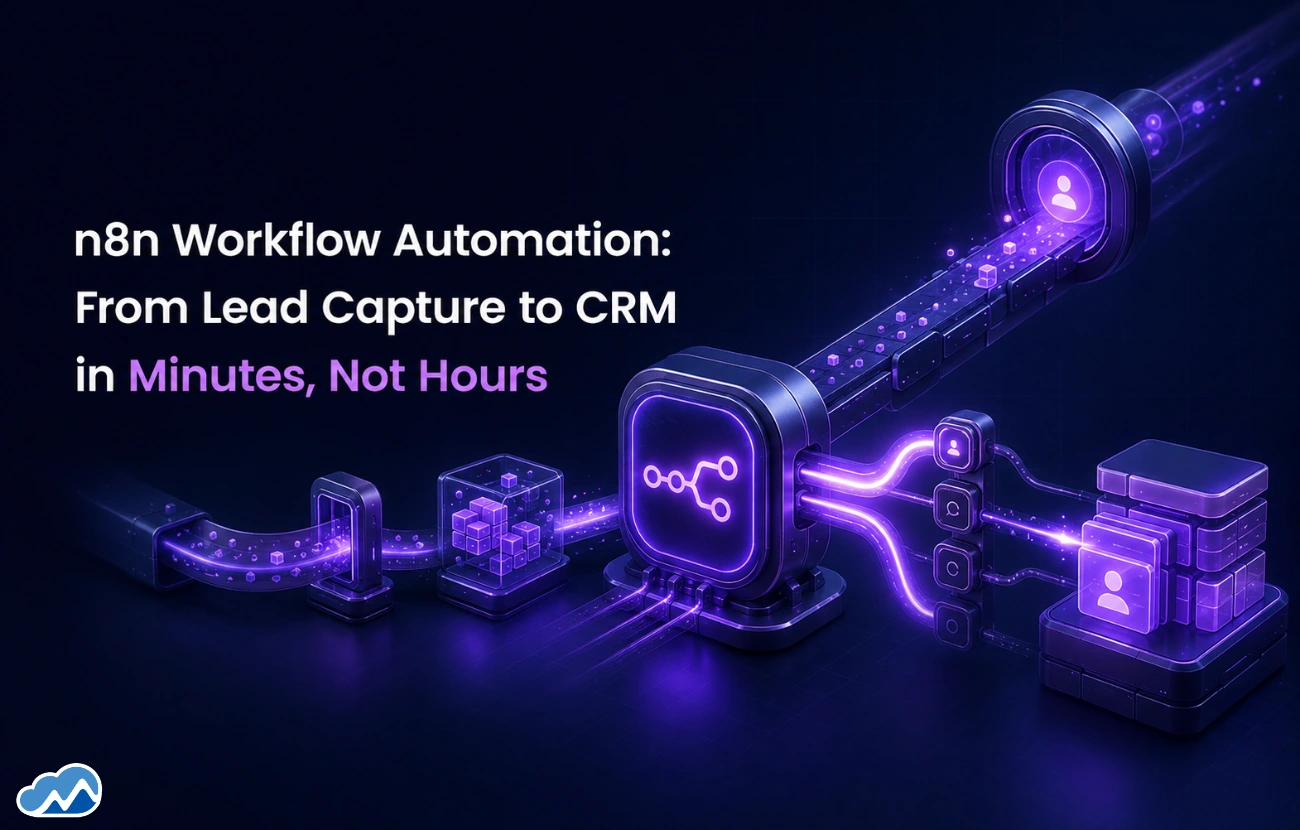
n8n Workflow Automation: From Lead Capture to CRM in Minutes, Not Hours

%20(1).webp)