Salesforce Implementation for Manufacturing: Lessons from the Field

Table of content
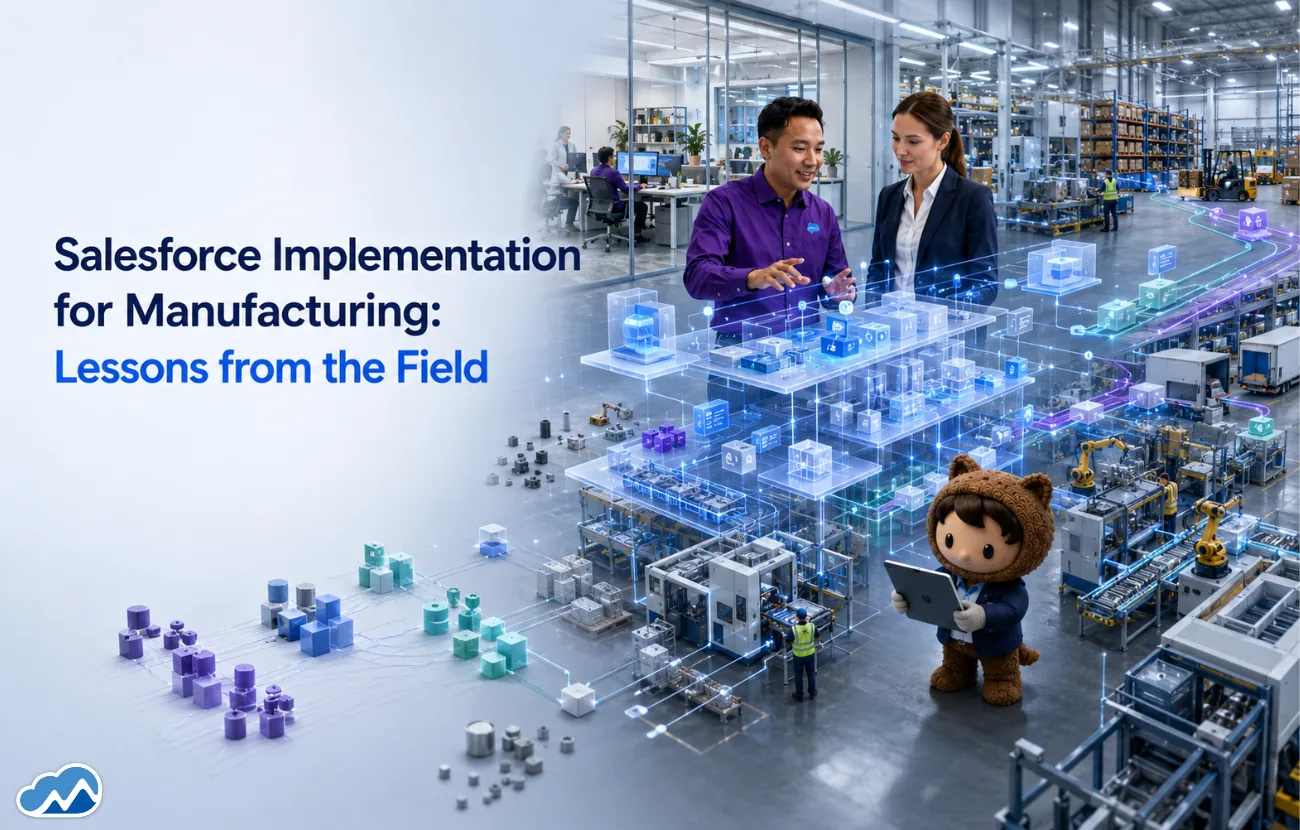
Plenty of manufacturers have a Salesforce implementation story that did not go to plan. The platform was capable, the budget was real, and yet the result never quite fit how the business actually runs. After enough of these projects, the lessons start to rhyme. A Salesforce implementation for manufacturing succeeds or struggles for fairly predictable reasons, and knowing them in advance is the cheapest way to avoid the expensive mistakes. This is what the field actually teaches.
Here are the lessons that separate a Salesforce implementation for manufacturing that fits the business from one that gets quietly worked around.
Lesson 1: Model Around Agreements, Not One-Off Deals
The most common early mistake is treating a manufacturing implementation like a standard sales CRM rollout. Manufacturers run on long-term agreements and run-rate volumes, and if the data model is built around one-off opportunities, it will never reflect the business. A successful Salesforce implementation for manufacturing starts by modelling the sales-agreement reality, so committed and actual volumes are visible from day one.
Lesson 2: Integrate with ERP and MES Early
The field lesson here is blunt: leave integration until the end and you will pay for it. A manufacturer's CRM only reflects reality when it is connected to the ERP and often the MES, so orders and production data flow rather than being re-keyed. Teams that plan those connections from the start avoid the classic outcome of a CRM that looks fine but disagrees with the factory floor.
This is genuine integration engineering, and it deserves to be scoped early rather than bolted on once the CRM is already live.
Lesson 3: The Data You Bring Across Decides Everything
Manufacturers tend to arrive with years of data across legacy systems, and moving it carelessly is one of the fastest ways to undermine a new CRM. Duplicate accounts, stale products and broken history quietly poison every report built on top.
The field is full of migrations that went wrong for avoidable reasons, which our guide on Salesforce data migration pitfalls covers in detail. A Salesforce implementation for manufacturing that treats migration as a chance to clean house, rather than a lift-and-shift, starts on far firmer ground.
Lesson 4: Configure First, Customise Where It Counts
Manufacturing processes can be genuinely complex, which tempts teams into heavy custom code early. The field lesson is to resist that. Configure what the platform offers first, and reach for custom development only where the requirement truly needs it, because every unnecessary line of custom code becomes maintenance you carry forever.
Knowing where that line sits is its own skill, covered in our guide on custom vs out-of-the-box development. The best manufacturing implementations are powerful where they need to be and simple everywhere else.
Lesson 5: Plan for After Go-Live
A Salesforce implementation for manufacturing is not finished at launch. Processes change, new products and partners arrive, and Salesforce ships updates three times a year. Teams that treat go-live as the end watch the system drift; teams that plan for ongoing ownership keep it healthy.
What that ongoing care involves is set out in our guide on what is included in Salesforce managed services. Deciding who owns the org after launch is one of the clearest predictors of whether an implementation keeps delivering.
Lesson 6: Build for the People Who Use It
The final field lesson is about adoption. A manufacturing implementation designed purely for management dashboards, with no thought for the sales and operations people who live in it daily, gets abandoned. Designing around how those teams actually work, and rolling it out properly, is what turns a technically sound build into one the business genuinely uses.
Frequently Asked Questions


Agentforce for Financial Services: AI-Driven Banking & Insurance Solutions










.webp)






n8n Workflow Automation: From Lead Capture to CRM in Minutes, Not Hours

%20(1).webp)