Salesforce CRM for Manufacturing: Top Use Cases in 2026

Table of content
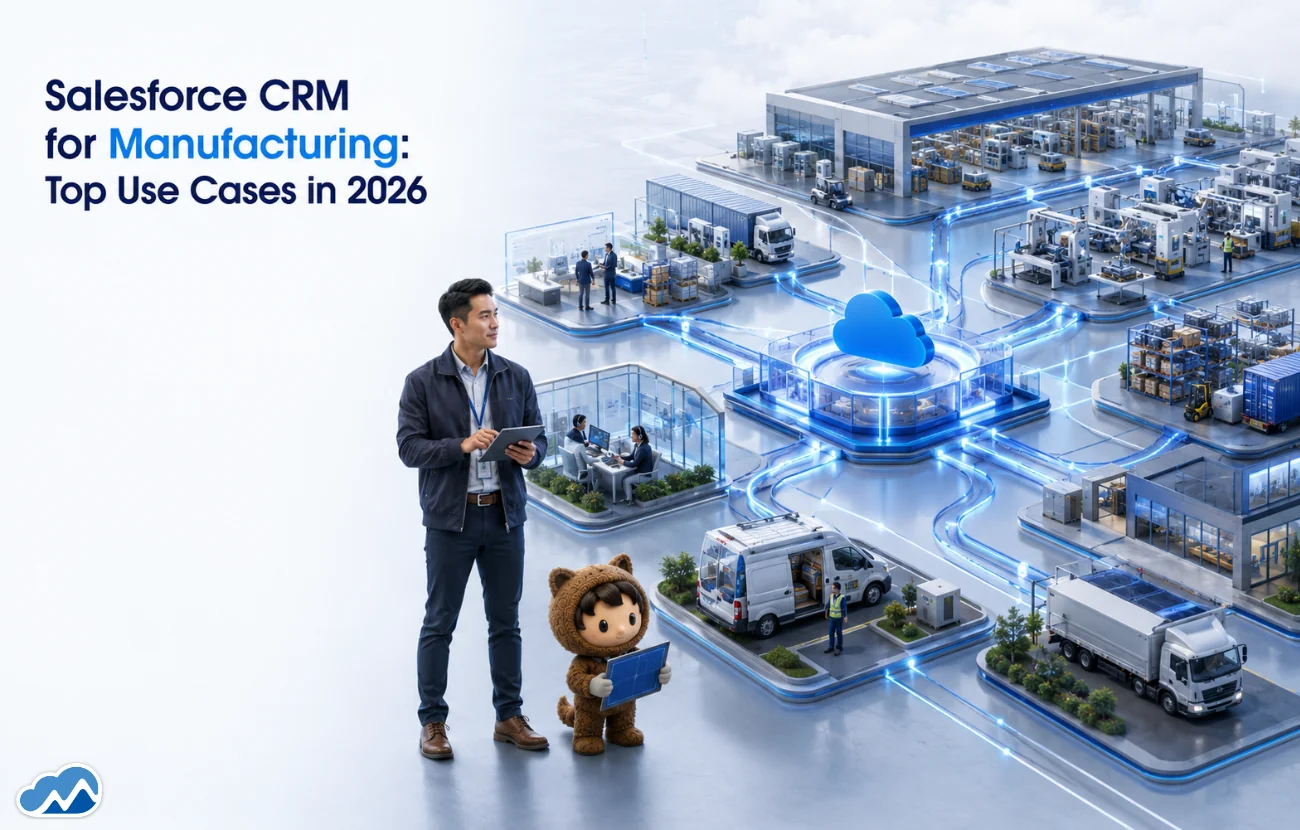
Manufacturers sell differently from almost everyone else, and most CRMs never got the memo. The typical CRM is built around one-off deals: a lead, an opportunity, a close. But a manufacturer's business runs on long-term agreements, run-rate volumes and a web of distributors, and a generic setup simply cannot see that clearly. That gap is what a purpose-built Salesforce CRM for Manufacturing is designed to close, and in 2026 the use cases have only got sharper. This guide walks through the ones that matter most.
Here is where a Salesforce CRM for Manufacturing earns its keep, from committed-revenue visibility to AI, and why each use case matters.
What "Salesforce CRM for Manufacturing" Actually Means
A Salesforce CRM for Manufacturing is Salesforce shaped around how manufacturers really operate, most often through Manufacturing Cloud. Its standout capability is sales agreements, which bring long-term contracts and their committed volumes into the CRM so you can finally see planned versus actual orders in one place. Alongside that sit account-based forecasting and tools for managing the distributors and partners manufacturers so often sell through.
The industry picture is covered on our Salesforce for Manufacturing page, and the platform detail is on our Manufacturing Cloud page. This piece focuses on the use cases that deliver the clearest value.
Top Use Cases in 2026
A few patterns come up in almost every manufacturer we speak to.
Sales agreements and run-rate visibility. The flagship use case. A Salesforce CRM for Manufacturing puts committed contract volumes and actual orders side by side, so run-rate revenue is finally visible and manageable rather than buried in spreadsheets.
Account-based forecasting. Blending that committed business with new opportunities into one forecast leadership can actually plan against, instead of a manual guess nobody fully trusts.
Distributor and channel management. Manufacturers often sell through partners, and a good setup brings that channel activity into view rather than leaving it a black box.
Service and aftermarket. Connecting sales with service so warranties, parts and support are managed against the same account, which is where a lot of manufacturing revenue and loyalty actually lives.
Connecting to ERP and MES
No Salesforce CRM for Manufacturing lives in isolation. The real value comes when it connects to the systems that run the factory and the finances, the ERP and often the MES, so orders, inventory and production data flow between them instead of being re-keyed. A closed agreement should turn into an order the ERP recognises, and production status should be visible to the people talking to the customer.
That integration is its own discipline, covered by our Salesforce API Integration Services. Getting the ERP and MES tie-in right is often what separates a CRM that reflects reality from one that quietly drifts out of sync with the shop floor.
Where AI and Automation Fit
This is where 2026 has moved things on. AI can sharpen demand and sales forecasting by working from your combined agreement and order data, and Agentforce agents can handle routine partner and customer queries so your team focuses on the complex accounts.
For a grounding in what those agents actually are, our What Is Salesforce Agentforce guide is a useful primer. Alongside AI, workflow automation quietly removes the manual glue work between systems, and tools like n8n workflow automation can move data and trigger actions across your stack without brittle custom code. Used together, AI and automation turn a Salesforce CRM for Manufacturing from a record-keeper into something that actively drives the operation.
Frequently Asked Questions

Agentforce for Financial Services: AI-Driven Banking & Insurance Solutions





.webp)



n8n Workflow Automation: From Lead Capture to CRM in Minutes, Not Hours

%20(1).webp)