AI-Drafted Replies: Automating Customer Responses Without Losing the Human Touch

Table of content

There is a fear that sits behind a lot of customer-service automation: that automating replies means sounding like a robot. Customers can tell when they are being fobbed off by a canned response, and it damages the relationship more than a slow reply would. But that fear is based on old, template-driven automation. Modern AI automated customer replies are a different thing entirely, capable of drafting genuinely helpful, human-sounding responses at speed. The trick is doing it in a way that keeps the human touch. This guide covers how.
Here is how AI automated customer replies can speed up your responses without making customers feel processed.
Why Old Automation Felt Robotic
The reason automated replies used to feel cold is that they were not really writing anything. They picked a template and filled in a blank, so any customer with a slightly unusual question got an answer that clearly did not address it. That is what trained people to distrust automated responses. AI automated customer replies work differently: rather than choosing a canned message, an AI model reads the actual message and drafts a relevant response to it, which is a fundamentally more human result.
This builds on the ideas in our guide to building self-running workflows with Claude inside n8n, which is the parent concept behind AI automated customer replies: using AI for the judgement, not just the plumbing.
How to Keep the Human Touch
The key to AI automated customer replies that do not feel robotic is a human-in-the-loop design. The most common and trustworthy pattern is draft, then approve: the AI reads the incoming message and drafts a reply, and a person reviews it before it goes out. That keeps the speed of automation and the judgement of a human, and it means the customer gets a genuinely appropriate response rather than a guess.
As trust in the system grows, you can let the AI send the simplest, safest responses on its own while still routing anything sensitive or complex to a human. The point is that AI automated customer replies should augment your team, not replace their judgement, especially on the interactions that matter most.
Where It Delivers Most
AI automated customer replies shine on the high-volume, repetitive questions that eat a support team's day: common queries, status requests, straightforward how-tos. Handling those quickly and well frees your people for the complex, emotional or high-value conversations where a human genuinely matters. Used this way, automation does not remove the human touch, it concentrates it where it counts.
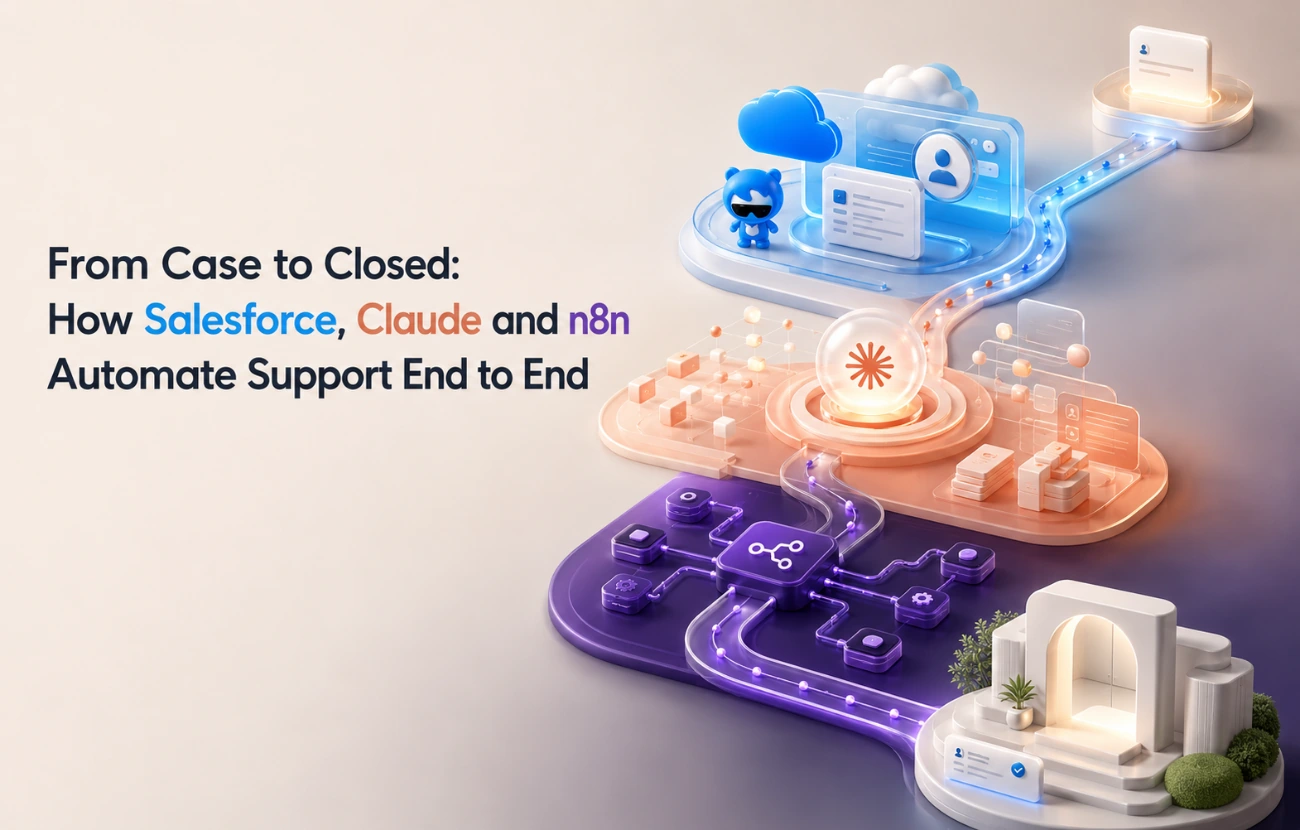
You can see this end-to-end in our guide on how Salesforce, Claude and n8n automate support, and the front-of-house version in our AI chatbots with Claude guide. Both show AI automated customer replies working alongside people rather than instead of them.
Keeping It Reliable
As with any AI automation, guardrails matter. Give the AI clear guidance on tone and what it can and cannot say, ground it in your actual knowledge so it is accurate, keep a human reviewing anything uncertain, and monitor quality over time. Done with that care, AI automated customer replies are dependable and genuinely helpful. Done carelessly, they recreate exactly the robotic experience you were trying to avoid.
Frequently Asked Questions

















Agentforce for Financial Services: AI-Driven Banking & Insurance Solutions














.webp)
















n8n Workflow Automation: From Lead Capture to CRM in Minutes, Not Hours





%20(1).webp)