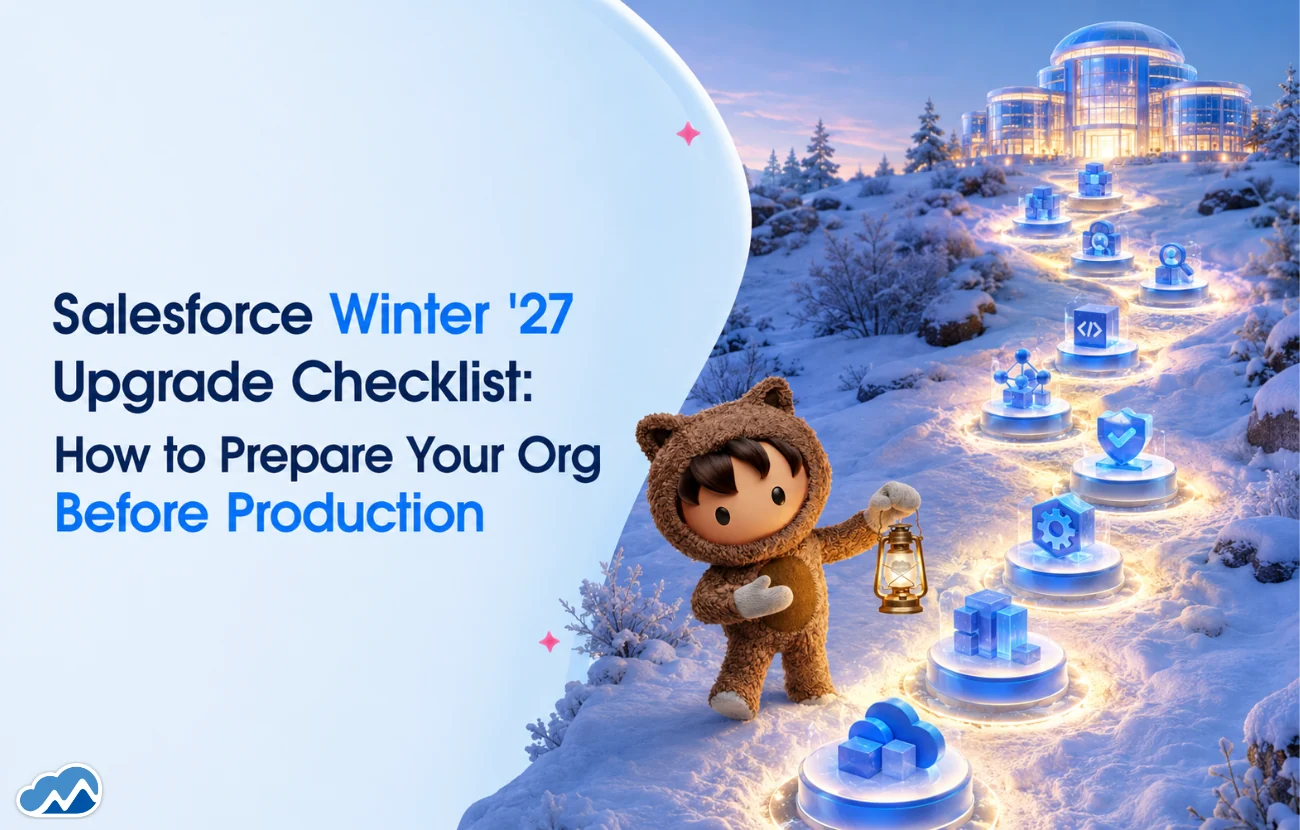
Salesforce Winter '27 Upgrade Checklist: How to Prepare Your Org Before Production

Table of content
Salesforce releases arrive three times a year, and they apply to your org whether you have prepared or not. That is the whole reason a Salesforce Winter '27 upgrade checklist is worth having: the update is coming regardless, so your only real choice is whether you meet it ready or get caught out in production. This is a practical checklist for preparing your org before Winter '27 lands, based on what the release actually enforces.
Here is how to work through a Salesforce Winter '27 upgrade checklist so the release is a planned event rather than a nasty surprise.
First, Know the Timeline and Use the Sandbox
The single most valuable habit is to preview the release in a sandbox before it reaches production. Salesforce provides a preview window on sandbox instances ahead of the general rollout, and that is where you want to discover problems, not in the environment your business runs on. Step one of any Salesforce Winter '27 upgrade checklist is to get a preview sandbox and test against it early.
This is the same discipline our Salesforce Support & Maintenance guide describes for every seasonal release. Release management is exactly the kind of proactive work that separates a healthy org from one that lurches from surprise to surprise.
Review the Release Updates That Enforce
Not everything in a release is optional. A handful of release updates enforce with Winter '27, and those are the ones to prioritise. Most notably, Enable Profile Filtering is the Winter '27 enforcement that actually changes what data a user can access, so it deserves careful testing. Alongside it, several accessibility enhancements for high-magnification viewing enforce as well. Your Salesforce Winter '27 upgrade checklist should list each enforcing update and confirm you have tested its impact in the sandbox.
Check Your Integrations and Authentication
This is where the quiet, expensive breakage hides. Salesforce is retiring older authentication methods, and integrations that rely on them can fail silently. The retirement of the OAuth 2.0 username-password flow is a key one to check, along with tightened rules around device flow and email verification. Any integration still authenticating the old way needs to be found and updated before the relevant enforcement dates. A thorough Salesforce Winter '27 upgrade checklist includes an audit of every integration's authentication, because a sync that stops working without an error message is the worst kind of failure.
Test Your Automations and Customisations
Releases can change how existing features behave, so your Flows, automations and custom code all need a pass in the preview sandbox. Check the automations your business depends on most, confirm they still behave as expected, and look for anything touching areas the release changes. This is the part teams most often skip and most often regret.
Plan Enablement for New Features
A release is not only risk; it is also opportunity. Winter '27 continues Salesforce's push into the agentic era, including the ongoing rebranding of products such as Sales Cloud to Agentforce Sales. Decide which genuinely useful new features you want to switch on deliberately, rather than letting them appear unannounced.
For the wider direction behind these changes, our Salesforce Agentforce & AI Trends 2026 guide is worth a read, and our write-up of the earlier Salesforce Summer release features shows how to approach a release methodically. The same method drives a good Salesforce Winter '27 upgrade checklist.
Decide Who Owns the Release
The final checklist item is ownership. Someone has to own reviewing, testing and enabling each release, and in many teams that responsibility is unclear until something breaks. Whether it is an in-house admin or a managed service, the release needs a named owner with the time to do it properly.
What that ongoing ownership involves is set out in our guide on what is included in Salesforce managed services, and if you would rather hand the whole release cycle to a team, our Salesforce Consulting Services can take it on. A Salesforce Winter '27 upgrade checklist only works if someone owns it.
Frequently Asked Questions









Agentforce for Financial Services: AI-Driven Banking & Insurance Solutions








.webp)







n8n Workflow Automation: From Lead Capture to CRM in Minutes, Not Hours

%20(1).webp)